Begleiten Sie uns auf eine literarische Weltreise!
Buch zum Bücherregal hinzufügen
Grey
Einen neuen Kommentar schreiben Default profile 50px
Grey
Jetzt das ganze Buch im Abo oder die ersten Seiten gratis lesen!
All characters reduced
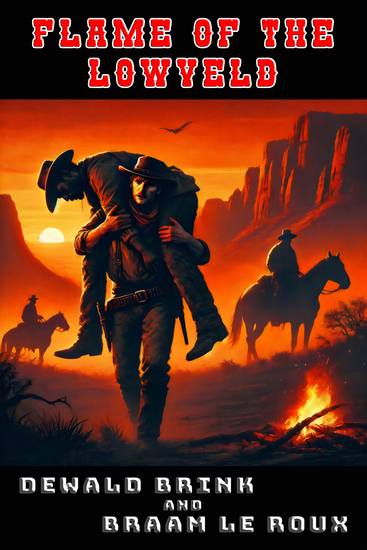
Flame of the Lowveld - The Frontiersman of the Lowveld - The Complete Series Book 1 - cover

Flame of the Lowveld - The Frontiersman of the Lowveld - The Complete Series Book 1

Dewald Brink, Braam le Roux

Übersetzer Pieter Haasbroek, A Ai

Verlag: Pieter Haasbroek

  • 0
  • 0
  • 0

Beschreibung

A frontier without mercy. 
 
A vow that can’t be broken. 
 
A killer known only as The Mask.
 
The Untamed Lowveld, 1885. Lone wanderer Johan Grimbeek arrives with a hidden purpose. To avenge the man who raised him by hunting down a ruthless phantom known only as “The Mask.”
 
Left for dead after a brutal ambush, Johan is rescued by the fierce and beautiful Juanita Perreira. But as he recovers under her care, he makes a horrifying discovery. Her father is the murderer he swore to destroy. Now, he is trapped in the lion’s den, unarmed and at the mercy of the woman who saved his life.
 
Juanita is torn between a dangerous loyalty and an all-consuming passion for the stranger she saved. But as Johan’s quest for vengeance collides with her dark family secrets, her obsession becomes as deadly as the enemies surrounding them. In this treacherous world, betrayal is a heartbeat away, and one wrong step will unleash a storm of violence that will consume them all.
 
A blistering fusion of classic adventure and high-stakes mystery, Flame of the Lowveld is a gripping tale of vengeance, loyalty, and forbidden passion. Perfect for fans of Louis L’Amour and Wilbur Smith.
 
Step into this first memorable Untamed Lowveld adventure now!
Verfügbar seit: 20.12.2024.
Drucklänge: 164 Seiten.
Weitere Bücher, die Sie mögen werden

  • Luigi Pirandello - A Short Story Collection - Nobel prize winning Italian master author - cover

    Luigi Pirandello - A Short Story...

    Luigi Pirandello

    • 0
    • 0
    • 0
    Luigi Pirandello was born on 28th June 1867 into an upper-class family in Agrigento, in Sicily. 
     
    In 1880, the family moved to Palermo and there he completed high school and thence to the University of Palermo, at that time the centre of what became the Fasci Siciliani movement.  Although not an active member he had close friendships with many of its leading ideologists.  Pirandello then completed his university studies in Rome and Bonn, receiving his Doctorate in March, 1891. 
     
    His time in Rome had provided him with the opportunity to visit its many theatres. "Oh the dramatic theatre! I will conquer it. I cannot enter into one without experiencing a strange sensation, an excitement of the blood through all my veins..." 
     
    1894 brought marriage, at his father's suggestion, to a shy, withdrawn girl: Mara Antonietta Portulano.  The marriage encouraged his studies and writings and, the following year, the first part of the ‘Dialoghi tra Il Gran Me e Il Piccolo Me’ was published. 
     
    In 1903 the flooding of the sulphur mines in which his father had invested the family capital and Antonietta's dowry, brought financial catastrophe.  She, on hearing the news, was mentally broken.  Pirandello would now work a full day and then watch over his troubled wife at night. Somehow he found time to write ‘The Late Mattia Pascal’.  It was an immediate and resounding success.  
     
    In 1909, Pirandello began his collaboration with the prestigious Corriere della Sera.  Whilst his fame as a writer was increasing his private life was poisoned by the suspicion and jealousy of Antonietta who now turned physically violent.  His plays were now being regularly performed but, within a decade, Antonietta had to be placed into an asylum from which she never left. 
     
    In 1921, in Rome his play, ‘Six Characters in Search of an Author’ debuted.  It was a failure.  However, when presented in Milan it was a great success, as it also was in London and New York. 
     
    In 1925, Pirandello, with Mussolini’s help, assumed the artistic direction and ownership of the Teatro d'Arte di Roma.  He now described himself both as ‘a Fascist because I am Italian’ and ‘I'm apolitical, I'm only a man in the world...’  However his later conflicts with fascist leaders meant he fell under close surveillance by the OVRA, the secret police. 
     
    In 1934 he won the Nobel Prize but asked that the medal be melted down for Italy’s occupation of Abyssinia Campaign to which he had given his support.  
     
    Pirandello's canon stretches across novels, short stories, poetry, essays and some 40 plays.  His tragic farces are often cited as forerunners of the Theatre of the Absurd. 
     
    Luigi Pirandello died on the 10th December 1936 at his home at Via Bosio, Rome, Italy.  He was 69.
    Zum Buch
  • Shadows from Boot Hill - cover

    Shadows from Boot Hill

    L. Ron Hubbard

    • 0
    • 0
    • 0
    Every man walks with a shadow... but what happens when he acquires a second one? Just ask Brazos, a cold-blooded killer for hire. His latest job means putting a bullet in a man schooled in the art of witchcraft, and this is one killing that brings with it a deadly curse and a second shadow — and there'll be the devil to pay. Lock the doors and turn on the lights as the audio version of Shadows from Boot Hill puts a chilling supernatural twist on the classic Western.
    Zum Buch
  • Pursuit of Paradise - cover

    Pursuit of Paradise

    Thomas N. Smith

    • 0
    • 0
    • 0
    This is the story of an East Texas farm boy, the war in the Pacific, and love. Based on true events, Red Smith leaves his farm, experiences the horrors of war, and returns a man, wanting only to go back to work on the farm.
    Zum Buch
  • Revolutionary Voices for Democracy - cover

    Revolutionary Voices for Democracy

    Gary L. Williams

    • 0
    • 0
    • 0
    Two hundred and fifty years ago, victory in the American Revolution empowered its founding fathers to consider a glorious ‘revolutionary idea’: a democracy of inclusiveness and diversity for all. Yet, America’s revolution never meant to include the enslaved, who lived in small, dark squares of windowless slave houses.
     
    At Philadelphia, Pennsylvania’s Constitutional Convention of 1787, compromises perpetuated America’s ‘slave society’ based on free labour, benefiting its citizenry to the detriment of America’s slave row. For the next seventy-eight years, ‘America’s democracy’ permitted this vile 
    system of slavery to continue. However, slave revolutions, revolutionary voices, and prayers persisted. As the smoke cleared from the battlefields of the American Civil War, Juneteenth (June 19, 1865) granted America a full Independence Day.
     
    The question remains to this very day whether the formerly enslaved and their descendants will ever fully receive the rights, reparations, and benefits of full citizenship in our American democracy. Revolutionary voices must continue to set an example for the entire world of the 
    revolutionary idea that is democracy.
     
    The next 250 years will answer this question as America approaches its 500th anniversary.
    Zum Buch
  • Earl - The Anarchy Series Book 5 - cover

    Earl - The Anarchy Series Book 5

    Griff Hosker

    • 0
    • 0
    • 0
    Alfraed is now the Earl of Cleveland but his new position throws him into a world of intrigue. There are plots and coups as the enemies of England try to wrest the land from King Henry. The Earl has to fight the Scots, the Welsh and Vikings before he travels to Normandy to fight alongside the king. Filled with battles and knightly combat the fast moving novel reflects the chaotic times before the first English Civil War.
    Zum Buch
  • Hot Time - A Mystery - cover

    Hot Time - A Mystery

    W. H. Flint

    • 0
    • 0
    • 0
    New York, August 1896. A "hot wave" has settled on the city with no end in sight, leaving tempers short and the streets littered with dead horses felled by the heat. In this presidential election year, the gulf between rich and poor has political passions flaring, while anti-immigrant sentiment has turned virulent. At police headquarters, the gruff, politically ambitious commissioner Theodore Roosevelt has been struggling to reform his notoriously corrupt department. Meanwhile, the yellow press is ready to pounce on the peccadilloes of the Four Hundred, the city's social elite—the better to sell papers with lurid stories and gossip or perhaps profit from a little blackmail on the side. When the body of Town Topics publisher William d'Alton Mann is found at the foot of the Brooklyn Bridge, any number of his ink-spattered victims may have a motive. 


    Hot Time is an immensely entertaining, deeply researched, and richly textured historical novel set in a period that reflects our own, with cameos by figures ranging from financier J. P. Morgan to journalist Jacob Riis. Our guides through New York are Otto "Rafe" Raphael, one of the first Jewish officers in the heavily Irish force; Minnie Kelly, the department's first female stenographer; Theodore Roosevelt himself; and the plucky orphan Dutch, one of the city's thousands of newsboys, who may have seen too much.
    Zum Buch