Begleiten Sie uns auf eine literarische Weltreise!
Buch zum Bücherregal hinzufügen
Grey
Einen neuen Kommentar schreiben Default profile 50px
Grey
Jetzt das ganze Buch im Abo oder die ersten Seiten gratis lesen!
All characters reduced
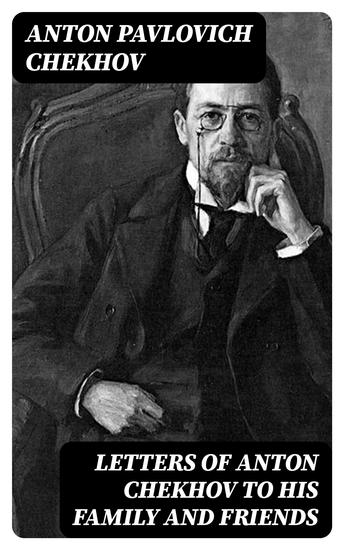
Letters of Anton Chekhov to His Family and Friends - Enriched edition - cover

Letters of Anton Chekhov to His Family and Friends - Enriched edition

Anton Pavlovich Chekhov

Übersetzer Constance Garnett

Verlag: DigiCat

  • 0
  • 0
  • 0

Beschreibung

In "Letters of Anton Chekhov to His Family and Friends," the great Russian playwright and short story writer Anton Pavlovich Chekhov provides a vivid, intimate glimpse into his life through personal correspondence. This collection showcases Chekhov's keen observations, humor, and profound philosophical reflections, all articulated in his characteristic succinct prose. Each letter serves not only as a conduit of personal expression but also offers insight into the socio-political context of late 19th-century Russia, allowing readers to appreciate the personal nuances that influenced his celebrated works. Chekhov's style—marked by simplicity and emotional depth—renders these letters as poignant as his fictional narratives, blending literary artistry with genuine human experiences. Chekhov, born in 1860 to a modest family, immersed himself in the world of literature and medicine, which closely informed his writing and personal ethos. Although he achieved prominence as a playwright, these letters reveal the man behind the public persona: a devoted brother, a comrade in artistic endeavors, and a contemplative spirit grappling with the challenges of his era. His correspondence reflects not just personal thoughts, but the broader cultural and social dynamics of his time. "Letters of Anton Chekhov to His Family and Friends" is highly recommended for readers seeking a more profound understanding of Chekhov's character and inspirations. This collection is an indispensable read for students of literature and lovers of humanistic narrative, revealing the delicate interplay between the writer's life and his timeless literary creations.

In this enriched edition, we have carefully created added value for your reading experience:
- A comprehensive Introduction outlines these selected works' unifying features, themes, or stylistic evolutions.
- The Author Biography highlights personal milestones and literary influences that shape the entire body of writing.
- A Historical Context section situates the works in their broader era—social currents, cultural trends, and key events that underpin their creation.
- A concise Synopsis (Selection) offers an accessible overview of the included texts, helping readers navigate plotlines and main ideas without revealing critical twists.
- A unified Analysis examines recurring motifs and stylistic hallmarks across the collection, tying the stories together while spotlighting the different work's strengths.
- Reflection questions inspire deeper contemplation of the author's overarching message, inviting readers to draw connections among different texts and relate them to modern contexts.
- Lastly, our hand‐picked Memorable Quotes distill pivotal lines and turning points, serving as touchstones for the collection's central themes.
Verfügbar seit: 13.06.2022.
Drucklänge: 281 Seiten.

Weitere Bücher, die Sie mögen werden

  • The Year the World Went Mad - A Scientific Memoir - cover

    The Year the World Went Mad - A...

    Mark Woolhouse

    • 0
    • 0
    • 0
    'An essential book.' -Matt Ridley
    In January 2020, leading epidemiologist Professor Mark Woolhouse learned of a new virus taking hold in China. He immediately foresaw a hard road ahead for the entire world, and emailed the Chief Medical Officer of Scotland warning that the UK should urgently begin preparations. A few days later he received a polite reply stating only that everything was under control.
    In this astonishing account, Mark Woolhouse shares his story as an insider, having served on advisory groups to both the Scottish and UK governments. He reveals the disregarded advice, frustration of dealing with politicians, and the missteps that led to the deaths of vulnerable people, damage to livelihoods and the disruption of education. He explains the follies of lockdown and sets out the alternatives. Finally, he warns that when the next pandemic comes, we must not dither and we must not panic; never again should we make a global crisis even worse.
    The Year the World Went Mad puts our recent, devastating, history in a completely new light.
    Zum Buch
  • Reverence - A priest's life of holiness and humanity - cover

    Reverence - A priest's life of...

    Magdalen Smith

    • 0
    • 0
    • 0
    Part memoir, part reflection on vocation, Reverence charts the past and present life of an Anglican and female priest, one of the first women to be ordained in the Church of England in the 1990s. Magdalen Smith grew up in a clergy family, married a cleric, then became one herself. Working in many different contexts, cathedral, outer estate, city and countryside, she draws from a depth of experience in ministry and spirituality and reflects on how the church has changed over the years. Describing the often quirky and profound experiences of human life where all is infused with the holy, the book communicates a deep love of enabling others to discover a sense of the divine for themselves.
    
     
    Reverence is a journey through one woman’s life, beginning in the 23-roomed vicarage where she grew up and ending in a place where her priestly calling is still believed to be relevant in a rapidly changing world. It takes familiar concepts of spirituality and through personal stories, reflections on art, culture and place, seeks to connect with the sense of vocation and an intuitive sense of the numinous that many people feel whether they describe themselves as religious or not.
    Zum Buch
  • Anathema - From their pens to your ears genius in every story - cover

    Anathema - From their pens to...

    Alexander Kuprin

    • 0
    • 0
    • 0
    Alexander Kuprin was born in Narovchat, Penza in Russia on 7th September 1870. 
    At 3 his Father died and he and mother moved to Moscow. By 10 he was enrolled at the Second Moscow Military High School and there his interest in literature began. The Alexander Military Academy followed and two years later he was a sub-lieutenant and posted to an Infantry Regiment for a further four years. 
    Despite his duties he was a now a keen writer and published his first short story at this time. His military duties also garnered him experiences for his breakthrough work ‘The Duel’.  Leaving the military he left for Kiev to work for local newspapers.  He continued to publish both stories and novels and by 1901 he was in St Petersburg becoming part of a group that included Chekhov, Ivan Bunin, Maxim Gorky and Leonid Andreyev.  
    In the years that followed further controversial works and acclaim followed.  His comments on the regime meant he was also put under secret police surveillance.   
    As World War I erupted, Kuprin opened a military hospital but was then given command of an infantry company in Finland. He was soon discharged on grounds of ill health.  
    The October Revolution saw him praise Lenin, but he warned that the Bolsheviks threatened Russian culture and might cause further widespread suffering to the peasants.  As Civil War raged he took his family to Helsinki and then on to Paris. 
    Exile saw his talents decline further and his succumbing to alcoholism. He became lonely and withdrawn. The family's poverty increased his malaise.   
    In May 1937, the Kuprin’s returned to Moscow.  He now saw his work published but wrote almost nothing new.  In 1938 his health rapidly deteriorated.  Already suffering from a kidney problems and sclerosis, he had now developed cancer of the oesophagus.  
    Alexander Kuprin died on 25th August 1938.
    Zum Buch
  • David Trimble: Peacemaker - cover

    David Trimble: Peacemaker

    Stephen Walker

    • 1
    • 0
    • 0
    Nobel laureate, party leader, peacemaker, first minister and statesman – David Trimble had many roles. But what is the real story behind the man who made headlines and changed lives?
    In this definitive biography of Trimble's life and death, award-winning journalist Stephen Walker vividly details how a shy Belfast academic changed the political landscape of Northern Ireland.
    Written with the cooperation of his widow, Lady Trimble, and their grown-up children, Peacemaker offers unparalleled insights into the life of the first person to be elected first minister of Northern Ireland and the most significant unionist leader since the creation of Northern Ireland in 1921. From the beginning of his political career in the dark days of the Troubles, to bringing unionism and nationalism together to end decades of division and violence and secure peace, Trimble's personal journey mirrors the story of Northern Ireland itself.
    Drawing on over 100 fresh interviews, this is a colourful and personal account of the life of a key figure in Irish history and an essential companion to Stephen Walker's bestselling biography of John Hume.
    Zum Buch
  • Silencing the Women: The Witch Trials of Mary Bliss Parsons - cover

    Silencing the Women: The Witch...

    Kathy-Ann Becker

    • 0
    • 0
    • 0
    SILENCING THE WOMEN: The Witch Trials of Mary Bliss Parsons is the true story of what happened to an early New England colonial Puritan woman settler who was too beautiful, too rich, and too outspoken for her times. Enmeshed in a web of jealousy and gossip, she struggled to overcome victimization by the harsh judgments of church, state, and gender expectations. How she survived in the fearsome wilderness of the Connecticut River Valley Massachusetts Bay Colony is a love story told by a descendant.
    Zum Buch
  • Better Dead - From their pens to your ears genius in every story - cover

    Better Dead - From their pens to...

    J M Barrie

    • 0
    • 0
    • 0
    Sir James Matthew Barrie, 1st Baronet, OM, was born in Kirriemuir, Angus on 9th May, 1860.  
    Barrie knew from an early age that he wished to be an author. His family wished otherwise. The compromise was that he would attend university to study literature at the University of Edinburgh. He graduated with an M.A. in April, 1882. 
    His first job was as a staff journalist for the Nottingham Journal. The London editor of the St. James's Gazette "liked that Scotch thing" in Barrie’s work and he wrote several stories for them and later several novels based on his mother’s early life.  
    Barrie though was increasingly drawn to working in the theatre.  His first plays achieved little attention but in 1901 and 1902, Barrie had back-to-back theatre successes with Quality Street and The Admirable Crichton. 
    The character of ‘Peter Pan’ first appeared in The Little White Bird in 1902. This most famous and enduring of his works; Peter Pan, or The Boy Who Wouldn't Grow Up had its first stage performance on December 27th, 1904.  
    Peter Pan would overshadow all his other works.  But his short stories cannot be overlooked.  Indeed, from today’s vantage point they are excellent gems of social manners, of class and the way characters, sometimes in the most mundane of circumstances, react in the most surprising of ways.
    Zum Buch