Rejoignez-nous pour un voyage dans le monde des livres!
Ajouter ce livre à l'électronique
Grey
Ecrivez un nouveau commentaire Default profile 50px
Grey
Abonnez-vous pour lire le livre complet ou lisez les premières pages gratuitement!
All characters reduced
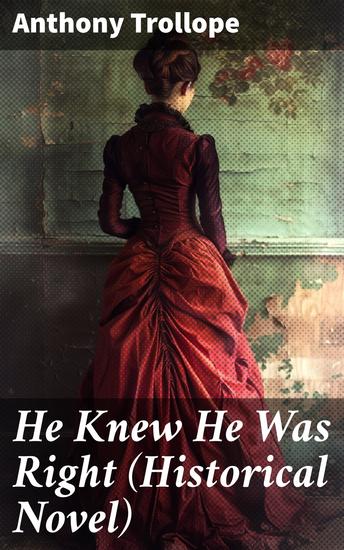
He Knew He Was Right (Historical Novel) - Victorian Romance Novel - cover

He Knew He Was Right (Historical Novel) - Victorian Romance Novel

Anthony Trollope

Maison d'édition: Good Press

  • 0
  • 0
  • 0

Synopsis

In 'He Knew He Was Right,' Anthony Trollope masterfully weaves a narrative rich with the complexities of human relationships, societal expectations, and the moral dilemmas that arise from jealousy and obsession. Set in the early Victorian era, this historical novel explores the conflicted life of Louis Garstin, whose relentless pursuit of control over his wife, Emily, leads to a tragic unraveling of their union and a deep critique of social mores. Trollope'Äôs meticulous prose, coupled with his keen psychological insights, immerses readers in the interpersonal drama while reflecting on the social fabric of his time, showcasing the tensions between personal desire and societal obligation. Anthony Trollope, a prolific Victorian novelist, drew on his experiences in both politics and the Church of England to inform his literary works. Born into a family that fluctuated between social classes, Trollope's life was marked by a keen awareness of social dynamics, which profoundly influenced his understanding of character and motivation. His travels, as well as his observant nature, enabled him to portray the intricacies of human behavior and societal structures, making 'He Knew He Was Right' a deeply introspective narrative set against the backdrop of his contemporary society. I highly recommend 'He Knew He Was Right' to readers who appreciate intricate character studies and rich social commentary. This novel not only provides a compelling story but also serves as a critical lens through which to examine the Victorian ethos and the undercurrents of personal agency and moral conflict. Trollope'Äôs vivid storytelling and keen societal observations make it an invaluable addition to the canon of English literature.
Disponible depuis: 17/12/2023.
Longueur d'impression: 836 pages.
D'autres livres qui pourraient vous intéresser

  • Freckles - From their pens to your ears genius in every story - cover

    Freckles - From their pens to...

    William Pett Ridge

    • 0
    • 0
    • 0
    William Pett Ridge was born at Chartham, near Canterbury, Kent, on 22nd April 1859. 
    His family’s resources were certainly limited. His father was a railway porter, and the young Pett Ridge, after schooling in Marden, Kent became a clerk in a railway clearing-house. The hours were long and arduous, but self-improvement was Pett Ridge’s goal.  After working from nine until seven o’clock he would attend evening classes at Birkbeck Literary and Scientific Institute and then to follow his passion; the ambition to write.  He was heavily influenced by Dickens and several critics thought he had the capability to be his successor. 
    From 1891 many of his humourous sketches were published in the St James's Gazette, the Idler, Windsor Magazine and other literary periodicals of the day. 
    Pett Ridge published his first novel in 1895, A Clever Wife. By the advent of his fifth novel, Mord Em'ly, a mere three years later in 1898, his success was obvious.  His writing was written from the perspective of those born with no privilege and relied on his great talent to find humour and sympathy in his portrayal of working class life. 
    Today Pett Ridge and other East End novelists including Arthur Nevinson, Arthur Morrison and Edwin Pugh are being grouped together as the Cockney Novelists.   
    In 1924, Pugh set out his recollections of Pett Ridge from the 1890s: “I see him most clearly, as he was in those days, through a blue haze of tobacco smoke. We used sometimes to travel together from Waterloo to Worcester Park on our way to spend a Saturday afternoon and evening with H. G. Wells. Pett Ridge does not know it, but it was through watching him fill his pipe, as he sat opposite me in a stuffy little railway compartment, that I completed my own education as a smoker... Pett Ridge had a small, dark, rather spiky moustache in those days, and thick, dark, sleek hair which is perhaps not quite so thick or dark, though hardly less sleek nowadays than it was then”. 
    With his success, on the back of his prolific output and commercial success, Pett Ridge gave generously of both time and money to charity. In 1907 he founded the Babies Home at Hoxton.  This was one of several organisations that he supported that had the welfare of children as their mission.  
    His circle considered Pett Ridge to be one of life's natural bachelors. In 1909 they were rather surprised therefore when he married Olga Hentschel.  
    As the 1920’s arrived Pett Ridge added to his popularity with the movies. Four of his books were adapted into films.  
    Pett Ridge now found the peak of his fame had passed. Although he still managed to produce a book a year he was falling out of fashion and favour with the reading public and his popularity declined rapidly.  His canon runs to over sixty novels and short-story collections as well as many pieces for magazines and periodicals. 
    William Pett Ridge died, on 29th September 1930, at his home, Ampthill, Willow Grove, Chislehurst, at the age of 71. 
    He was cremated at West Norwood on 2nd October 1930.
    Voir livre
  • South Sea Tales - cover

    South Sea Tales

    Jack London

    • 0
    • 0
    • 0
    South Sea Tales (1911) is a collection of short stories written by Jack London. Most stories are set in island communities, like those of Hawaii, or are set aboard a ship.
    
    Contents: The House of Mapuhi / The Whale Tooth / Mauki / "Yah! Yah! Yah!" / The Heathen / The Terrible Solomons / The Inevitable White Man / The Seed of McCoy
    Voir livre
  • Hamlet - Full Cast Drama - cover

    Hamlet - Full Cast Drama

    William Shakespeare

    • 0
    • 0
    • 0
    The play begins with the guards of Elsinore Castle encountering the ghost of the recently deceased King Hamlet, the father of Prince Hamlet. The ghost appears to be a harbinger of doom, hinting at foul play surrounding the former king's death. Prince Hamlet is informed of this mysterious apparition and decides to meet the ghost, who reveals that he was murdered by Hamlet's uncle, Claudius, who has now assumed the throne and married Queen Gertrude. Hamlet is deeply disturbed by this revelation and the apparent betrayal by his mother. He grapples with his grief, anger, and a profound sense of disillusionment. To confirm the ghost's claims, Hamlet stages a play within a play called "The Mousetrap," which mirrors the circumstances of his father's murder. Claudius's reaction to this play confirms Hamlet's suspicions. As Hamlet navigates the complexities of the court, he feigns madness as a way to investigate further and protect himself. His erratic behavior confuses those around him, and he alienates his lover, Ophelia, and her brother, Laertes, in the process. Meanwhile, Hamlet's obsession with revenge intensifies, and he contemplates the moral and philosophical implications of taking another person's life. His famous soliloquies, such as "To be or not to be," reflect his inner turmoil and contemplation of existence and mortality. "Hamlet" is not only a story of revenge and political intrigue but also a profound exploration of the human psyche, existentialism, and the moral and emotional complexities of life. The character of Hamlet is an enduring symbol of the human condition, and his journey through the play continues to captivate and resonate with audiences to this day. 
     
    Voir livre
  • The Minerva Club - cover

    The Minerva Club

    Victor Canning

    • 0
    • 0
    • 0
    The Minerva Club might look like any other London gentlemen’s club but behind its respectable and discreet façade, some of the most ambitious schemes for heists, money-making and evasion of the law are being worked out. It’s an exclusive club for criminals. Entry qualification: members must have served a prison sentence of two years minimum. Though the club’s criminal ventures don’t always go as planned… 
    From trying to break into an old prison cell and stealing a stash of jewels hidden during a previous incarceration, love getting in the way during a hideout from the police, a cleverly planned break-in being interrupted by an unexpected guest, to figuring out where to steal a last-minute wedding cake – the club’s amiable criminals somehow always achieve their goal in the most surprising ways.   
    This collection of five short stories follows the Minerva Club’s (mis)adventures and evokes the very best of humorous classic crime fiction.
    Voir livre
  • A Lickpenny Lover - From their pens to your ears genius in every story - cover

    A Lickpenny Lover - From their...

    O Henry

    • 0
    • 0
    • 0
    William Sydney Porter was born on 11th September 1862 in Greensboro, North Carolina. At age 3 his mother died from tuberculosis. From an early age it was clear Porter had a large appetite for reading as he absorbed the world around him. 
    He first attended at a school run by his aunt before enrolling at the Lindsey Street High School and then worked at his uncle’s drugstore and gained a pharmacists’ license in 1881.  
    A persistent cough took him to Texas in the hope that a change of climate would help his symptoms. He took on various types of work, initially from ranch hand and cook and then as varied as pharmacist, draftsman, bank teller and journalist. He also began to write, though for now, purely as a hobby. 
    He was a member of several singing and dramatic groups when he met 17 year old Athol Estes, daughter of a wealthy Austin family. Despite her mother’s objection owing to Athol’s tuberculosis, they began courting and in July 1887, they eloped and soon married. 
    Athol, impressed by his writing, encouraged him to get them published. A job as a draftsman at the Texas General Land Office paid a healthy $100 dollars per month and life was good. 
    But then life turned cruel. His son died a few hours after birth although a daughter, Margaret, came the following year.  His job had to be vacated but another was found at the First National Bank of Austin. The bank operated informally and Porter was careless in keeping the books. He lost that job but began writing for the humourous weekly The Rolling Stone and the Houston Post. Some time later the federal Bank auditors went through his former accounts and he was arrested on charges of embezzlement. 
    Porter fled the day before his trial to Honduras. Holed up for several months he began to write.  Athol had become too ill to travel to meet him and learning that her health was deteriorating he surrendered to the court in February 1897.  Bail was obtained so that he could stay with Athol during her final days.  
    Porter was sentenced to five years at the Ohio Penitentiary in Columbus. His pharmacy qualifications got him the job of night druggist.  His sentence also gave him time to write and publish fourteen short stories. In December 1899 in McClure’s Magazine he published a short story as O Henry.  
    He was released two years early in July 1901, and reunited with Margaret, now 11, in Pittsburgh.  He now began his most prolific period of writing; a short story per week for the New York World, while also publishing works in other magazines.  Eventually over 600 of his short stories were published. 
    Porter was a heavy drinker and in 1908 his health, which had deteriorated for several years, took a dramatic turn for the worse, as did his writing.  
    O Henry died of cirrhosis of the liver complicated by diabetes and an enlarged heart on 5th June 1910.
    Voir livre
  • Treasure Island (Part 3: My Shore Adventure) - cover

    Treasure Island (Part 3: My...

    Robert Louis Stevenson

    • 0
    • 0
    • 0
    Part 3: My Shore Adventure from Treasure Island:
    "For sheer storytelling delight and pure adventure, Treasure Island has never been surpassed. From the moment young Jim Hawkins first encounters the sinister Blind Pew at the Admiral Benbow Inn until the climactic battle for treasure on a tropic isle, the novel creates scenes and characters that have fired the imaginations of generations of readers. Written by a superb prose stylist, a master of both action and atmosphere, the story centers upon the conflict between good and evil - but in this case a particularly engaging form of evil. It is the villainy of that most ambiguous rogue Long John Silver that sets the tempo of this tale of treachery, greed, and daring. Designed to forever kindle a dream of high romance and distant horizons, Treasure Island is, in the words of G. K. Chesterton, 'the realization of an ideal, that which is promised in its provocative and beckoning map; a vision not only of white skeletons but also green palm trees and sapphire seas.' G. S. Fraser terms it 'an utterly original book' and goes on to write: 'There will always be a place for stories like Treasure Island that can keep boys and old men happy.'
    Voir livre