Rejoignez-nous pour un voyage dans le monde des livres!
Ajouter ce livre à l'électronique
Grey
Ecrivez un nouveau commentaire Default profile 50px
Grey
Abonnez-vous pour lire le livre complet ou lisez les premières pages gratuitement!
All characters reduced
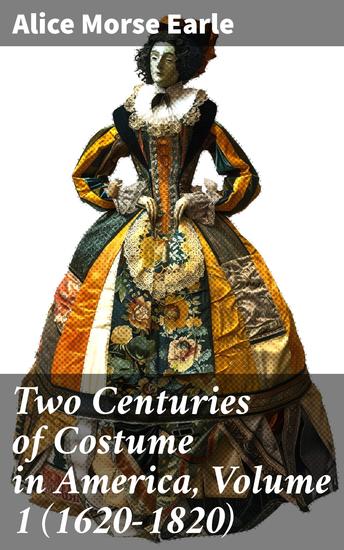
Two Centuries of Costume in America Volume 1 (1620-1820) - Exploring the Evolution of Fashion in Early America - cover

Two Centuries of Costume in America Volume 1 (1620-1820) - Exploring the Evolution of Fashion in Early America

Alice Morse Earle

Maison d'édition: Good Press

  • 0
  • 0
  • 0

Synopsis

In "Two Centuries of Costume in America, Volume 1 (1620-1820)," Alice Morse Earle offers an exhaustive exploration of the evolution of American fashion, intertwining detailed illustrations with meticulous descriptions of attire from the early Colonial era to the dawn of the 19th century. Earle's literary style marries scholarly rigor with accessible prose, creating a vivid tapestry that captures not just the garments worn, but the cultural and social contexts that influenced these styles. This volume delves into the intricacies of fabric, design, and the stark variations seen across different regions and social strata, illustrating how clothing became a reflection of identity and change in a nascent nation. Alice Morse Earle, a pioneering American historian, drew upon her expansive knowledge of American life and customs, influenced by her own experiences and interests in the material culture of her surroundings. Earle'Äôs background in researching and preserving early American artifacts likely contributed to her desire to document and analyze the country'Äôs sartorial history, framing it within a broader narrative of societal development and cultural exchange that resonates throughout her work. This meticulous volume is an invaluable resource for those interested in fashion history, American studies, or cultural anthropology. Earle's insightful observations and comprehensive research provide a rich understanding of how fashion informs our perception of history, making this book a must-read for scholars and casual readers alike who wish to uncover the sartorial stories of two centuries.
Disponible depuis: 12/08/2023.
Longueur d'impression: 298 pages.

D'autres livres qui pourraient vous intéresser

  • China Japan and the USA - cover

    China Japan and the USA

    John Dewey

    • 0
    • 0
    • 0
    "China, Japan, and the U.S.A." by John Dewey is a compelling exploration of the complex interplay between these three influential nations in the early 20th century. With keen insight and intellectual rigor, Dewey delves into the political, cultural, and philosophical dynamics that shaped their interactions and the global landscape. Drawing upon his extensive knowledge of history, Dewey meticulously examines the evolving relationships between China, Japan, and the United States during a pivotal era of transformation. He skillfully navigates the intricate threads of diplomacy, economic development, and cultural exchange, offering a nuanced understanding of the forces at play. Read in English, unabridged.
    Voir livre
  • Walden - cover

    Walden

    Henry David Thoreau

    • 0
    • 0
    • 0
    Immerse yourself in the tranquil beauty of nature and the profound insights of Henry David Thoreau's timeless classic, "Walden," now available as an audiobook. 
    In this captivating work, Thoreau reflects on his two-year experiment of living simply and self-sufficiently in a small cabin near Walden Pond. As you listen, you'll be transported to the serene shores of this idyllic setting, where Thoreau explores the rhythms of the natural world, the joys of solitude, and the essence of true freedom. 
    Through his keen observations and introspective musings, Thoreau invites listeners to contemplate life's fundamental questions and to reconsider their own values and priorities. From the wonders of the changing seasons to the simplicity of daily routines, "Walden" offers a profound meditation on the human experience and our place in the universe. 
    Narrated with clarity and sensitivity, this audiobook brings Thoreau's words to life, allowing you to fully appreciate the beauty and wisdom of his prose. Whether you're seeking inspiration, solace, or a deeper connection to the world around you, "Walden" is sure to leave a lasting impression. 
    So, if you're ready to embark on a journey of self-discovery and spiritual renewal, don't wait any longer. Start listening to "Walden" today and let Thoreau's timeless wisdom guide you toward a life of simplicity, mindfulness, and fulfillment.
    Voir livre
  • Thrive - The Freedom to Flourish - cover

    Thrive - The Freedom to Flourish

    Lesley Riddoch

    • 0
    • 0
    • 0
    Why won't Scots simmer down?
    Why batter on about independence when folk voted no a decade back?
    
    After all. Scotland is not as populated as Yorkshire, nor as wealthy as London.
    But it's also not as Conservative, nor as suspicious of Europeans, as keen on Brexit or as willing to flog off public assets to the ruling party's pals.
    
    Scotland is a former state with its own laws, education, universities, languages, welfare system, history and hang-ups. A progressive North Atlantic nation steered by a Westminster government that's totally preoccupied with regaining lost imperial status. 
    Put simply – with or without Nicola Sturgeon at the helm – Scotland is another country. A social democracy stuck in a Conservative state.
    And that's why 50% of Scots are determined to find a way out.
    
    In this book, Blossom author Lesley Riddoch sets out an impassioned case for independence, weaving academic evidence with the story, and international comparison with anecdote, to explain why Scotland is ready to step forward as the world's newest state and how the British Isles can work better when Scotland is governed by the folk who call it home. 
    
    Let's cast aside preconceptions. Whichever way you voted in 2014 – if you were able – the world has changed, Europe has changed and the UK has changed – though not in a good way.
    Scots need the freedom to change too.
    Voir livre
  • The Shocking Truth about Cultural Appropriation - cover

    The Shocking Truth about...

    Zoey Fraisers

    • 0
    • 0
    • 0
    Cultural appropriation is the act of taking or borrowing elements of one culture by members of another culture, typically without permission or proper understanding. This often occurs when a dominant culture adopts aspects of a marginalized or minority culture, without recognizing the significance or history behind these cultural symbols, practices, or traditions. While some might argue that cultural exchange is a natural part of globalization, cultural appropriation is controversial because it is frequently associated with power imbalances, exploitation, and the erasure of the identities of those whose culture is being borrowed. 
    At its core, cultural appropriation is not about borrowing something for appreciation or respect, but rather taking something from another culture in a way that is exploitative or disrespectful. For example, wearing traditional garments like a kimono or a Native American headdress as fashion statements, without understanding their cultural importance or context, is often cited as an example of cultural appropriation. These items are not just clothes or accessories; they carry deep meanings and are often tied to spiritual, ceremonial, or political significance. 
    One of the key aspects that distinguishes cultural appropriation from cultural appreciation is power dynamics. The group that appropriates tends to have more social, political, or economic power, while the culture being appropriated is often marginalized. This power imbalance is evident in many cases where elements of minority cultures are commodified and turned into trends or products, while the people from those cultures continue to face oppression, discrimination, and lack of recognition.
    Voir livre
  • The Brexit Referendum - The UK's EU Departure - cover

    The Brexit Referendum - The UK's...

    Nova Ashford

    • 0
    • 0
    • 0
    The Brexit referendum, which took place on June 23, 2016, marked a pivotal moment in the history of the United Kingdom and its relationship with the European Union. The decision to leave the EU, known as Brexit, came after years of mounting debate and growing division within British society and politics. The referendum was the result of a long-standing debate over the UK’s membership in the European Union, with political, economic, and cultural tensions playing a central role in shaping the outcome. 
    The road to Brexit began long before the referendum vote. The United Kingdom joined the European Economic Community (EEC) in 1973, a precursor to the European Union, and since then, the nation’s relationship with the organization has been fraught with disagreement. Euroscepticism, or skepticism about the benefits of EU membership, had been steadily rising, particularly among certain political groups and sections of the public. Critics of the EU argued that membership undermined national sovereignty and that the UK was bound by regulations and policies that did not align with its interests. This sentiment was exacerbated by issues such as immigration, trade regulations, and the financial burden of contributing to the EU budget. 
    In the years leading up to the referendum, the political landscape of the UK began to shift. The rise of UKIP (the United Kingdom Independence Party), led by Nigel Farage, brought the issue of EU membership into sharper focus. UKIP’s success in the 2014 European Parliament elections, where it emerged as the largest UK party, put pressure on the Conservative Party to address the growing concerns over the EU. Prime Minister David Cameron, seeking to quell dissent within his own party and avoid a potential electoral challenge from UKIP, promised a referendum on EU membership in 2013. This pledge set the stage for the referendum that would ultimately decide the UK’s fate within the EU.
    Voir livre
  • 24 Hours in Shogun's Japan - A Day in the Life of the People Who Lived There - cover

    24 Hours in Shogun's Japan - A...

    Mark Hudson

    • 0
    • 0
    • 0
    Spend twenty-four hours in the vibrant, divided world of Shogun's Japan.  
    In 1614, Japan stood at a crossroads. As the Tokugawa shogunate tightened its grip on power, samurai prepared for war, Christians faced persecution, and foreign merchants navigated a rapidly shifting political landscape.  
    In 24 Hours in Shogun's Japan, Mark Hudson brings this pivotal moment to life through the eyes of twenty-four individuals–nobles and farmers, merchants and monks, pirates and poets–each living through one dramatic hour of a single day. From the streets of Kyoto to the slopes of Mount Fuji, this book offers an immersive portrait of this fascinating era of Japanese history.
    Voir livre