Begleiten Sie uns auf eine literarische Weltreise!
Buch zum Bücherregal hinzufügen
Grey
Einen neuen Kommentar schreiben Default profile 50px
Grey
Jetzt das ganze Buch im Abo oder die ersten Seiten gratis lesen!
All characters reduced
Story of Anemone - cover

Story of Anemone

Zara Sagan

Übersetzer A AI

Verlag: Publifye

  • 0
  • 0
  • 0

Beschreibung

"Story of Anemone" masterfully weaves together the botanical and cultural legacy of one of nature's most enchanting flowers, exploring how these delicate blooms have influenced art, mythology, and science across civilizations.From their legendary origins in Greek mythology, where they sprouted from Aphrodite's tears, to their symbolic presence in Renaissance vanitas paintings, anemones have maintained a remarkable presence in human culture and artistic expression. The book's unique approach combines rigorous botanical analysis with rich cultural history, examining how these flowers adapted across different continents while simultaneously shaping artistic movements and cultural symbolism.Readers discover fascinating insights about anemones' distinctive pigmentation patterns, which challenged and inspired artists from the Dutch Golden Age to the Impressionists, and their complex symbolic meanings, ranging from fleeting life in Renaissance art to forsaken love in Victorian flower language.Structured in three comprehensive sections, the narrative progresses from detailed botanical characteristics and global distribution patterns to mythological interpretations and artistic representations. Drawing from previously untranslated botanical texts, private art collections, and archaeological findings, the book offers fresh perspectives on these versatile flowers while maintaining accessibility for both academic researchers and garden enthusiasts. This interdisciplinary exploration effectively demonstrates how a single flower species can embody diverse meanings across different societies and time periods.
Verfügbar seit: 30.01.2025.
Drucklänge: 94 Seiten.

Weitere Bücher, die Sie mögen werden

  • Data Mining for Beginners - Extracting Knowledge from Large Datasets From Raw Data to Actionable Insights - cover

    Data Mining for Beginners -...

    Brian Murray

    • 0
    • 0
    • 0
    This comprehensive guide takes you step by step through the fundamentals of data mining, making it an essential resource for aspiring data scientists, analysts, and anyone curious about the power of data-driven decision-making. 
    Starting with the basics, this book demystifies core concepts such as data preprocessing, classification, clustering, and association rule mining. With practical examples and clear explanations, you'll explore popular algorithms, tools, and techniques used to analyze patterns, trends, and relationships within data. Learn how to apply these techniques to real-world scenarios, from marketing to healthcare, and discover how insights derived from data mining can drive strategic decisions and innovation. 
    Whether you're a student, a professional looking to enhance your skills, or someone interested in understanding the foundations of data mining, this book provides a solid starting point. With its approachable style, hands-on exercises, and focus on practical applications, Data Mining for Beginners will empower you to turn data into knowledge and knowledge into action. 
    Take the first step on your data mining journey and unlock the limitless potential of your data.
    Zum Buch
  • Ulcers - cover

    Ulcers

    Hippocrates

    • 0
    • 0
    • 0
    The ancient Greek physician Hippocrates is often credited with being the first to identify ulcers as a medical condition. In his famous treatise On the Sacred Disease, Hippocrates describes ulcers as open sores that can occur on the skin or mucous membranes. He notes that ulcers are often painful and may be accompanied by fever, swelling, and redness. Read in English, unabridged.
    Zum Buch
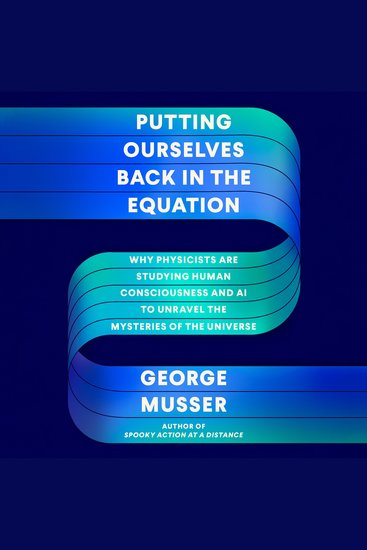
  • Putting Ourselves Back in the Equation - Why Physicists Are Studying Human Consciousness and AI to Unravel the Mysteries of the Universe - cover

    Putting Ourselves Back in the...

    George Musser

    • 0
    • 0
    • 0
    "This is a delightful account of one of the deepest and most fascinating explorations going on today at the frontier of our knowledge." —Carlo Rovelli, bestselling author of The Order of Time and Seven Brief Lessons on PhysicsA revelatory exploration of how a "theory of everything" depends upon our understanding of the human mindThe whole goal of physics is to explain what we observe. For centuries, physicists believed that observations yielded faithful representations of what is out there. But when they began to study the subatomic realm, they found that observation often interferes with what is being observed—that the act of seeing changes what we see. The same is true of cosmology: our view of the universe is inevitably distorted by observation bias. And so whether they’re studying subatomic particles or galaxies, physicists must first explain consciousness—and for that they must turn to neuroscientists and philosophers of mind.Neuroscientists have painstakingly built up an understanding of the structure of the brain. Could this help physicists understand the levels of self-organization they observe in other systems? These same physicists, meanwhile, are trying to explain how particles organize themselves into the objects around us. Could their discoveries help explain how neurons produce our conscious experience?Exploring these questions and more, George Musser tackles the extraordinary interconnections between quantum mechanics, cosmology, human consciousness, and artificial intelligence. Combining vivid descriptions with portraits of scientists working on the cutting edge, Putting Ourselves Back in the Equation shows how theories of everything depend on theories of mind—and how they might be one and the same.A Macmillan Audio production from Farrar, Straus and Giroux.
    Zum Buch
  • Radio Frequency Identification - Fundamental Ideas And Principles Concerning RFID - cover

    Radio Frequency Identification -...

    Owen Jones

    • 0
    • 0
    • 0
    RFID technology has emerged as a transformative force, revolutionizing industries ranging from retail and logistics to healthcare and manufacturing. Its ability to track and identify objects wirelessly has paved the way for enhanced efficiency, improved operational visibility, and streamlined processes. However, with these advancements come important considerations regarding privacy, security, and best practices for implementation. 
    In this manual, we aim to provide readers with a clear understanding of RFID technology, its capabilities, and its implications in both business and consumer sectors. From exploring the basics of RFID chips and tags to discussing advanced applications such as asset management and supply chain optimization, we cover a wide range of topics to equip readers with the knowledge needed to navigate the RFID landscape effectively. 
    Additionally, we address key privacy and security concerns associated with RFID technology, offering insights into best practices for safeguarding sensitive information and ensuring compliance with regulatory requirements. By implementing robust privacy measures and security protocols, businesses and consumers can harness the benefits of RFID technology while protecting individual privacy rights and maintaining trust in the digital age. 
    Whether you`re new to RFID or seeking to deepen your understanding of its practical applications and implications, this manual serves as a comprehensive resource for navigating the world of Radio Frequency Identification. Join us as we explore the potential of RFID technology and discover how it is shaping the future of business and innovation. 
    I hope that you will find the information helpful, useful and profitable.
    Zum Buch
  • The Superluminal Universe - Redefining Consciousness Time and Space - cover

    The Superluminal Universe -...

    Brigitte Dutheil, Régis Dutheil

    • 0
    • 0
    • 0
    The Superluminal Universe reveals, for the first time in English, the incredible insights of French quantum physicist Professor Régis Dutheil. Thanks to the development of particle accelerators, physicists are now able to propel particles (tachyons) at a speed close to that of light (300,000 km per second). At these extreme speeds, the laws that govern our universe no longer apply. Professor Dutheil's work has shown that the theory of relativity is not incompatible with that of tachyons, provided that we allow for the possibility of a double reality: that alongside our sub-luminous universe, which follows the law of time, is a superluminal universe. This second reality is another universe, complementary to and symmetrical with ours, governed by superluminal space-time in which light moves 300,000 km/s to infinity. 


    In the superluminal universe, everything is instantaneous. It is possible to conceive of a superluminal being capable of moving from one end of space to the other. This parallel universe consists only of information and consciousness: all information (past, present, future) and the consciousness of all humanity. Professor Dutheil's thesis joins the intuitions of ancient philosophers with current quantum physics to blow our current notions of time, of past and present, of the nature of consciousness, of birth and death right out of the water.
    Zum Buch
  • Is Anyone Listening? - What Animals Are Saying to Each Other and to Us - cover

    Is Anyone Listening? - What...

    Denise L. Herzing

    • 0
    • 0
    • 0
    If you could pose one question to a dolphin, what would it be? And what might a dolphin ask you? For forty years, researcher and author Denise L. Herzing has investigated these and related questions of marine mammal communication. But the dolphins are not the only ones talking, and in this wide-ranging and accessible book, Herzing explores the astonishing realities of interspecies communication, a skill that humans currently lack. 


    Is Anyone Listening? connects research on dolphin communication to findings from Jane Goodall on chimpanzees, Dian Fossey on mountain gorillas, Cynthia Moss on African elephants, and others driving today's exploration of possible animal languages. As Herzing reveals, researchers are finding fascinating hints of language in nonhuman species, including linguistic structures, vowel equivalents, and complex repeated sequences. By looking at the many ways animals use and manipulate signals, we see that we've only just begun to appreciate the diversity of animal intelligence and the complicated and subtle aspects of animal communication. 


    Considering dolphins and other nonhuman animals as colleagues instead of research subjects, Herzing asks us to meet animals as both speakers and listeners, as mutually curious beings, and to listen to what they are saying.
    Zum Buch