Rejoignez-nous pour un voyage dans le monde des livres!
Ajouter ce livre à l'électronique
Grey
Ecrivez un nouveau commentaire Default profile 50px
Grey
Abonnez-vous pour lire le livre complet ou lisez les premières pages gratuitement!
All characters reduced
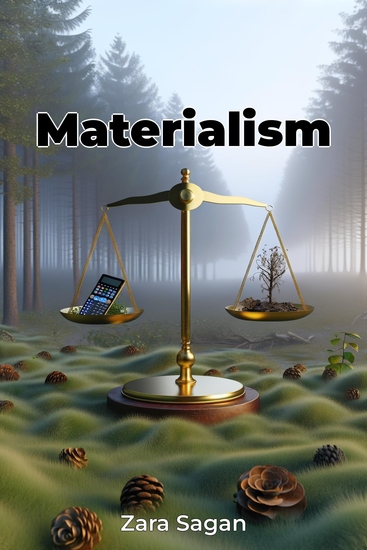
Materialism - cover

Materialism

Zara Sagan

Traducteur A AI

Maison d'édition: Publifye

  • 0
  • 0
  • 0

Synopsis

"Materialism: The Pursuit of Possessions and Its Impact on Human Well-being" offers a comprehensive exploration of materialism's influence on our lives and society. This thought-provoking book examines the historical roots of materialistic thinking, from ancient Greek philosophy to modern consumer culture, and investigates its psychological effects on individuals and broader societal implications.

 
The book argues that while material possessions can provide temporary satisfaction, an excessive focus on acquiring goods often leads to decreased well-being, strained relationships, and environmental degradation. It presents compelling research from various fields, including psychology, sociology, and environmental science, to support this thesis. For instance, longitudinal studies reveal the long-term effects of materialistic values on happiness and life satisfaction.

 
Structured in three parts, the book progresses from defining materialism to exploring its psychological impact and, finally, examining its societal consequences. What sets this work apart is its interdisciplinary approach, combining philosophical inquiry with empirical research and practical applications.

 
It not only critiques materialism but also offers constructive alternatives and strategies for personal and societal change, making it a valuable resource for anyone seeking to understand and navigate the challenges of living in a materialistic world.
Disponible depuis: 14/10/2024.
Longueur d'impression: 161 pages.

D'autres livres qui pourraient vous intéresser

  • Paracelsus: A short biography - 5 Minutes: Short on time – long on info! - cover

    Paracelsus: A short biography -...

    5 Minutes, 5 Minute Biographies,...

    • 0
    • 0
    • 0
    Paracelsus, natural philosopher and healer: Life and work in a short biography! Everything you need to know, brief and concise. Infotainment, education and entertainment at its best!
    Voir livre
  • End of World War II The: The History of the Battles that Ended the Fighting in Europe and the Pacific - cover

    End of World War II The: The...

    Editors Charles River

    • 0
    • 0
    • 0
    After the successful amphibious invasion on D-Day in June 1944, the Allies began racing east toward Germany and liberating France along the way. The Allies had landed along a 50 mile stretch of French coast, and despite suffering 8,000 casualties on D-Day, over 100,000 still began the march across the western portion of the continent. By the end of August 1944, the German Army in France was shattered, with 200,000 killed or wounded and a further 200,000 captured. However, Adolf Hitler reacted to the news of invasion with glee, figuring it would give the Germans a chance to destroy the Allied armies that had water to their backs. As he put it, “The news couldn’t be better. We have them where we can destroy them.” While that sounds delusional in retrospect, it was Hitler’s belief that by splitting the Allied march across Europe in their drive toward Germany, he could cause the collapse of the enemy armies and cut off their supply lines.  
    Near the end of 1944, as Allied forces were pushing across the Pacific and edging ever closer to Japan, plans were drawn up to invade the Ryuku islands, the most prominent of them being Okinawa. Military planners anticipated that an amphibious campaign would last a week, but instead of facing 60,000 Japanese defenders as estimated, there were closer to 120,000 on the island at the beginning of the campaign in April 1945. The Battle of Okinawa was the largest amphibious operation in the Pacific theater, and it would last nearly 3 months and wind up being the fiercest in the Pacific theater during the war, with nearly 60,000 American casualties and over 100,000 Japanese soldiers killed. In addition, the battle resulted in an estimated 40,000-150,000 Japanese civilian casualties.
    Voir livre
  • Phenomenology of Productive Imagination: Embodiment Language Subjectivity - cover

    Phenomenology of Productive...

    Saulius Geniusas

    • 0
    • 0
    • 0
    Although productive imagination has played a highly significant role in (post-) Kantian philosophy, there have been very few book-length studies explicitly dedicated to its analysis. 
    
    In his new book, Saulius Geniusas develops a phenomenology of productive imagination while relying on those resources that we come across in Edmund Husserl’s, Max Scheler’s, Martin Heidegger’s, Ernst Cassirer’s, Miki Kiyoshi’s, Jean-Paul Sartre’s, Maurice Merleau-Ponty’s, and Paul Ricoeur’s writings, while also engaging in present-day philosophical discussions of the imagination. Investigating the relation between imagination and embodiment, affectivity, perception, language, selfhood, and intersubjectivity, the book provides a phenomenological conception of productive imagination, which is committed to basic phenomenological principles and which is sensitive to how productive imagination has been conceptualized in the history of phenomenology. 
    
    Against such a background, Geniusas develops a new conception of productive imagination: It is a basic modality of intentionality that indirectly shapes the human experience of the world by forming the contours of action, intuition, knowledge, and understanding. It is not so much a blind and indispensable function of the soul, but an art concealed in the body, for it springs out of instincts, drives, desires, and needs. 
    
    The author demonstrates unexpected ways in which phenomenology of productive imagination enriches our understanding of embodied subjectivity.
    Voir livre
  • The Most Fascinating Man in the World - The Life and Biography of Peter Freuchen - cover

    The Most Fascinating Man in the...

    John Harpoon

    • 0
    • 0
    • 0
    Peter Freuchen was born on February 2, 1886, in the small town of Nykøbing Falster, Denmark. Raised in a well-off family, his early life was marked by an environment that fostered curiosity and exploration. From a young age, Freuchen exhibited a strong interest in adventure and the natural world. He was inspired by his father, a civil engineer, and his mother, who instilled in him a love for literature and storytelling. These early experiences would play a crucial role in shaping his adventurous spirit and intellectual curiosity, which would define much of his later life. 
    Freuchen's education was broad and varied. Initially attending school in his hometown, he soon showed an aptitude for science and geography. However, his desire to explore the world beyond the classroom eventually led him to study at the University of Copenhagen, where he focused on medicine and natural sciences. Although Freuchen did not complete his medical degree, his time at the university was pivotal in forming his understanding of the natural world and fostering his interest in Arctic exploration. 
    During his student years, Freuchen was drawn to the literature of explorers such as Fridtjof Nansen and Roald Amundsen. These accounts of Arctic adventures ignited a deep passion in him to experience such feats firsthand. While still a young man, he decided to leave behind his academic pursuits and embark on an adventure that would change his life forever. At the age of 22, Freuchen sailed to Greenland, where he would spend the next several years of his life living among the Inuit people. It was here that Freuchen learned the skills necessary to survive in one of the harshest environments on Earth. His time in Greenland was not just a physical trial but also an intellectual journey, as he immersed himself in the culture, language, and survival techniques of the Inuit.
    Voir livre
  • Healthy Relationships - cover

    Healthy Relationships

    Morgan Blake

    • 0
    • 0
    • 0
    Healthy Relationships: A Simple Yet Effective Guide For Couples on How to Maintain a Healthy and Happy RelationshipEveryone wants to fall and stay in love. The ‘falling in love’ part usually just happens naturally. It is the ‘staying in love’ part that is more complicated. It demands commitment. It requires intentionality, dedication, and work. A happy and healthy relationship does not ‘just happen.’ It is a result of continuing attention, constant effort, and meaningful work. It is the happy consequence of commitment. In this audiobook, you will learn the secrets to happy and healthy relationships. It aims to provide inspiration and direction to anyone who wants to develop and maintain healthy and fulfilling intimate relationships. Even if you are currently single, it will help put you in the right disposition as you prepare to fall in love and stay in love.Topics that will be covered are: - Keep a Realistic Perspective about Your Relationship- Stay Committed about Making Your Relationship Work- Make Sure Your Relationship is a Source of Happiness in Your Life- Open Communication is a Must- Allow for Growth Both Separately and TogetherA stable relationship needs more than romance and passion to keep it going. To learn more, download your copy of this audiobook today!
    Voir livre
  • Leon Trotsky - cover

    Leon Trotsky

    Kelly Mass

    • 0
    • 0
    • 0
    Leon Trotsky was a Ukrainian-Russian Marxist revolutionary, political thinker, and political leader who lived from November the 7th, in the year 1879 till August the 21st 1940. He developed a variation of Marxism referred to as Trotskyism after being a communist ideologically.Trotsky accepted Marxism after moving to Nikolayev in the year 1896, where he was born to a wealthy Ukrainian-Jewish family in Yanovka (now Bereslavka, Ukraine). He was detained and banned to Siberia by Tsarist authorities in the year 1898 for advanced activity. In the year 1902, he got away Siberia for London, where he ended up being good friends with Vladimir Lenin. At the time of the Russian Social Democratic Labour Party's preliminary organizational split in the year 1903, he supported Julius Martov's Mensheviks against Lenin's Bolsheviks. Trotsky was locked up and deported to Siberia after helping to prepare the unsuccessful Russian Revolution of 1905. He got away again and operated in the U.K., Austria, Switzerland, France, Spain, and the U.S. for the next 10 years. After the Tsarist monarchy was toppled in the February Revolution of 1917, Trotsky went back to Russia and signed up with the Bolshevik faction as a leader. He was a popular figure in the November 1917 October Revolution, which deposed the new Provisional Federal government, as head of the Petrograd Soviet.Let’s see what else Leon Trotsky did in his life.
    Voir livre