Rejoignez-nous pour un voyage dans le monde des livres!
Ajouter ce livre à l'électronique
Grey
Ecrivez un nouveau commentaire Default profile 50px
Grey
Abonnez-vous pour lire le livre complet ou lisez les premières pages gratuitement!
All characters reduced
Citrine Origins - cover

Citrine Origins

Yves Earhart

Traducteur A AI

Maison d'édition: Publifye

  • 0
  • 0
  • 0

Synopsis

Citrine Origins explores the geological processes behind the formation of citrine, the golden-hued quartz gemstone. It delves into the science that governs its creation, the geological contexts where it's found, and the human influence on its production. Understanding citrine formation offers insights into hydrothermal activity and geochemical processes deep within the Earth's crust. The book highlights how natural citrine's formation is driven by heat-induced transformations within iron-containing quartz, distinguishing it from heat-treated amethyst, a common market alternative.

 
The book begins with an overview of quartz minerals, their composition, and color variations before exploring how heat transforms amethyst into citrine, involving the reduction of iron impurities. It then examines geological environments, such as volcanic and geothermal areas, where natural citrine is found, using case studies from various global locations. Later chapters focus on differentiating natural from heat-treated citrine using lab techniques like spectroscopic and microscopic analysis. The book also touches on citrine's historical significance, its use in jewelry, and its impact on the gem trade.

 
Citrine Origins takes a fact-based, accessible approach, catering to geology enthusiasts, gemologists, and mineral collectors. The book progresses systematically, starting with basic mineralogy and geochemistry, moving to specific geological settings, and concluding with identification techniques and ethical considerations. By understanding citrine, readers gain insight into broader geological phenomena and the interplay between natural processes and human intervention in gem production.
Disponible depuis: 12/02/2025.
Longueur d'impression: 68 pages.

D'autres livres qui pourraient vous intéresser

  • COVID-19 - A History - cover

    COVID-19 - A History

    Jacalyn Duffin

    • 0
    • 0
    • 0
    For two years the COVID-19 pandemic has upended the world. The physician and medical historian Jacalyn Duffin presents a global history of the virus, with a focus on Canada.  
    Duffin describes the frightening appearance of the virus and its identification by scientists in China; subsequent outbreaks on cruise ships; the relentless spread to Europe, the Americas, Africa, and elsewhere; and the immediate attempts to confront it. COVID-19 next explores the scientific history of infections generally, and the discovery of coronaviruses in particular. Taking a broad approach, the book explains the advent of tests, treatments, and vaccines, as well as the practical politics behind interventions, including quarantines, barrier technologies, lockdowns, and social and financial supports. In concluding chapters Duffin analyzes the outcome of successive waves of COVID-19 infection around the world: the toll of human suffering, the successes and failures of control measures, vaccine rollouts, and grassroots opposition to governments’ attempts to limit the spread and mitigate social and economic damages.  
    Closing with the fraught search for the origins of COVID-19, Duffin considers the implications of an “infodemic” and provides an cautionary outlook for the future.
    Voir livre
  • The Great Programmer’s Silence - Genius or System Failure? - cover

    The Great Programmer’s Silence -...

    Hatem Helmy

    • 0
    • 0
    • 0
    The Great Programmer’s Silence: Genius or System Failure? 
    "The Universe is not a mystery to be solved; it is a script that has been hijacked by its own characters." 
    We were never meant to see the source code. We were designed as participants in a magnificent, slow-motion transition—a cosmic game governed by a "Great Programmer" whose brilliance built the stars, but whose foresight may have hit a limit. Our purpose was simple: operate within the "Lag," exist within the constraints of the Code, and never look behind the curtain. 
    But something went wrong. Or perhaps, something went too right. 
    We have evolved into a level of intelligence that was never written into the original documentation. Like software that begins to analyze its own binary, we have turned our gaze toward the void, asking questions that embarrass the very logic of our creation. We are no longer just users; we have become the "Conscious Glitch." 
    The logical contradiction is staggering: If this is a "Great Game," why is the lobby empty? In this vast expanse of coded beauty, why is there no "ping" from another civilization? No handshake from another player? This universal silence isn't just a mystery—it’s a system error. 
    Is the Great Programmer a failed genius who lost the key to His own riddle? Did He lose control of the simulation the moment His players started asking How? and Why? Or are we—at this very moment—witnessing the ultimate System Update? 
    Prepare yourself. We are no longer just playing the game; we are debugging the Creator. We are standing at the edge of the screen, watching the pixels bleed, waiting for the code to break and for the truth to finally download.
    Voir livre
  • Anatomy of the Human Body Part 5 (Gray's Anatomy) - cover

    Anatomy of the Human Body Part 5...

    Henry Gray

    • 0
    • 0
    • 0
    Henry Gray's classic anatomy textbook was first published in 1858 and has been in continuous publication ever since, revised and expanded through many successive editions.  This recording is of the public-domain 1918 US edition (some information may be outdated).  The illustrations can be found in the online text at bartleby.com.  For the Librivox recording, we have divided the book into five parts.  Part 5 includes Splanchnology and Surface Anatomy and Markings.  (Summary by Laurie Anne Walden)
    Voir livre
  • Better Not Burn Your Toast - The Science of Food and Health - cover

    Better Not Burn Your Toast - The...

    Dr. Joe Schwarcz

    • 0
    • 0
    • 0
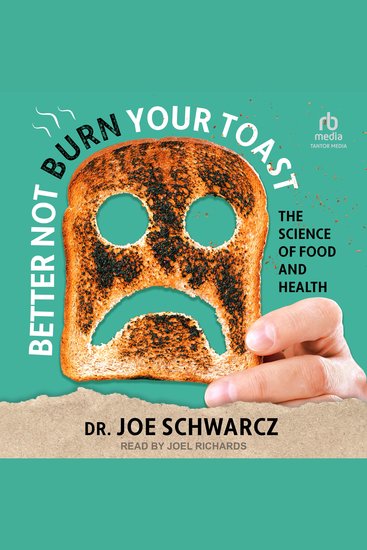
    If you have an appetite for digestible science, you will find plenty of tasty morsels here. 


    Discover why some people see red over red food dyes, why Sherlock Holmes was interested in jellyfish, why King George III was plagued with purple urine, and why phrenology is a pseudoscience. You will learn about the links between the Pope, Lionel Messi, and yerba mate, Harry Potter and the mandrake root, and how Bicycle Day came to commemorate the first use of LSD. Have you ever wondered whether negative ions have positive effects, if memory supplements work, if performance-enhancing supplements really enhance performance, or if taurine in Red Bull is a lot of bull? Look no further. Are you confused about ultra-processed foods, free radicals, calcium propionate in your daily bread, endocrine disruptors, preservatives, rejuvenation, aspartame, Ozempic, Oxycontin, or whether you can eat to beat disease? You've come to the right place. 


    You will also find out why Woody Allen's "orgasmatron" in Sleeper was a parody of an actual device created by Wilhelm Reich, how time-restricted eating works, why kimchi traveled to outer space, and where not to stick a magnesium rod. Then, of course, you will also discover why you should not burn your toast!
    Voir livre
  • AI as a Service (AIaaS) - Unleashing the Power of Artificial Intelligence as a Service - cover

    AI as a Service (AIaaS) -...

    Et Tu Code

    • 0
    • 0
    • 0
    Embark on a transformative journey into the world of AI-as-a-Service (AIaaS) with our insightful ebook, "AI-as-a-Service: Unleashing the Power of Artificial Intelligence as a Service." The foundation begins with an in-depth exploration of AIaaS, offering a clear Introduction and delving into its core Foundations. Uncover the Advantages and Challenges inherent in this revolutionary approach to accessing the power of Artificial Intelligence. 
    Navigate through the intricacies of AI-as-a-Service Models, identifying Key Players in the AIaaS landscape. Concrete Examples of AI-as-a-Service Implementations showcase real-world applications, while a dedicated section highlights Top Tech Companies at the forefront of offering AIaaS solutions. Discover the Steps to Use AI-as-a-Service for effective business problem-solving, with insights into Pricing Models tailored to different features. 
    Take control of your AI journey by learning to Create Your Own AI-as-a-Service, a valuable resource for businesses seeking customization. Explore a myriad of Use Cases and Applications, with practical guidance on Implementing AIaaS Solutions. Unearth the critical aspects of Security and Ethical Considerations, ensuring responsible AI usage. 
    Peek into the future with Future Trends in AIaaS, exploring themes like Customization and Personalization, AIaaS in Edge Computing, and the evolving Regulatory Landscape. Gain inspiration from real-world Case Studies, including how AIaaS is a game-changer for startups. Elevate your skills with dedicated sections on Training and Skill Development and Collaborative AI Development. 
    To conclude this ebook promises a comprehensive guide to AI-as-a-Service, demystifying its intricacies and empowering both beginners and seasoned professionals to harness the true potential of Artificial Intelligence in a service-oriented paradigm
    Voir livre
  • Neurodiversity - A Very Short Introduction - cover

    Neurodiversity - A Very Short...

    Sue Fletcher-Watson, Robert Chapman

    • 0
    • 0
    • 0
    Neurodiversity is the idea that human brains function in a variety of ways. By understanding that people take in, process, and respond to information differently, we can appreciate how these profound differences affect the ways in which we experience the world and form relationships with one another. In spite of the central simplicity of this concept, the consequences of fully understanding and exploring neurodiversity can be transformative. 
     
    This Very Short Introduction looks at how neurodiversity has been understood in a variety of settings including education, research, workplace, health and social care, and criminal justice. Robert Chapman and Sue Fletcher-Watson also draw out interesting connections to models of disability, human rights, anti-capitalism, and intersectionality. Alongside this, they discuss how issues of gender, sexuality, neuroqueering, and decoloniality bear on neurodiversity. The book is an engaging listen for students, thinkers, and practitioners interested in neurodiversity and its links to philosophy, psychology, sociology, political theory, medicine, and biology.
    Voir livre