Begleiten Sie uns auf eine literarische Weltreise!
Buch zum Bücherregal hinzufügen
Grey
Einen neuen Kommentar schreiben Default profile 50px
Grey
Jetzt das ganze Buch im Abo oder die ersten Seiten gratis lesen!
All characters reduced
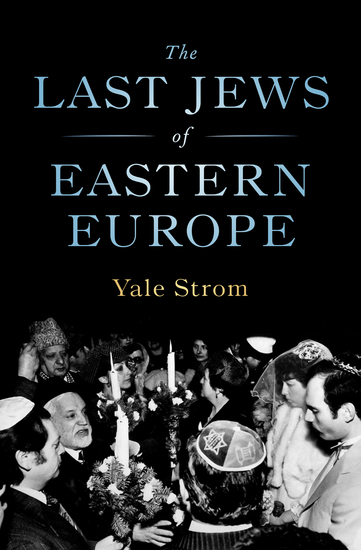
The Last Jews of Eastern Europe - cover

The Last Jews of Eastern Europe

Yale Strom

Verlag: Philosophical Library/Open Road

  • 0
  • 0
  • 0

Beschreibung

In striking photography and informative text, this volume both celebrates and mourns Eastern European Jewish life of the early- to mid-twentieth century.From Odessa to Budapest, Warsaw, Prague, and Sarajevo, the Jews of Eastern Europe established thriving, traditional communities . And while there are still proud Jews who keep the Kehilla robust in the region, they are a shadow of their former glory. In The Last Jews of Eastern Europe, Yale Strom and photographer Brian Blue record a way of life that largely disappeared through the torment, violence, and upheaval of the twentieth century. Through the USSR, Poland, Czechoslovakia, Hungary, Romania, Yugoslavia, and Bulgaria, this volume records the three great blows to Eastern European Jewry: the historical persecution of the Jews who suffered the envy of their neighbors; the slaughter of millions during World War II; and the loss of those who accepted the aliyah to Israel. It also records how the Jews of Eastern Europe laugh, weep, and sing.
Verfügbar seit: 02.08.2022.
Drucklänge: 392 Seiten.

Weitere Bücher, die Sie mögen werden

  • Karma Yoga - cover

    Karma Yoga

    Bhikshu

    • 0
    • 0
    • 0
    The lessons included in this book are written by an Asiatic for the English-speaking peoples of the world, and suffer from the fact that the mother tongue of the writer is not English nor Sanskrit and that his metaphysic is oriental. Much of the teaching that 1s given here has been given out privately in the Yogic schools of the select, though not in the practical form herein presented. The excuse for the book is the need of arrangement before doubting, enquiring minds prepared to question every argument and assertion; of facts and theories so that they fit in with the composite scheme presented by the Yogi philosophy.
    Zum Buch
  • Write Yourself Out of a Corner - 100 Exercises to Unlock Creativity - cover

    Write Yourself Out of a Corner -...

    Alice LaPlante

    • 0
    • 0
    • 0
    100 imagination-stretching writing exercises inspired by the idea of creative constraints, from the author of The Making of a Story. 


    When you are facing down a blank page (or screen), a constraint-based prompt—for example, "you must use the words 'cloud' and 'green'" or "you must set the scene in a crowded grocery store"—can get your brain working in unexpected ways. 


    In this creative writing guide, longtime teacher and novelist Alice LaPlante shares 100 original exercises that will simultaneously push you into a corner and give you the tools to write yourself out of it. LaPlante explains the purpose of each exercise—to sharpen your ear for dialogue, generate surprising images, or access intense emotions—and breaks down student examples to reveal how to achieve these goals. Whether you are looking to jumpstart new ideas or find a fresh angle on a work in progress, and whether you write fiction, creative nonfiction, or poetry, Write Yourself Out of a Corner will strengthen your imagination and your craft.
    Zum Buch
  • Learn Chinese Idioms with Stories: Volume 2 - An Easy Guide with Meaning & Story - cover

    Learn Chinese Idioms with...

    Letitia Wu

    • 0
    • 0
    • 0
    More wisdom. More stories. More Chinese you’ll never forget. 
    Discover the meaning behind 10 powerful Chinese idioms through story and sound. 
    Even if you don’t speak Chinese yet, you can enjoy the journey. 
    Each idiom includes: 
    • A vivid, short story 
    • A clear explanation in simple English 
    • A cultural insight or life lesson 
    • Easy memory tips 
    • And a few example sentences — perfect if you’re ready to try using the idioms yourself! 
    Whether you’re a beginner, advanced learner, or simply curious about Chinese culture, this audiobook helps you: 
    ✔︎ Understand how Chinese people think 
    ✔︎ Learn real expressions, naturally 
    ✔︎ Enjoy meaningful stories, anytime 
    No textbook needed. Just press play.
    Zum Buch
  • Selfless Leadership - A Complete Guide to Awakening the Servant Leader Within - cover

    Selfless Leadership - A Complete...

    Katrijn Van Oudheusden

    • 0
    • 0
    • 0
    You already have all you need for servant leadership within: 
    Selfless service is our true nature beyond the ego. 
    In this practical, transformational book, you're invited on a complete self-coaching journey to authentic and effortless servant leadership. 
    You will learn: 
    The four insights into your true nature as selfless service. 
    Sixteen transformational practices guaranteed to awaken selfless service in you. 
    How to do the most meaningful work you will ever do, without having to work on yourself endlessly or follow a demanding spiritual path. 
    You can be a servant leader right now, in the job you already do with the skills you already have. This book will show you how.
    Zum Buch
  • No Democracy Lasts Forever - How the Constitution Threatens the United States - cover

    No Democracy Lasts Forever - How...

    Erwin Chemerinsky

    • 0
    • 0
    • 0
    No Democracy Lasts Forever argues that the Constitution has become a threat to American democracy and must be dramatically changed or replaced if secession is to be avoided. 


    Deeply troubled by the Constitution's inherent flaws, Erwin Chemerinsky, the renowned dean of Berkeley law school, came to the sobering conclusion that our nearly 250-year-old founding document is responsible for the crisis now facing American democracy. Pointing out that just fifteen of the 11,848 amendments proposed since 1789 have passed, Chemerinsky contends that the very nature of our polarization results from the Constitution's "bad bones," which have created a government that no longer works or has the confidence of the public. Yet political armageddon can still be avoided, Chemerinsky writes, if a new constitutional convention is empowered to replace the Constitution of 1787, much as the Founding Fathers replaced the outdated Articles of Confederation. If this isn't possible, Americans must give serious thought to forms of secession—including a United States structured like the European Union—based on a recognition that what divides us as a country is, in fact, greater than what unites us.
    Zum Buch
  • Montenegro in the Late Middle Ages: The History of the Different States and Dynasties that Controlled the Area - cover

    Montenegro in the Late Middle...

    Editors Charles River

    • 0
    • 0
    • 0
    Much has been written about Western intervention during the breakup of Yugoslavia, and whether it made matters worse, prevented worse atrocities, or was simply ineffective. In early 1992, however, what was clear was that Europe was hopelessly divided over the best course of action to take towards Yugoslavia, and after several years of fighting, the Bosnian War was one of the most violent conflagrations in Europe since the end of World War II. 
    That war had been the byproduct of centuries of tensions in the Balkans, and an attempt in the wake of World War I to redraw the political boundaries of Europe and the Middle East. That included forming the Kingdom of Yugoslavia, initially known as the Kingdom of Serbs, Croats and Slovenes, a particularly fragile enterprise, and there was almost constant tension between the majority Serbs and the other Yugoslav nationalities, especially the Croats. As a result, the Kingdom was a land of political assassinations, underground terrorist organizations, and ethnic animosities. In 1929, King Alexander I suspended democracy and ruled as a dictator until he himself was assassinated in 1934. 
    Depending on the source, many authors have focused on different catalysts for Yugoslavia’s demise, but Vesna Drapac may have succinctly summed the situation up when he wrote that by the end, the state “lacked a reason to exist.” There is certainly something in this sentiment, but the disintegration came at an enormous cost. Given what happened in Yugoslavia, it should be little surprise the area that eventually became the modern nation of Montenegro has had a turbulent history for millennia, with shifting borders, different degrees of autonomy, and various conflicts occurring within it.
    Zum Buch