Rejoignez-nous pour un voyage dans le monde des livres!
Ajouter ce livre à l'électronique
Grey
Ecrivez un nouveau commentaire Default profile 50px
Grey
Abonnez-vous pour lire le livre complet ou lisez les premières pages gratuitement!
All characters reduced
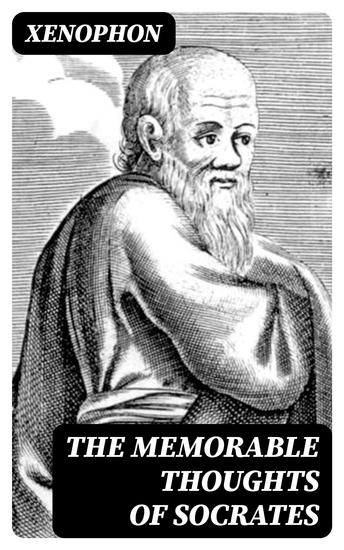
The Memorable Thoughts of Socrates - Enriched edition - cover

The Memorable Thoughts of Socrates - Enriched edition

Xenophon

Traducteur Edward Bysshe

Maison d'édition: DigiCat

  • 0
  • 0
  • 0

Synopsis

In "The Memorable Thoughts of Socrates," Xenophon presents a series of dialogues that capture the essence of Socratic philosophy, revealing the profound ethical and practical wisdom of Socrates. Unlike Plato's more dramatic portrayals, Xenophon adopts a straightforward narrative style, emphasizing clarity and accessibility while embedding deeper philosophical inquiry within everyday conversations. This work serves as both a companion piece to Plato's dialogues and a standalone exploration of Socratic thought, addressing themes such as virtue, education, and the nature of the good life, all framed through Socrates' distinctive method of questioning and dialogue. Xenophon, an Athenian historian and philosopher, was a student of Socrates who later became a general and a prominent figure in the ancient Greek world. His experiences in the tumultuous political landscape of Greece, combined with personal encounters with Socratic teachings, informed his perspectives on leadership, ethics, and the nature of knowledge. Recognized for his clear prose and practical insights, Xenophon offers a unique portrayal of Socrates that complements the more idealized depiction found in other philosophical texts. I highly recommend "The Memorable Thoughts of Socrates" for anyone interested in ancient philosophy, ethics, or the foundations of Western thought. Xenophon's work not only illuminates Socratic wisdom but also invites readers to engage in their own reflective practice on the nature of morality and personal conduct in contemporary society.

In this enriched edition, we have carefully created added value for your reading experience:
- A succinct Introduction situates the work's timeless appeal and themes.
- The Synopsis outlines the central plot, highlighting key developments without spoiling critical twists.
- A detailed Historical Context immerses you in the era's events and influences that shaped the writing.
- An Author Biography reveals milestones in the author's life, illuminating the personal insights behind the text.
- A thorough Analysis dissects symbols, motifs, and character arcs to unearth underlying meanings.
- Reflection questions prompt you to engage personally with the work's messages, connecting them to modern life.
- Hand‐picked Memorable Quotes shine a spotlight on moments of literary brilliance.
- Interactive footnotes clarify unusual references, historical allusions, and archaic phrases for an effortless, more informed read.
Disponible depuis: 15/09/2022.
Longueur d'impression: 138 pages.


D'autres livres qui pourraient vous intéresser

  • Hell With the Fire Out: A History of the Modoc War - cover

    Hell With the Fire Out: A...

    Arthur Quinn

    • 0
    • 0
    • 0
    Written by Arthur Quinn 
    Read by Ed Quinn (with an introduction written and read by Julia Whelan) 
    The final book from esteemed Berkeley historian Arthur Quinn, Hell With the Fire Out is both a complex chronicle of a forgotten chapter in American Indian history and a vivid detailing of human foible, folly, and failure. With a novelistic flair, Quinn outlines the sad inevitability of America's westward expansion in its post-Civil War era. Wrangling all the inherent contradictions — Quaker Peace Policy vs Grant and Sherman's War Department; inter- and inner-tribal conflicts; the opposing attitudes of the region's White settlers — Quinn gives us a battle story not merely between nations and governments, but within the hearts of the very individuals at its center. 
    This is the first time an audio version of this book has been available and it is read by none other than the author's son, actor Ed Quinn (Two Broke Girls, One Day at a Time, Tyler Perry's The Oval).
    Voir livre
  • Roman Gods and Legends - Exploring the Divine Myths of Ancient Rome - cover

    Roman Gods and Legends -...

    Odessa Nightshade

    • 0
    • 0
    • 0
    Mythology was at the heart of ancient Roman culture, shaping the way people understood the world, their history, and even their daily lives. Roman myths were more than just entertaining stories; they provided a framework for religious practices, reinforced social hierarchies, and legitimized political authority. From grand temples dedicated to Jupiter to household shrines honoring protective spirits, mythology was deeply embedded in Roman society. These myths explained the origins of Rome, the will of the gods, and the moral expectations placed upon its people.  
      
    One of the most fascinating aspects of Roman mythology is its connection to Greek mythology. The Romans borrowed heavily from the Greeks, adapting their gods, myths, and religious traditions to fit their own culture. Jupiter became the Roman equivalent of Zeus, Venus took the place of Aphrodite, and Neptune mirrored Poseidon. Yet, Roman mythology was not simply a copy of Greek traditions—it evolved to reflect Rome’s unique values, including its emphasis on duty, discipline, and the power of the state. Roman gods were deeply tied to civic life, with religious festivals and rituals reinforcing the unity and strength of the empire.  
      
    As Rome expanded, so did its pantheon. Over time, new deities were integrated from conquered cultures, blending native Italian, Etruscan, and foreign influences into Roman religious beliefs. This constant evolution reflected the empire’s adaptability and its ability to absorb and reshape traditions to maintain social cohesion. The role of mythology also shifted, particularly as emperors began to position themselves as semi-divine figures, further intertwining politics with religion. These myths were not just ancient relics but living traditions that reinforced Rome’s identity and dominance. 
    Voir livre
  • The Viking Saga - Discovering the Mythology of the Norsemen - cover

    The Viking Saga - Discovering...

    Odessa Nightshade

    • 0
    • 0
    • 0
    The mythology of the Norsemen is a tapestry woven with gods, giants, heroes, and creatures, shaping the beliefs and culture of the Viking Age. Rooted in oral tradition, these stories were passed down through generations, evolving over time yet retaining their essence. Norse myths explain the creation of the world, the forces that govern existence, and the inevitable fate that awaits all beings, including the gods themselves. Unlike many mythologies that depict their deities as all-powerful, Norse mythology embraces the concept of struggle, destiny, and the impermanence of even the mightiest figures.  
      
    At the heart of Norse mythology is a pantheon of gods divided into two main groups: the Aesir and the Vanir. The Aesir, led by Odin, are associated with war, wisdom, and governance, while the Vanir, including Freyja and Njord, are linked to fertility and prosperity. Though originally at odds, these two factions eventually united, reflecting the Viking worldview of balance between opposing forces. Alongside these deities are powerful figures such as Loki, the trickster, and the Norns, who weave the fates of gods and men alike.  
      
    The Norse cosmos is structured around Yggdrasil, the World Tree, which connects the Nine Realms. These include Asgard, the home of the gods; Midgard, the realm of humans; and Hel, the domain of the dead. This vast and interconnected universe embodies the Viking understanding of life as an intricate web of cause and effect, where fate is both inescapable and deeply intertwined with personal action. 
    Voir livre
  • Building Business: Secrets to Captivating Customers Instantly - "Unlock business success! Access dynamic audio lessons crafted to enchant your customers from the start" - cover

    Building Business: Secrets to...

    Jasper Elmsworth

    • 0
    • 0
    • 0
    Building Business: Secrets to Captivating Customers Instantly 
    Are you ready to advance your career and gain the insights needed to transform your brand by connecting deeply with customers? 
    Looking for a comprehensive guide that equips you with all the essential strategies to forge strong customer relationships? 
    Your quest ends here! 
    This audiobook is your ultimate resource for enhancing your knowledge, applying effective techniques, and participating in practical exercises. With this guide in hand, you're set up for success. 
    Updated for the latest strategies in customer engagement. 
    Key features of this enhanced guide: 
    - In-depth insights on captivating customers instantly 
    - Thorough explanations of brand transformation 
    - Proven strategies for customer connection and engagement 
    Our guide stands out with its extensive coverage, which is crucial for your success in understanding customer dynamics. Concepts are not just glossed over; they are explored with clarity and depth. 
    Please note that this guide is an independent resource and not affiliated with any official entities in the field. 
    With a well-organized structure and accessible language, our guide ensures smooth transitions between concepts. Say farewell to confusing jargon and embrace clear, concise, and accurate content. 
    So, why wait? Click the BUY NOW button, secure your guide, and embark on your journey to transforming your brand by connecting deeply with customers!
    Voir livre
  • The Daimon and the Soul of the West - Finding identity meaning and purpose in a sacrificial life - cover

    The Daimon and the Soul of the...

    Bernardo Kastrup

    • 0
    • 0
    • 0
    We, Western minds, have forgotten who we are, despite having never once stopped being who we are. We've lost touch with the impersonal, Daimonic forces that give us direction and the sacrificial nature of our existence. No longer do we realize that our lives aren't, have never been, and will never be about ourselves. Consequently, we've lost our ability to sense the immanent context that couches our lives in meaning and purpose. Our alienation from our own inborn nature and role has led to a tragic schism: a divorce between essence and narrative, being and action. This book is an effort to help heal this schism. It's about re-encountering our natural selves and guiding Daimon, retuning into the archetypal dispositions we embody, and relearning how to navigate the choppy waters of life in a spontaneous and fulfilling manner.
    Voir livre
  • Japan and World War II: The History of the Imperial Japanese Empire during the War - cover

    Japan and World War II: The...

    Anonyme

    • 0
    • 0
    • 0
    All Americans are familiar with the “day that will live in infamy.” At 9:30 a.m. on Sunday, December 7, 1941, Pearl Harbor, the advanced base of the United States Navy’s Pacific Fleet, was ablaze. It had been smashed by aircraft launched by the carriers of the Imperial Japanese Navy. All eight battleships had been sunk or badly damaged, 350 aircraft had been knocked out, and over 2,000 Americans lay dead. Indelible images of the USS Arizona exploding and the USS Oklahoma capsizing and floating upside down have been ingrained in the American conscience ever since. In less than an hour and a half the Japanese had almost wiped out America’s entire naval presence in the Pacific. 
    Despite fighting in North Africa and the Atlantic, the United States still had the resources and manpower to fight the Japanese in the Pacific. Though the Japanese had crippled the American fleet at Pearl Harbor, its distance from Japan made an invasion of Pearl Harbor impossible, and Japan had not severely damaged important infrastructure. Thus, the United States was able to quickly rebuild a fleet, still stationed at Pearl Harbor right in the heart of the Pacific. This forward location allowed the United States to immediately push deeply into the Pacific theater. 
    In fact, the turning point in the Pacific theater took place in 1942 near Midway Island. The Japanese had moved a sizable fleet intending to occupy Midway Island and draw the American navy near. Instead, American aircraft flying from three aircraft carriers that had been away from Pearl Harbor in December 1941 got a bearing on the Japanese fleet and sunk four Japanese aircraft carriers, permanently crippling Japan’s navy. The Battle of Midway was one of the first naval battles in history where the enemy fleets never saw or came into contact with each other.
    Voir livre