
Begleiten Sie uns auf eine literarische Weltreise!
Buch zum Bücherregal hinzufügen
Grey
Einen neuen Kommentar schreiben Default profile 50px
Grey
Jetzt das ganze Buch im Abo oder die ersten Seiten gratis lesen!
All characters reduced
Hunger Beyond Food - cover

Hunger Beyond Food

Xena Mindhurst

Übersetzer A AI

Verlag: Publifye

  • 0
  • 0
  • 0

Beschreibung

Hunger Beyond Food explores the fascinating concept that human hunger extends far beyond physical needs, delving deep into the psychological and emotional dimensions that drive our feelings of satisfaction and fulfillment. Through a compelling blend of neuroscience, cognitive psychology, and behavioral research, the book reveals how our brains process different types of hunger signals and why we often mistake emotional needs for physical ones.

 
The book's three-part structure guides readers through a comprehensive understanding of hunger's multiple dimensions. Beginning with biological and psychological foundations supported by neuroimaging studies, it progresses to examine how social factors and relationships shape our perception of satisfaction. The final section provides practical tools for identifying and addressing various forms of psychological hunger, making complex concepts accessible through real-world examples and clear explanations.

 
What sets this work apart is its innovative approach to understanding human behavior through the lens of psychological hunger patterns. Drawing from multiple disciplines, including behavioral economics and cultural anthropology, it offers readers practical strategies for developing emotional awareness and making better decisions in various life domains. The book's balanced treatment of controversial topics, such as social media's influence on psychological hunger, makes it particularly relevant for anyone interested in personal growth, mental health, or understanding their relationship with satisfaction and fulfillment.
Verfügbar seit: 24.01.2025.
Drucklänge: 126 Seiten.

Weitere Bücher, die Sie mögen werden

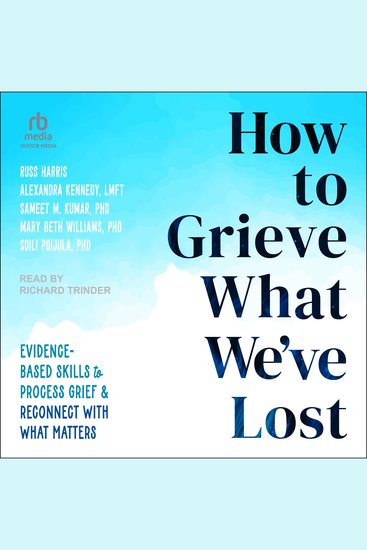
  • How to Grieve What We've Lost - Evidence-Based Skills to Process Grief and Reconnect with What Matters - cover

    How to Grieve What We've Lost -...

    PhD Mary Beth Williams, Russ...

    • 0
    • 0
    • 0
    Grief comes in many forms. You may grieve a loved one who has passed on, a romantic relationship which has ended, the loss of a job you loved, or even a place you used to go that no longer exists or has changed. You may also be dealing with another kind of loss—a sense of who you are and how you can live your life in an increasingly uncertain and changed world. But what if you could transform your grief into lasting positive growth? 


    Filled with the most effective therapeutic tools drawn from acceptance and commitment therapy (ACT), mindfulness, cognitive behavioral therapy (CBT), and more, How to Grieve What We've Lost will help you heal from the pain of loss, move forward, and reconnect with what truly matters to you right now. You'll find strategies for immediate relief—including present-moment awareness and mindful breathing. You'll learn how to create a safe sanctuary for your grief, so you can honor your feelings and give them the space they deserve. And you'll discover ways to create a support network, give voice to your sorrow, and share your humanity with others. 


    Whether you are struggling with your own loss or a collective sense of grief, the evidence-based skills in this book will help you mourn in healthy and resilient ways—leading to profound personal growth and a renewed sense of meaning and purpose in life.
    Zum Buch
  • Wise Men not so Wise - Investigation into the Constitutional Council - cover

    Wise Men not so Wise -...

    Yvan Stefanovitch

    • 0
    • 0
    • 0
    The Constitutional Council is the embodiment of wisdom and is responsible for defending the rule of law and the individual freedoms of the French people, by censuring a law if it considers it unconstitutional. Discretionarily appointed by the three highest authorities of the State for a non-renewable nine-year term, its members are nevertheless the subject of much controversy: - This Institution is in fact the watchdog of the Head of State, and not of the rule of law; - Since its creation by General De Gaulle, its 92 members, most of them in their seventies, have been appointed based solely on political criteria or reasons of simple cronyism, old friendship, in gratitude for services rendered or simply on a whim. The General, Georges Pompidou, François Mitterrand, Jacques Chirac and Emmanuel Macron have appointed their close friends, often even their confidants (such as Richard Ferrand in 2025), to head the Constitutional Council. A pinnacle of insiders that does not bode well for the impartiality and independence of the nine judges. - To facilitate “the constitutional passage by force” or to validate campaign accounts that have been greatly exceeded, the head of state relies on the “Sages”. A reading of the archives of the minutes of the plenary sessions of the Constitutional Council now makes it possible to state that the nine “Sages” have regularly flouted the law for 67 years. France is the only country in the world where former heads of state sit on a Constitutional Court as ex officio and life members. Three parliamentary attempts have mysteriously failed to put an end to this incredible tradition. Nicolas Sarkozy, still “Wise” for life, is now wearing an electronic bracelet because of his multiple convictions. It has also come to light that the remuneration of the Wise Men, whether or not they sit on the court, has remained illegal for 24 years. The “Sages” perform a moderate job with a comfortable income (22,000 to 32,000 euros), which they can combine with several pensions, completely illegally. This serious journalistic investigation, written by one of the most renowned journalists in this field, reveals an impressive number of worrying and aberrant dysfunctions of this supreme and very “political” regulator of our democracy. Protected by a court spirit violently hostile to any transparency, the “Wise Men” dangerously fuel the ambient populism and the growing lack of confidence of the French in their elites.
    Zum Buch
  • Rhythm of Resistance - The Soulful Echoes of Black Musicians in the Era of Martin Luther King Jr (1957-1968) - cover

    Rhythm of Resistance - The...

    Eroms Ehiagwina

    • 0
    • 0
    • 0
    "Rhythm of Resistance: The Soulful Echoes of Black Musicians in the Era of Martin Luther King Jr. (1957-1968)" is a must-read book that sheds light on the pivotal role of music in the Civil Rights Movement. It provides a comprehensive overview of the social, political, and cultural context of the era, highlighting how music served as a powerful tool for expressing the aspirations and frustrations of African Americans. Through songs such as "We Shall Overcome" and "A Change Is Gonna Come," music became an anthem of the movement, inspiring activists and mobilizing communities across America and beyond, it also highlights the struggles of people of color in the United Kingdom at this time. This book is a testament to the enduring spirit of resistance and resilience that drives us towards a more just and equitable society. It serves as a reminder that the struggle for racial justice is ongoing, and the power of music to inspire social change remains as relevant today as it was during the Civil Rights era. Get ready to be inspired and motivated by the transformative power of music in the fight for civil rights. 
     
    Zum Buch
  • German Literary History for Beginners an Exciting and Entertaining Journey Through German Literature From the Middle Ages to the Present Day - cover

    German Literary History for...

    Christian Möhlenkamp

    • 0
    • 0
    • 0
    This book is intended for readers who are looking for an introduction to the confusing diversity of German literature. The chronological order chosen is best suited for this purpose because, in contrast to topic- or genre-oriented ordering procedures, it shows a genesis and traces the genealogy of German literature. The fact that Goethe's novel Wilhelm Meisters Lehrjahre would most likely have looked completely different without Hans Jakob Christoffel von Grimmelshausen's Simplicissimus can be shown most easily and effectively in the context of a chronologically presented journey through time. And this is only one of many examples, especially in the field of poetry quite a few more could be found.
    
    "He who knows how to read holds the key to great deeds, to undreamed-of possibilities," Aldous Huxley once said. This book is intended to open up some of these possibilities for you.
    Zum Buch
  • The Haunt of Home - A Journey through America’s Heartland - cover

    The Haunt of Home - A Journey...

    Zachary Michael Jack

    • 0
    • 0
    • 0
    What does it mean to deeply love a home place that haunts us still? From Mark Twain to Grant Wood to Garrison Keillor, regionalists from the Gilded Age to the Digital Age have explored the American Gothic and the homegrown fatalism that flourishes in many of the nation’s most far-flung and forgotten places. The Haunt of Home introduces us to a cast of real-life midwestern characters grappling with the Gothic in their own lives, from promising young professionals debating the perennial “should I stay or should I go now” dilemma, to recent emigres and entrepreneurs seeking personal reinvention, to faithful boosters determined to keep their communities alive despite the odds. In The Haunt of Home Zachary Michael Jack considers the many ways a region’s abiding spirit shapes the ethos of a land and its people, offering portraits of others who, like himself, are determined to live out the unique promise and predicament of the Gothic.
    Zum Buch
  • The Dangerous Life and Ideas of Diogenes The Cynic - cover

    The Dangerous Life and Ideas of...

    Jean-Manuel Roubineau

    • 0
    • 0
    • 0
    The ancient philosopher Diogenes—nicknamed "The Dog" and decried by Plato as a "Socrates gone mad"—was widely praised and idealized as much as he was mocked and vilified. A favorite subject of sculptors and painters since the Renaissance, his notoriety is equally due to his eccentric behavior, scorn of conventions, and biting aphorisms, and to the role he played in the creation of the Cynic school, which flourished from the 4th century B.C. to the Christian era. Jean-Manuel Roubineau paints a new portrait of an atypical philosopher whose life left an indelible mark on the Western collective imagination and whose philosophy courses through various schools of thought well beyond antiquity. 


    Roubineau sifts through the many legends and apocryphal stories that surround the life of Diogenes. Was he a counterfeiter? Did he meet Alexander the Great? Was he an apologist for incest, patricide, and anthropophagy? How did he actually die? Roubineau retraces the known facts of Diogenes' existence. 


    Beyond the rehashed clichés, this book inspires us to rediscover Diogenes' philosophical legacy—whether it be the challenge to the established order, the detachment from materialism, the choice of a return to nature, or the formulation of a cosmopolitan ideal strongly rooted in the belief that virtue is better revealed in action than in theory.
    Zum Buch