Begleiten Sie uns auf eine literarische Weltreise!
Buch zum Bücherregal hinzufügen
Grey
Einen neuen Kommentar schreiben Default profile 50px
Grey
Jetzt das ganze Buch im Abo oder die ersten Seiten gratis lesen!
All characters reduced
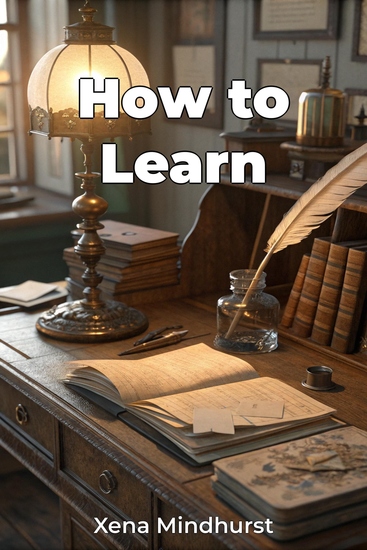
How to Learn - cover

How to Learn

Xena Mindhurst

Übersetzer A AI

Verlag: Publifye

  • 0
  • 0
  • 0

Beschreibung

How to Learn offers a practical guide to mastering effective learning techniques, enhancing memory, and optimizing study habits. It emphasizes that learning is a skill that can be developed, not just an innate talent. The book delves into metacognition, or "thinking about thinking," presenting strategies to tailor learning for optimal results.

 
It presents techniques like spaced repetition and retrieval practice to promote deeper understanding. The book's approach is unique, focusing on actionable advice grounded in cognitive psychology and neuroscience. Readers will discover how memory enhancement techniques, like mnemonic devices and visualization, can improve information retention.

 
It provides step-by-step instructions, real-world examples, and dismantles ineffective study habits. The book progresses logically, beginning with core concepts and moving to specific techniques, exploring the science behind each. It guides readers on integrating these techniques into daily life and personalizing them to their individual learning style.

 
It's designed for students, professionals, and lifelong learners seeking efficient learning strategies for personal and professional development.
Verfügbar seit: 12.02.2025.
Drucklänge: 107 Seiten.
Weitere Bücher, die Sie mögen werden

  • The Chemical Marriage - cover

    The Chemical Marriage

    Manly Palmer Hall

    • 0
    • 0
    • 0
    The self-admitted author of The Chemical Marriage, Johann Valentin Andreæ, born in Württemberg in 1586, was twenty-eight years of age when that work was first published. It was presumably written about twelve years prior to its publication--or when the author was fifteen or sixteen years old. The fact is almost incredible that one so young could produce a volume containing the wealth of symbolic thought and philosophy hidden between the lines of The Chemical Marriage. This book makes the earliest known reference to Christian Rosencreutz, and is generally regarded as the third of the series of original Rosicrucian manifestoes. As a symbolic work, the book itself is hopelessly irreconcilable with the statements made by Andreæ concerning it. The story of The Chemical Marriage relates in detail a series of incidents occurring to an aged man, presumably the Father C.R.C. of the Fama and Confessio. If Father C.R.C. was born in 1378, as stated in the Confessio, and is identical with the Christian Rosencreutz of The Chemical Marriage, he was elevated to the dignity of a Knight of the Golden Stone in the eighty-first year of his life (1459). In the light of his own statements, it is inconceivable that Andreæ could have been Father Rosy Cross.
    Zum Buch
  • Start of World War I The: The History of the Events at the Beginning of the Great War - cover

    Start of World War I The: The...

    Editors Charles River

    • 0
    • 0
    • 0
    By the 20th century, warfare was nothing new to the European powers, especially when it came to fighting each other. Conflicts had been a mainstay on the European continent for over two millennia. Even after the Napoleonic wars had enveloped Europe in large scale war for nearly 20 years in the 19th century, the Europeans’ imperialism continued unabated. It would take the devastation of World War I to shock Europe and jolt the world’s superpowers out of their imperialistic tendencies.  
    	 The final straw came June 28, 1914, when a Serbian assassinated Archduke Franz Ferdinand, the heir to the throne of Austria-Hungary, in Sarajevo, Bosnia. Austria-Hungary immediately issued ultimatums to Serbia. When they declared war on Serbia July 28, 1914, Russia mobilized for war as well. The Germans mobilized in response to Russia on July 30, and the French, still smarting from the Franco-Prussian War, mobilized for war against Germany. The British also declared war on Germany on August 4. Thus, in the span of one week, six nations had declared war, half of which had no interest in the Balkans.  
    	Needless to say, the First World War came at an unfortunate time for those who would fight in it. After an initial period of relatively rapid maneuver during which the German forces pushing through Belgium and the French and British forces attempting to stymie them made an endless series of abortive flanking movements that extended the lines to the sea, a stalemate naturally tended to develop. The infamous trench lines soon snaked across the French and Belgian countryside, creating an essentially futile static slaughterhouse whose sinister memory remains to this day, but if trench warfare was an inevitability during the war, it is only because the events leading up to the initial battles were quite different.
    Zum Buch
  • Matisse at War - cover

    Matisse at War

    Christopher C. Gorham

    • 0
    • 0
    • 0
    In 1940, with the Nazis sweeping through France, Henri Matisse found himself at a personal and artistic crossroads. His marriage had ended, he was gravely ill, and after decades at the forefront of modern art, he was beset by doubt. As scores of famous figures escaped the country, Matisse took refuge in Nice, with his companion, Lydia. By defiantly remaining, Matisse was a source of inspiration for his nation. 


    While enemy agents and Resistance fighters played cat-and-mouse in the alleyways of Nice, Matisse's son, Jean, engaged in sabotage efforts with the Allies. In Paris, under the swastika, Matisse's estranged wife worked for the Communist underground. His daughter, Marguerite, active in the French Resistance, was arrested and tortured by the Gestapo, sentenced to Ravensbruck concentration camp—and miraculously escaped when her train was halted by Allied bombs. His younger son, Pierre helped Jewish artists escape to New York; even his grandson risked his life by defying the Germans and their Vichy collaborators. Amidst this chaos, Matisse responded to the dark days of war by inventing a dazzling new paper technique that led to some of his most iconic pieces, including The Fall of Icarus, his profile of Charles De Gaulle, Monsieur Loyal, and his groundbreaking cut-out book, Jazz. His wartime works were acts of resistance, subtly patriotic, and daringly new.
    Zum Buch
  • My Bipolar Backpack - cover

    My Bipolar Backpack

    Susan Ralphe

    • 0
    • 0
    • 0
    In this powerful memoir Susan Ralphe employs sharp storytelling skills honed over a long  newspaper reporting career to tell her own story of long-term, heart-wrenching bipolar madness.She recounts soaring accomplishments alternating with. black periods of tenseness, brain freeze and despair.
    Zum Buch
  • Freddy Mercury: A short biography - 5 Minutes: Short on time - long on info! - cover

    Freddy Mercury: A short...

    5 Minutes, 5 Minute Biographies,...

    • 0
    • 0
    • 0
    Freddie Mercury, frontman of Queen and global star: Life and work in a short biography! Everything you need to know, brief and concise. Infotainment, education and entertainment at its best!
    Zum Buch
  • Critias - The Lost Story of Atlantis – A Fragment on Power Decline and Civilization - cover

    Critias - The Lost Story of...

    Plato, Tim Zengerink

    • 0
    • 0
    • 0
    What if the lost world of Atlantis was more than just a legend—what if it was a prophecy? 
    In Critias, Plato recounts the rise and fall of Atlantis—an empire of incredible wealth and power that crumbled due to its own moral failure. Though only a fragment remains, its impact is enduring. 
    What you'll discover inside: 
    •	The Myth of Atlantis – One of the earliest and most powerful visions of a lost civilization. 
    •	A Moral and Political Allegory – A deep reflection on the perils of corruption and unchecked ambition. 
    •	Philosophical and Historical Significance – An essential part of Plato’s political thought and a foundational myth of Western culture. 
    •	A Timeless Warning – Relevant to any age facing questions of leadership, balance, and societal decay. 
    •	Critias is more than a myth—it’s a haunting vision of what we stand to lose when wisdom is cast aside for power. 
    Start listening today and unlock the secrets of Atlantis.
    Zum Buch