Join us on a literary world trip!
Add this book to bookshelf
Grey
Write a new comment Default profile 50px
Grey
Subscribe to read the full book or read the first pages for free!
All characters reduced
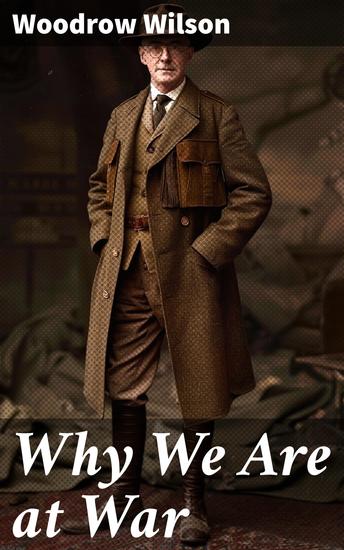
Why We Are at War - Messages to the Congress January to April 1917 - cover

Why We Are at War - Messages to the Congress January to April 1917

Woodrow Wilson

Publisher: Good Press

  • 0
  • 0
  • 0

Summary

In "Why We Are at War," Woodrow Wilson articulates the ideological landscape of World War I, contending that the United States' involvement is a moral obligation rather than mere political expediency. Wilson employs a persuasive and eloquent literary style, blending factual analysis with impassioned rhetoric, as he stresses the themes of democracy, justice, and humanity. Set against the backdrop of a tumultuous global conflict, this work serves as both a military rationale and a manifesto for a new world order, emphasizing self-determination and international cooperation, reflective of Wilsonian ideals. Woodrow Wilson, the 28th President of the United States, was deeply influenced by his scholarly background and progressive beliefs. His tenure in academia and the political realm informed his conviction that America must take a stand against tyranny and champion democratic values. These experiences culminated in his passionate argumentation in "Why We Are at War," which reflects his desire to reshape international relations and reinforce his vision of an idealistic peace. This compelling exploration is a must-read for historians and political science enthusiasts alike, as it not only reveals the motivations behind America's entry into World War I but also provides insights into Wilson's broader vision for global diplomacy. Readers who seek to understand the interplay of ethics and warfare will find this work both illuminating and significant.
Available since: 11/16/2023.
Print length: 33 pages.

Other books that might interest you

  • Mauryan Empire - cover

    Mauryan Empire

    Saurabh Kumar

    • 0
    • 0
    • 0
    The Mauryan Empire was established in 322 B.C. by the great king Chandragupta Maurya. The era of the Mauryas is a milestone throughout the entire existence of Ancient India. The Mauryan Empire was broad and the most powerful in the realm of old Indian history in the ruling from 322 BC to 185 BC.
    Show book
  • Swapped for My Lesbian Roommate - Gender Swap - cover

    Swapped for My Lesbian Roommate...

    Kinky Press

    • 0
    • 0
    • 0
    How does a straight guy get with a lesbian? 
      
    Eric has had the hots for his roommate since the first days of college. Now that they are both interning at the prestigious genetics company Generico, he may finally have an opportunity to do something about the unrequited lust playing out in his boxer shorts. 
      
    One medically enhanced procedure later, and Eric becomes Erica, a hot blonde ready for action. Will his roommate jump at the chance to jump Erica’s new bones?
    Show book
  • Queen Kunti Divine Yogini - Mistress Of Devotional Yoga - cover

    Queen Kunti Divine Yogini -...

    Bhaktivedanta Swami

    • 0
    • 0
    • 0
    Queen Kunti, a tragic and heroic figure, emerges from an explosive era in the history of ancient India. Her teachings are simple and illuminating outpourings revealing the deepest transcendental emotions of the heart and the deepest philosophical and theological penetrations of the intellect. 
     
    Kunti is a major figure in the history of the ancient world. The wife of world emperor Pandu and mother of the warrior Arjuna—to whom Krishna spoke the Bhagavad-gita—she appears again and again in historical epics such as the Mahabharata and Srimad-Bhagavatam. Like other enlightened leaders of her time, her worldview was informed by a thorough understanding of Vedic wisdom literature. Thus she understood that Sri Krishna—Who happened to be her nephew—was none other than the Absolute Truth in person, appearing on earth to establish righteous rule over the planet. 
     
    At the conclusion of the devastating battle of Kurukshetra, Queen Kunti approaches Krishna as He prepares to depart for his home city of Dwaraka. Kunti's spontaneous glorification of Krishna and her description of the spiritual path appear in the First Canto of the Srimad-Bhagavatam. Srila Prabhupada wrote his translation and commentary on the First Canto in 1962—before coming to the West—but in a series of lectures given in the spring of 1973 in Los Angeles, he analyzed Queen Kunti's prayers in significantly greater detail and shed even more light upon them. 
     
    If truth be told from the dawn of creation it has been the female energy which from all life springs, is sustained, and propels us on in our timeless evolutionary journey to self. The powerful positive Shakti of the feminine energy invigorates, inspires, and enhances the finer propensities of life and reveals the subtle secrets of existence via its indivisible healing continence.
    Show book
  • The Writing on the Wall - 100 Iconic Blue Plaques Commemorating Britain's History - cover

    The Writing on the Wall - 100...

    Mike Read

    • 0
    • 0
    • 0
    A blue plaque is a recognised symbol of our national heritage; a living footprint of our history with each one serving as a permanent reminder of an important contribution to the history of the country.
    The blue plaques commemorate notable, influential and successful people from all walks of life. They are erected in the present to celebrate our past and inspire our future.
    This book contains 100 blue plaques, and the stories and people behind them, from across the United Kingdom, each linking, through a common denominator, to the next.
    From David Bowie to William Shakespeare, we run the gamut of plaques remembering kings, actors, singers, explorers, footballers, cricketers, writers, inventors, scientists, politicians, musicians, reformers, broadcasters, songwriters, comedians, pioneers, artists, the military, athletes, dancers, activists, poets and education.
    From Lennon and McCartney to the victims of Jack the Ripper this is an eclectic representation of British life, through our blue plaques, from the 1500s to 2017.
    Show book
  • The Prophet - by Kahlil Gibran - cover

    The Prophet - by Kahlil Gibran

    Kahlil Gibran

    • 0
    • 0
    • 0
    The Prophet by Khalil Gibran is a timeless masterpiece of poetic prose that explores universal themes of love, life, and the human experience. Written in a deeply lyrical and spiritual tone, the book follows Almustafa, a wise prophet, as he prepares to leave the city of Orphalese after twelve years. Before his departure, the townspeople gather to seek his counsel, prompting him to share profound reflections on 26 essential aspects of life, including love, marriage, work, freedom, joy, and sorrow. Through its eloquent and thought-provoking insights, The Prophet offers readers an inspiring guide to living with purpose, compassion, and self-awareness. Its enduring relevance and universal wisdom have made it a beloved literary treasure across generations.
    Show book
  • Bob Dylan in the Attic - The Artist as Historian - cover

    Bob Dylan in the Attic - The...

    Freddy Cristóbal Domínguez

    • 0
    • 0
    • 0
    Bob Dylan is an iconic American artist, whose music and performances have long reflected different musical genres and time periods. His songs tell tales of the Civil War, harken back to 1930s labor struggles, and address racial violence at the height of the civil rights movement, helping listeners to think about history, and history making, in new ways. While Dylan was warned by his early mentor, Dave Van Ronk, that, "You’re just going to be a history book writer if you do those things. An anachronism," the musician has continued to traffic in history and engage with a range of source material—ancient and modern—over the course of his career. 


    In this beautifully crafted book, Freddy Cristóbal Domínguez makes a provocative case for Dylan as a historian, offering a deep consideration of the musician's historical influences and practices. Utilizing interviews, speeches, and the close analysis of lyrics and live performances, Bob Dylan in the Attic is the first book to consider Dylan's work from the point of view of historiography.
    Show book