Rejoignez-nous pour un voyage dans le monde des livres!
Ajouter ce livre à l'électronique
Grey
Ecrivez un nouveau commentaire Default profile 50px
Grey
Abonnez-vous pour lire le livre complet ou lisez les premières pages gratuitement!
All characters reduced
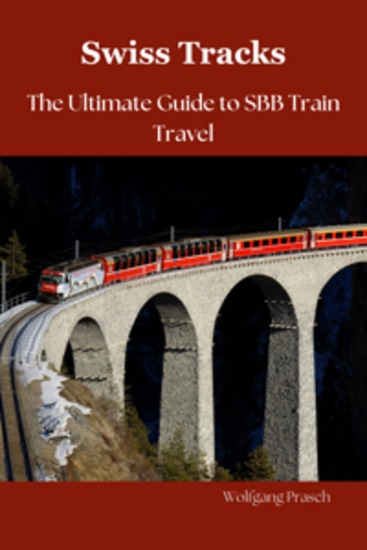
Swiss Tracks Your Ultimate Guide to SBB Train Travel - Your Ultimate Guide to SBB Train Travel - cover

Swiss Tracks Your Ultimate Guide to SBB Train Travel - Your Ultimate Guide to SBB Train Travel

Wolfgang Prasch

Maison d'édition: BookRix

  • 0
  • 0
  • 0

Synopsis

Switzerland's trains aren't just transportation—they're an experience. Whether you're gliding past shimmering lakes, winding through Alpine valleys, or speeding between world-class cities, the Swiss Federal Railways (SBB) offers the most efficient, scenic, and stress-free way to explore the country.
But navigating Swiss trains can be overwhelming. Which ticket is best? When should you book? How can you travel like a local and avoid tourist pitfalls?
In Swiss Tracks, you'll get insider tips, route recommendations, and practical hacks to master Switzerland's legendary rail system. From the must-ride panoramic routes to the hidden gems only locals know, this book is your ultimate companion to Swiss train travel—whether you're a first-time visitor or a seasoned rail enthusiast.
Packed with personal stories, historical insights, and expert advice, this guide will help you travel smarter, save money, and turn every journey into an unforgettable adventure.
All aboard! Your Swiss rail adventure starts here.
Disponible depuis: 13/02/2025.
Longueur d'impression: 97 pages.


D'autres livres qui pourraient vous intéresser

  • The Fit Traveler - Staying in Shape While Exploring the World - cover

    The Fit Traveler - Staying in...

    Zane Ryder

    • 0
    • 0
    • 0
    Staying fit while traveling might seem like a daunting task, but it’s an approach that can transform the way you explore the world. Traveling often disrupts routines, introduces unfamiliar foods, and brings logistical challenges that make fitness seem secondary. However, adopting a mindset of balance and adaptability allows you to maintain your health without sacrificing the joys of discovery. 
    Fit travel is about integrating physical activity, mindfulness, and wellness into your adventures. It’s not about rigid routines or missing out on cultural experiences—it’s about enhancing your journey by staying energized, focused, and physically capable of making the most of every opportunity. When you prioritize fitness while traveling, you’ll find yourself more present, resilient, and ready to engage with the world around you. 
    The benefits of staying fit on the road go beyond physical health. Exercise is a proven stress reliever, helping to combat the anxieties of navigating new places and managing travel logistics. It boosts your mood and energy levels, making you more equipped to enjoy long days of sightseeing, hikes, or cultural immersion. Moreover, it creates a sense of accomplishment that can positively shape your entire travel experience.
    Voir livre
  • Why You Should Take a Weekend Break in Bruges - cover

    Why You Should Take a Weekend...

    Mark Ferdinand

    • 0
    • 0
    • 0
    Bruges is a city made for weekends—a fairytale escape of cobbled streets, tranquil canals, and medieval charm. Small enough to explore on foot yet rich with history and beauty, it’s the perfect destination for a short but unforgettable break. 
    Mark Ferdinand shows you how to make the most of your time in this enchanting Belgian city: wandering the Markt Square beneath its soaring belfry, taking a boat ride through the dreamy canals, indulging in world-famous chocolates and Belgian beer, and discovering quiet corners where time seems to stand still. Whether you’re looking for romance, culture, or simply a change of pace, Bruges offers the ideal weekend away.
    Voir livre
  • The Long Way Home - cover

    The Long Way Home

    Reece Davis

    • 0
    • 0
    • 0
    After years spent chasing distant horizons, what happens when the road finally leads you back? 
    In The Long Way Home, acclaimed travel writer Reece Davis turns his compass inward, exploring the idea of home through the lens of a lifetime spent in motion. From the quiet streets of his childhood to the far corners of the world where he’s found pieces of himself, Davis weaves a tapestry of memory, movement, and meaning. 
    With the lyrical grace of a memoir and the keen observation of a traveler, he asks what it means to belong in a world without fixed borders — and whether returning home is ever the same as staying. 
    Poignant, introspective, and deeply human, The Long Way Home is a meditation on distance, identity, and the timeless journey between leaving and arriving.
    Voir livre
  • Qing Dynasty - China's Last Empire and the Dawn of Modernity - cover

    Qing Dynasty - China's Last...

    Rolf Hedger

    • 0
    • 0
    • 0
    The Qing Dynasty, China’s last imperial dynasty, emerged from the northeastern frontier, led by the Manchu people. Before establishing their rule over China, the Manchus were a semi-nomadic group descended from the Jurchens, who had previously ruled northern China under the Jin Dynasty. In the early 17th century, Nurhaci, a formidable leader, laid the foundation for Manchu power by unifying various Jurchen tribes and adopting administrative and military structures inspired by the Ming Dynasty. His successor, Hong Taiji, continued these efforts, formally establishing the Qing Dynasty in 1636. However, the conquest of China was still incomplete, as the Ming Dynasty continued to rule the heartland. 
    The decline of the Ming Dynasty provided an opportunity for the Qing to assert their dominance. By the early 17th century, the Ming government was weakened by internal corruption, peasant uprisings, and economic distress exacerbated by famine and mismanagement. The most devastating of these rebellions was led by Li Zicheng, a former postal worker turned insurgent, whose forces overran Beijing in 1644. The fall of the Ming capital marked a critical turning point. With the Ming emperor dead and the central government in disarray, a Ming general, Wu Sangui, faced a difficult choice: resist the rebel forces or seek outside aid. He chose the latter, opening the gates of the Great Wall at Shanhai Pass to the advancing Qing army. The Manchus, under the leadership of Prince Dorgon, seized the moment, swiftly capturing Beijing and declaring the establishment of Qing rule.
    Voir livre
  • Thai History - Facts and Background of the Siamese and the Khmer Empire (2 in 1) - cover

    Thai History - Facts and...

    Kelly Mass

    • 0
    • 0
    • 0
    Learn more about the history of those countries. The topics addressed will be the following: 
    The Khmer Empire--Historians describe Cambodia as the Khmer State or the Angkorian Empire (Khmer:) from the 9th century to the 15th century, when it was a Hindu/Buddhist empire in Southeast Asia. The empire, which developed from the old societies of Funan and Chenla, governed and/or "vassalized" the majority of mainland Southeast Asia and parts of Southern China, covering from the suggestion of the Indochinese Peninsula northward to modern-day Yunnan province in China, and from Vietnam westward to Myanmar. The Khmer Empire was greater at its peak than the Byzantine Empire (Eastern Roman Empire) that existed at the exact same period. 
    The Siamese-- Siam was just a much different name for what's now referred to as Thailand. The Siamese are the people who live there, though they're never ever called as such any longer. 
    Thailand is a fascinating country, with its own culinary arts, culture, history, royalty, infrastructure, and influence on the world. To learn more about these “Thai” people before they were called Thai, when they were Siamese, is to learn about those people’s roots.
    Voir livre
  • My African Conquest - Cape to Cairo at 80 - cover

    My African Conquest - Cape to...

    Julia Albu

    • 0
    • 0
    • 0
    ‘Next year I’m going to be 80 years old. My car will be 20 years old. Together we’ll be 100. We’re going to drive to Cairo.’ 
      
    ‘And what route are you going to take?’ 
      
    ‘I have no idea. I think I’ll keep to the right.’ 
      
    When 80-year-old Julia Albu calls in to her favourite radio show with a zany, half-baked idea, she has no idea that it will lead her to the adventure of a lifetime. 
    From helping push a 30-year-old Toyota bakkie up a precipitous mountain pass in Malawi to being ‘adopted’ by the riotous ex-pat South African community in Dar es Salaam and being fed mildly hallucinogenic ‘herbs’ by her Ethiopian driver-guide, nothing deterred 80-year-old Julia Albu from her quest to drive through Africa from the Cape to Cairo. 
    	She and her 20-year-old Toyota Conquest, Tracy – a personality in her own right – travelled through 10 African countries, from South Africa to Egypt (and beyond). Julia was accompanied by a series of companions who added texture to her travels: three of her four grown-up children, her son-in-law, and at least one person who began as a complete stranger and ended up as a friend for life. 
    	Reminiscing about her long and interesting life along the way, and maintaining a bright and upbeat outlook regardless of the circumstances, Julia proves that you’re never too old to tackle that bucket list.
    Voir livre