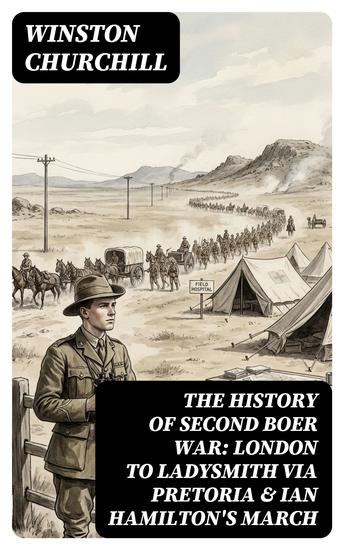
The History of Second Boer War: London to Ladysmith via Pretoria & Ian Hamilton's March - Enriched edition
Winston Churchill
Maison d'édition: DigiCat
Synopsis
In "The History of the Second Boer War: London to Ladysmith via Pretoria & Ian Hamilton's March," Winston Churchill provides a meticulous and personal exploration of the conflict that shaped South Africa and British imperial politics at the turn of the 20th century. Drawing from his own experiences as a war correspondent and soldier, Churchill's narrative is imbued with vivid descriptions, first-hand accounts, and a sense of immediacy that captures both the chaos of battle and the larger strategic maneuverings at play. His literary style is characterized by sharp insights and eloquent prose, offering a unique blend of journalism and historiography in a time when the British Empire was grappling with its methods of colonial governance and military engagement. Winston Churchill, a key historical figure and statesman, brought his rich background and personal investment in British imperial affairs to this work. His experiences in the Boer War, where he was both a soldier and a reporter, fueled his lifelong interest in military history and leadership. Churchill's observations during this conflict shaped not only his future policies but also reflected his complex views on empire and governance, imbuing his work with both authority and empathy. This book is an essential read for those interested in military history, colonial studies, and Churchill's own development as a leader. With its combination of historical analysis and personal narrative, readers will gain a deeper understanding of the Boer War's significance—both contemporaneously and in the context of Churchill's evolving political ideologies.

In this enriched edition, we have carefully created added value for your reading experience:
- A comprehensive Introduction outlines these selected works' unifying features, themes, or stylistic evolutions.
- A Historical Context section situates the works in their broader era—social currents, cultural trends, and key events that underpin their creation.
- A concise Synopsis (Selection) offers an accessible overview of the included texts, helping readers navigate plotlines and main ideas without revealing critical twists.
- A unified Analysis examines recurring motifs and stylistic hallmarks across the collection, tying the stories together while spotlighting the different work's strengths.
- Reflection questions inspire deeper contemplation of the author's overarching message, inviting readers to draw connections among different texts and relate them to modern contexts.
- Lastly, our hand‐picked Memorable Quotes distill pivotal lines and turning points, serving as touchstones for the collection's central themes.
Disponible depuis: 25/12/2023.
Longueur d'impression: 422 pages.