Begleiten Sie uns auf eine literarische Weltreise!
Buch zum Bücherregal hinzufügen
Grey
Einen neuen Kommentar schreiben Default profile 50px
Grey
Jetzt das ganze Buch im Abo oder die ersten Seiten gratis lesen!
All characters reduced
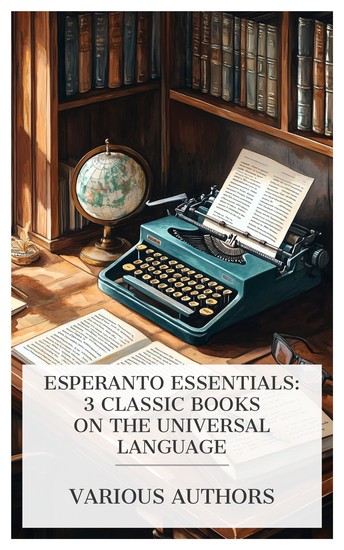
Esperanto Essentials: 3 Classic Books on the Universal Language - Esperanto Self-Taught with Phonetic Pronunciation Esperanto: Hearings before the Committee on Education etc - cover

Esperanto Essentials: 3 Classic Books on the Universal Language - Esperanto Self-Taught with Phonetic Pronunciation Esperanto: Hearings before the Committee on Education etc

William W. Mann, Walter John Clark, Richard Bartholdt, A. Christen

Verlag: e-artnow

  • 0
  • 0
  • 0

Beschreibung

Esperanto Essentials: 3 Classic Books on the Universal Language is a profound anthology that captures the essence and versatility of Esperanto through a diverse range of literary works. Delve into the core themes of universality, linguistic innovation, and cross-cultural communication that underscore this collection. Each piece, curated with precision, showcases varying literary styles that range from eloquent essays to pioneering linguistic discourses, painting a comprehensive picture of Esperanto's impact across literary landscapes. The anthology is a testament to the language's enduring significance and its role as a bridge in a world of diverse tongues. The erudite contributions of Richard Bartholdt, A. Christen, Walter John Clark, and William W. Mann form the backbone of this collection. These authors, through their unique lenses, have collectively enriched the dialogue surrounding Esperanto, embedding it within historical and cultural narratives. Their works reflect a commitment to the ideals behind the Esperanto movement, aligning with the broader 20th-century pursuit of global communication and understanding. The anthology leverages their diverse backgrounds to shed light on how Esperanto has been a beacon for unity in linguistic diversity. For readers eager to traverse the history and possibilities of a truly universal language, this anthology offers an invaluable exploration. It provides access to a rich tapestry of perspectives and styles that emphasize learning and understanding beyond cultural confines. Esperanto Essentials not only educates but also fosters a dialogue among the works, allowing readers to appreciate the literary and cultural richness of the Esperanto movement. Engaging with this collection invites readers into a global conversation, showcasing the transformative power of language in connecting humanity.
Verfügbar seit: 04.03.2025.
Drucklänge: 1044 Seiten.

Weitere Bücher, die Sie mögen werden

  • Days on the Road: Crossing the Plains in 1865 - cover

    Days on the Road: Crossing the...

    Sarah Raymond Herndon

    • 0
    • 0
    • 0
    Days on the Road is an autobiographical account of a young woman who traveled over the Great Plains toward the Rocky Mountains by wagon train with her mother and two younger brothers. Barely a month after the end of the Civil War, Sarah Raymond Herndonheaded westwith no certain idea of where to go but a strong desire to leave Missouri and start a new life in the West.
    Zum Buch
  • Meetings with Remarkable Men - cover

    Meetings with Remarkable Men

    G.I. Gurdjieff

    • 0
    • 0
    • 0
    G.I. Gurdjieff allows the reader in these narratives to become acquainted with a person that is up to this day to many, who have for instance read his "Beelzebub", still an enigma. You will meet a person, who is more often than not, as the esteemed Mulla Nassr Edin would say "into the deepest galoshes that have ever been worn on sweaty feet." In other words, you will meet G.I. Gurdjieff, the human being. The spiritual messages are hidden inside breathtaking adventures and a colorful description of really remarkable men and women and the time before and after the Russian Revolution.
    Zum Buch
  • Cracking the Genetic Code: Revolutionizing Our Future - "Revolutionize Your Future! Master genetic code insights with our dynamic audio lessons" - cover

    Cracking the Genetic Code:...

    Osric Wynter

    • 0
    • 0
    • 0
    Cracking the Genetic Code: Revolutionizing Our Future 
    ⭐⭐ Simplified Guide & Explanations Included ⭐⭐ 
    Are you aiming to advance your understanding of genetic advancements and how they are shaping our future? 
    Looking for a comprehensive guide that equips you with everything you need to grasp the complexities of genetic breakthroughs? 
    Your search ends here! 
    This audiobook is your ultimate companion for deepening your knowledge, applying new insights, and engaging with hands-on exercises. With this resource, you're set for success. 
    Updated for the Latest Genetic Discoveries 
    Key Features of this Enriched Guide: 
    - Profound insights about the impact of genetic code on our future 
    - Detailed explanations of genetic breakthroughs and their applications 
    - Effective strategies for understanding and leveraging these advancements 
    Our guide stands out with its comprehensive coverage, essential for mastering genetic concepts. We don't just skim the surface; we delve deep with precision. 
    Please note that this guide is not affiliated with any official genetic authority and is purely an independent resource for your benefit. 
    Designed with a clear structure and easy-to-understand language, our Genetic Code Guide ensures smooth transitions between topics. Say goodbye to dense jargon and welcome clear, precise, and technically accurate content. 
    So, why wait? Click the BUY NOW button, secure your guide, and embark on your journey to understanding the genetic breakthroughs that are revolutionizing our future!
    Zum Buch
  • Churchill's War - How Winston Churchill Led Britain through Its Darkest Hours - cover

    Churchill's War - How Winston...

    Sage Winters

    • 0
    • 0
    • 0
    Winston Churchill is remembered as one of history’s most formidable leaders, a man whose unwavering resolve and stirring oratory inspired a beleaguered nation to withstand its darkest hour. Rising to prominence during one of humanity’s most perilous times, Churchill’s leadership during World War II not only shaped the fate of Britain but left an indelible mark on the global landscape. His life and career encapsulate the qualities of resilience, vision, and adaptability that are crucial during moments of profound crisis.  
      
    Born into an aristocratic family in 1874, Churchill's early life was one of privilege, yet his path to greatness was anything but guaranteed. Despite academic struggles and initial failures, he demonstrated remarkable tenacity, carving out a career as a soldier, journalist, and eventually a politician. His varied experiences—whether charging on horseback in colonial campaigns or reporting from the frontlines—imbued him with a deep understanding of courage and strategy, traits that would serve him well in the years to come.  
      
    Churchill’s rise to the role of wartime Prime Minister was far from linear. By the late 1930s, his political career seemed to be in decline. His outspoken criticism of appeasement policies and his relentless warnings about Adolf Hitler’s ambitions rendered him an isolated figure, often dismissed as a relic of an earlier age. Yet, as Europe hurtled toward war, Churchill’s foresight and defiance became assets too valuable to ignore. In 1940, as Nazi Germany’s forces swept across the continent, Churchill was called upon to lead. 
    Zum Buch
  • Equal to Mystery: In Search of Harold Sonny Ladoo - cover

    Equal to Mystery: In Search of...

    Christopher Laird

    • 0
    • 0
    • 0
    When the Trinidadian novelist, Harold Sonny Ladoo was found dead soon after the publication of his classic novel, No Pain Like This Body, for Christopher Laird, it became an obsession to try to discover the writer behind the work and what had brought about his untimely end. Equal to Mystery – words written by Ladoo – is the record of that pursuit.
    
    When, as the editor of a Trinidadian literary journal in the radical years of the early 1970s, Christopher Laird was sent Harold Sonny Ladoo's novel, No Pain Like This Body (1973) to review, he knew he was looking at something revolutionary in Caribbean fiction. It is a novel that has recently been republished as a Penguin Modern Classic. But the next news Laird heard of Ladoo was that he had returned to Trinidad from Canada and had been found dead – very probably murdered – in the canefields outside his family's village of McBean. Laird follows in the path of Ladoo to Canada, where he went to make a name for himself as a writer, and tracks him as a student and young married man through conversations with his widow and other family members. He looks in detail at his relationships with two Canadian writers, Dennis Lee and Peter Such, who supported his work, and in Lee's case published him. Here there is an acute account of their meetings across the line of race, of the mix of generous contact and elusive flight in their relationship. Above all, with access to Ladoo's unpublished material -- short stories and fragments of the vast body of fiction he announced he was writing -- Laird offers acute analysis of what is there, honest bafflement about just what Ladoo was up to, with a tragic sense of the talent that was lost through his untimely death.
    Zum Buch
  • Empire of Pain: Book Summary & Analysis - cover

    Empire of Pain: Book Summary &...

    Alexander Pike

    • 0
    • 0
    • 0
    This content is an independent and unofficial summary created for informational and educational purposes only. It is not affiliated with, authorized, approved, licensed, or endorsed by the original author or publisher. All rights to the original work belong to its respective copyright holders. This summary is not intended to substitute the original book, but to offer a concise overview and interpretation of its main ideas. 
     
    A chilling journey through the corridors of power, Empire of Pain exposes the rise and fall of one of the most powerful families in American pharmaceutical history. At the heart of the opioid epidemic lies a dynasty that built an empire on pain—driven by ambition, protected by influence, and sustained by denial. 
    This gripping narrative unveils how a fortune was forged not just with innovation, but through manipulation of public trust, regulatory loopholes, and aggressive marketing. As addiction swept across the nation, the architects remained hidden behind boardroom walls and museum wings.
    Zum Buch