Rejoignez-nous pour un voyage dans le monde des livres!
Ajouter ce livre à l'électronique
Grey
Ecrivez un nouveau commentaire Default profile 50px
Grey
Abonnez-vous pour lire le livre complet ou lisez les premières pages gratuitement!
All characters reduced
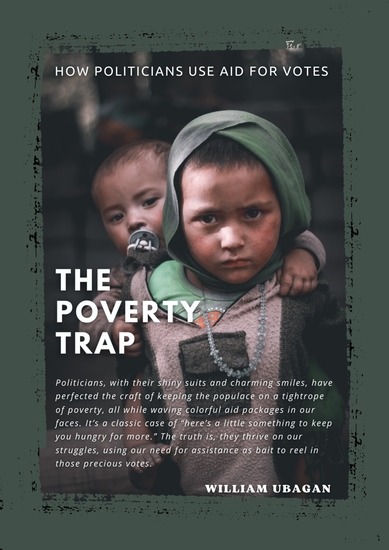
The Poverty Trap - How Politicians Use Aid for Votes - cover

The Poverty Trap - How Politicians Use Aid for Votes

William Ubagan

Maison d'édition: ZRK Book Shop

  • 0
  • 0
  • 0

Synopsis

In The Poverty Trap: How Politicians Use Aid for Votes, William Ubagan explores the dark side of political manipulation in aid distribution—unveiling how aid programs, intended to alleviate poverty and foster development, are often distorted to serve the personal and electoral ambitions of politicians. Through in-depth analysis, historical examples, and contemporary case studies, this book delves into the detrimental effects of aid dependency and highlights the need for reforms that prioritize empowerment, transparency, and sustainable growth. Offering a thought-provoking perspective, Ubagan challenges readers to rethink the relationship between aid and power, advocating for a future where aid truly serves its purpose of uplifting communities and fostering lasting change.
Disponible depuis: 17/01/2025.
Longueur d'impression: 123 pages.

D'autres livres qui pourraient vous intéresser

  • Tokugawa Shogunate - Peace Isolation and the Preservation of Samurai Culture - cover

    Tokugawa Shogunate - Peace...

    Rolf Hedger

    • 0
    • 0
    • 0
    The Tokugawa Shogunate, also known as the Edo period (1603–1868), was a time of unprecedented peace and stability in Japan, following centuries of war and political fragmentation. This era began with the victory of Tokugawa Ieyasu at the Battle of Sekigahara in 1600, a decisive conflict that allowed him to consolidate power over the warring daimyo. Three years later, in 1603, he was granted the title of shogun by the emperor, officially marking the beginning of Tokugawa rule. 
    Ieyasu’s triumph at Sekigahara was not merely a military success but also a demonstration of his strategic brilliance and political foresight. By carefully forging alliances and exploiting rivalries among the daimyo, he ensured that his Tokugawa clan would emerge as the dominant force in Japan. Once in power, Ieyasu took immediate steps to secure his family’s hold over the nation. He redistributed land among the daimyo, rewarding loyal vassals and weakening potential threats. This reorganization of landholdings laid the foundation for the centralized feudal system that would define the Tokugawa era. 
    Although Ieyasu formally retired in 1605, passing the title of shogun to his son Tokugawa Hidetada, he continued to wield significant influence from behind the scenes. His retirement was a strategic move designed to solidify the legitimacy of hereditary succession, ensuring that the Tokugawa family would maintain control for generations. This transition of power set a precedent for stability, preventing the kind of succession disputes that had plagued previous shogunates.
    Voir livre
  • Wide Sargasso Sea by Jean Rhys (Book Analysis) - Detailed Summary Analysis and Reading Guide - cover

    Wide Sargasso Sea by Jean Rhys...

    Bright Summaries

    • 0
    • 0
    • 0
    Unlock the more straightforward side of Wide Sargasso Sea with this concise and insightful summary and analysis!
    This engaging summary presents an analysis of Wide Sargasso Sea by Jean Rhys, which was inspired by Charlotte Brontë's Jane Eyre and tells the story of the most frequently overlooked character in that novel: Bertha Mason, the infamous "madwoman in the attic". Rhys's novel takes the reader back to Bertha's childhood in the Caribbean, when she was known by the name Antoinette Cosway, and explores how her status as an outcast, her unhappy marriage and the pernicious influence of rumour and slander eventually transform her from a quiet child into the deranged character from Brontë's novel. Wide Sargasso Sea was the last novel published by Jean Rhys prior to her death in 1979, and is generally considered her masterpiece. It was also partially influenced by Rhys's own childhood in the Caribbean.
    Find out everything you need to know about Wide Sargasso Sea in a fraction of the time!
    This in-depth and informative reading guide brings you:
    •A complete plot summary
    •Character studies
    •Key themes and symbols
    •Questions for further reflection
    Why choose BrightSummaries.com?
    Available in print and digital format, our publications are designed to accompany you on your reading journey. The clear and concise style makes for easy understanding, providing the perfect opportunity to improve your literary knowledge in no time.
    See the very best of literature in a whole new light with BrightSummaries.com!
    Voir livre
  • Light and Legacies - Stories of Black Girlhood and Liberation - cover

    Light and Legacies - Stories of...

    Janaka Bowman Lewis

    • 0
    • 0
    • 0
    An engaging examination of Black Girl Magic and its significance in American literature 


    In Light and Legacies, author Janaka Bowman Lewis examines Black girlhood in American literature from the mid-twentieth century to the present. The representation of Black girlhood in contemporary literature has long remained underexplored. Through this literary history of "Black Girl Magic," Lewis offers one of the first studies in this rapidly growing field of study. Light and Legacies poignantly showcases the activist dimensions of creative literature through work by women writers such as Toni Morrison and Toni Cade. As vectors of protest, these stories reflect historical events while also creating an enduring space of liberation and expression. The book provides didactic and reflective portrayals of the Black experience—an experience that has long been misunderstood. In a work both enlightening and personal, Lewis brilliantly weaves accounts of her own journey together with the liberating stories that shaped her and so many others.
    Voir livre
  • Transform Your Body: Secrets to Unlocking Vitality and Health - "Elevate your fitness goals with dynamic audio insights for optimal vitality and health transformation!" - cover

    Transform Your Body: Secrets to...

    Cyrus Valemont

    • 0
    • 0
    • 0
    Transform Your Body: Secrets to Unlocking Vitality and Health 
    Are you ready to enhance your well-being and discover the secrets to a healthier, more vibrant life? 
    If you’re in search of a thorough and practical guide to help you navigate this transformative journey, your quest ends here! 
    This audiobook is your ultimate companion for enriching your understanding of your body, applying effective practices, and engaging in transformative exercises. With this resource, you are set on the path to revitalization. 
    Key features of this insightful guide include: 
    - In-depth insights on unlocking your body’s full potential 
    - Clear explanations of the principles of health and vitality 
    - Effective strategies for a successful transformation 
    What sets this guide apart is its thorough approach, which is crucial for achieving your health goals. Concepts are explored in detail, ensuring a comprehensive understanding. 
    Please note that this guide is an independent resource and not affiliated with any official health organization. 
    Crafted with a straightforward structure and accessible language, our guide guarantees seamless transitions between topics. Say goodbye to complex jargon and embrace clear, precise, and accurate information. 
    So, why hesitate? Click the BUY NOW button, secure your audioguide, and embark on your journey to unlocking the secrets of your body and embracing life to the fullest!
    Voir livre
  • Rome's Greatest Generals - Leaders Who Shaped the Empire - cover

    Rome's Greatest Generals -...

    Rogan Fish

    • 0
    • 0
    • 0
    The rise of the Roman general was a gradual yet transformative process that shaped the very foundation of Rome’s military might. In the early days of the Roman Republic, military leadership was closely intertwined with social status and political influence. Unlike later periods where generals held almost absolute power, early Roman commanders were often aristocrats or elected officials whose primary duties lay not only in warfare but also in governance and civil administration. 
    One of the pivotal aspects that shaped the rise of the Roman general was the evolution of military traditions. Initially, Rome’s military structure was heavily influenced by the Etruscans and other neighboring cultures. Early Roman armies were comprised of citizen-soldiers who fought primarily to protect their homeland rather than for conquest. Generals were typically chosen from the patrician class, and their leadership was seen as both a duty and an honor. As Rome expanded, the need for a more organized and strategic military became apparent, leading to the emergence of commanders who were not just noblemen but skilled tacticians. 
    The social and political influences on the role of the general were significant. During the Republic, the Senate played a crucial role in appointing generals, often selecting consuls or appointed military tribunes. These leaders were expected to exemplify Roman virtues such as bravery, discipline, and piety. The successes of early generals not only brought personal glory but also bolstered their political careers. Victorious commanders could parlay their military achievements into political power, as evidenced by figures like Scipio Africanus, who leveraged his triumphs against Carthage to gain influence within the Senate.
    Voir livre
  • Essays: First Series Intellect - cover

    Essays: First Series Intellect

    Ralph Waldo Emerson

    • 0
    • 0
    • 0
    Intellect is not a possession but a force—fluid, expansive, untamed. It cannot be hoarded, nor can it be caged within doctrine or tradition. In Intellect, Ralph Waldo Emerson urges us to see thought as a living current, not a stagnant pool. True understanding, he suggests, is not about collecting knowledge but about breaking through to deeper insight, where intuition leads and logic follows.
    Emerson's vision of the mind defies confinement. He challenges the idea that intelligence is something fixed, something to be measured or owned. Instead, he sees it as a ceaseless motion, a self-renewing energy that thrives on boldness and independence. To think freely is to embrace the unknown, to risk uncertainty in pursuit of wisdom.
    Part of Essays: First Series, Intellect is a call to let go of borrowed opinions and trust the mind's own unfolding. It is not a guidebook, not a doctrine—it is an invitation to intellectual courage. To read it is to reconsider not only what we think but how we think.
    Voir livre