Rejoignez-nous pour un voyage dans le monde des livres!
Ajouter ce livre à l'électronique
Grey
Ecrivez un nouveau commentaire Default profile 50px
Grey
Abonnez-vous pour lire le livre complet ou lisez les premières pages gratuitement!
All characters reduced
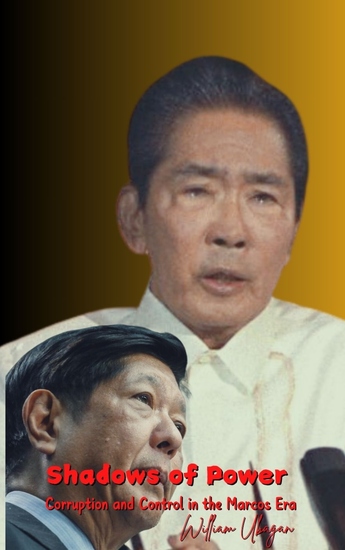
Shadows of Power - Corruption and Control in the Marcos Era - cover

Shadows of Power - Corruption and Control in the Marcos Era

William Ubagan

Maison d'édition: ZRK Book Shop

  • 0
  • 0
  • 0

Synopsis

Shadows of Power: Corruption and Control in the Marcos Era is an incisive exploration of one of the most turbulent periods in Philippine history. Author William Ubagan delves into the mechanisms of control and the depths of corruption that characterized the Marcos regime, unraveling how power was wielded to suppress opposition, manipulate public perception, and entrench an authoritarian rule.
 
Through extensive research and first-hand accounts, this book examines the political strategies, economic maneuvers, and social impacts of the era, offering readers a clear picture of how an entire nation was shaped by a single family's hold on power. Shadows of Power not only tells the story of a dark chapter in the Philippines but also serves as a warning about the vulnerabilities of any democracy.
 
A compelling read for history enthusiasts, political analysts, and anyone interested in the universal struggle for freedom and justice, Shadows of Power is a sobering reminder of the resilience required to protect human rights and maintain democratic principles.
Disponible depuis: 11/11/2024.
Longueur d'impression: 136 pages.

D'autres livres qui pourraient vous intéresser

  • Democratic Delusions - How the Media Hollows Out Democracy and What We Can Do About It 1st Edition - cover

    Democratic Delusions - How the...

    Natalie Fenton

    • 0
    • 0
    • 0
    A free media is inextricably linked to a healthy democracy, but in many parts of the world liberal democracies are deemed to be dying or on the demise—a demise that many forms of media have enabled while heralding themselves as democracy's savior. The hollowing out of democracy in these ways has left many people questioning the value of (neo)liberal democratic societies. What can we do about it? 


    Democratic Delusions explores the potential of our media and tech systems to be democratic and contribute to a just and transformative democracy. This is only possible, Natalie Fenton argues, by first situating our political systems and mediated worlds within global capitalism. By interrogating different media and their relationship to seven key elements of democracy—power, participation, freedom, equality, public good, trust, and hope—the book asks: What is the response of society when the ability of news media to speak truth to power has been restricted by corporate logic? And, how do we tackle a deep-rooted market logic that shifts public debate towards private interest and marginalizes progressive perspectives? The book explores how these elements can be reimagined through newly conceived media and tech landscapes and, ultimately, what democracy might be in a future mediated world that places more power in the hands of more people.
    Voir livre
  • Who Really Owns Ireland - How we became tenants in our own land - and what we can do about it - cover

    Who Really Owns Ireland - How we...

    Matt Cooper

    • 0
    • 0
    • 0
    Through centuries of oppression, we were tenants in our own land.
    Today, despite our independence and new-found affluence, we are in the midst of a crisis.
    The question of who owns Ireland is once again taking on a sense of urgency. Is the land of Ireland still for the people of Ireland?
    In a deep and far-reaching investigation, journalist, broadcaster and No. 1 bestselling author Matt Cooper examines the power wielded by those who control the land where we live, work and play. Who are they, how did they acquire so much and what does it mean for ordinary citizens when the ownership of key resources like shopping centres, wind farms, forestry and data centres comes from outside?
    This is a story about how power and money influence and control the present and the future of Ireland … sometimes for good and sometimes for bad. Filled with riveting detail, this compelling story of who really owns Ireland is an essential account of the issues that affect every single one of us living on this island.
    Voir livre
  • Gun Curious - A Liberal Professor's Surprising Journey Inside America's Gun Culture - cover

    Gun Curious - A Liberal...

    David Yamane

    • 0
    • 0
    • 0
    More than ever, it feels like cultural and political divisions over firearms are tearing the United States apart. Guns are an undeniable and contradictory presence in America, both widely owned and controversial. This book does something remarkable: it promotes insight over animosity in understanding the complex reality of guns in America. It challenges firearms skeptics, entertains enthusiasts, and informs the uncommitted by taking readers on a surprising journey inside gun culture. 
    A lifelong liberal from the San Francisco Bay Area, David Yamane became a new gun owner as a 42-year-old and embarked on an immersive twelve-year study of American gun culture. Weaving together his personal experiences and sociological observations to explain why guns make sense to those who own them, he illuminates defensive gun ownership, the risk of negative outcomes associated with firearms, and what responsible gun ownership looks like in the twenty-first century. This book lowers the heat on America’s inflamed arguments about firearms and models the civil discussions we desperately need.
    Voir livre
  • Anarchy in Action - Case Studies of Anarchist Experiments and Their Outcomes - cover

    Anarchy in Action - Case Studies...

    Arlo Holders

    • 0
    • 0
    • 0
    Anarchism is often misunderstood and misrepresented, seen by many as synonymous with chaos and disorder. However, anarchism is a diverse and complex political philosophy that seeks to create a society free from oppressive hierarchies, such as the state, capitalism, and institutionalized authority. At its core, anarchism advocates for the dismantling of centralized power structures and the establishment of self-governed, voluntary communities based on mutual aid, solidarity, and direct action. Anarchists believe that individuals should have the freedom to organize their lives and work collectively without the interference of coercive institutions. 
    The history of anarchism traces back to the early 19th century, with influential thinkers such as Pierre-Joseph Proudhon, Mikhail Bakunin, and Peter Kropotkin shaping its development. Proudhon is often credited with coining the term “anarchy,” which he defined as “order without power.” Bakunin, one of the most prominent anarchist figures, argued that the state inherently oppresses the individual and stifles freedom, calling for a revolutionary transformation that would replace governmental authority with voluntary associations. Kropotkin, another major figure, emphasized the importance of mutual aid and cooperation, asserting that human beings are naturally inclined to work together for the common good, rather than being solely driven by competition and self-interest.
    Voir livre
  • The Politically Incorrect Guide to the Supreme Court - cover

    The Politically Incorrect Guide...

    John Yoo, Robert Delahunty

    • 0
    • 0
    • 0
    Guaranteed to give the reader a deeper understanding of America’s most powerful judicial body, John Yoo, professor of law at UC Berkeley, and Robert Delahunty, professor of law at the University of St. Thomas detail in sprightly, slightly irreverent manner how the black robed judges who make up the U.S. Supreme Court have swung like a pendulum from saviors of the Republic to super-legislators who usurp the roll of Congress and dictate law from the bench, back to defenders of the Constitution again—or at least for the moment.
    Voir livre
  • How Not to Be a Political Wife: INSTANT SUNDAY TIMES BESTSELLER - cover

    How Not to Be a Political Wife:...

    Sarah Vine

    • 0
    • 0
    • 0
    ‘You think you’ve married a journalist, then, horrors, he becomes a politician.' 
    'Sarah Vine is the Bridget Jones of politics.' Plum Sykes 
    'Everyone in Westminster is talking about it.' The London Standard 
    'I take it all back; she's fabulous. Nobody in Westminster can afford not to buy this book.' Rachel Johnson 
    ‘Moving and heartfelt – what a journey. I’m amazed she’s still standing.’ Imogen Edwards-Jones 
    How Not to Be a Political Wife is an unflinching account of life at the heart of politics, and what it's like to have politics rip the heart out of your life. It’s a story of high hopes and dirty tricks, broken friendships and divided loyalties, laughter and glamour. 
    Recollections, as a great woman once said, may of course vary, but this is my story, the way I remember it, written with no fear, no favour – and no fucks left to give. 
    Buckle up. 
    I thought long and hard about writing this memoir. I’ve done so not to settle old scores or plead my case, but more because I hope it’s a tale worth telling, not just for those who are interested in the political events of the past few years, but also because it’s about the people and characters behind those events, and why things ended up the way they did. 
    For nearly 20 years I was inside the rooms of government, a sanctioned eavesdropper on the rise – and fall – of the Cameroon style of Conservatism. At the same time I was building a career in journalism, raising two children and doing my best to support my own husband, Michael Gove, on his political journey. I was both an insider and an outsider; an observer – via my journalism – as well as a participant in the cut and thrust (mainly cut, if I’m honest) of frontline politics. 
    After my divorce from Michael and the demise of the Conservatives’ Old Guard, that all came to an end. I’m no longer officially a Westminster WAG, but you won’t find me mourning. Politics trampled my health, my happiness, my marriage, my sanity; it placed intolerable pressure on my loved ones, especially my children; it twisted my sense of self, and others’ sense of me; it tainted everything I did or said. I can’t say I miss it. I do, however, miss the life and the relationships I had before it all. These are the recollections of a survivor, but they are also a love letter to all that was lost in the wreck. 
    In her latest memoir, Sarah Vine, the Sunday Times bestselling author, gives us an insider's view of the political process. This is not just a biography, but a story of campaigns, elections, and the personal toll they take. 
    nan 
    HarperCollins 2025
    Voir livre