Begleiten Sie uns auf eine literarische Weltreise!
Buch zum Bücherregal hinzufügen
Grey
Einen neuen Kommentar schreiben Default profile 50px
Grey
Jetzt das ganze Buch im Abo oder die ersten Seiten gratis lesen!
All characters reduced
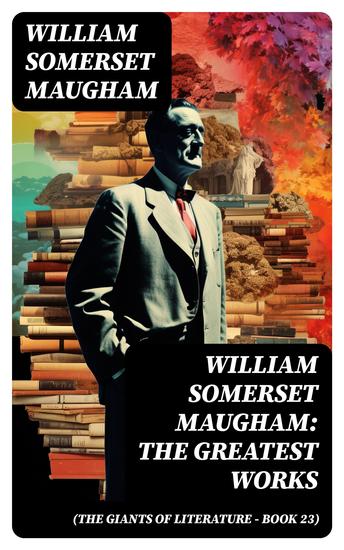
William Somerset Maugham: The Greatest Works (The Giants of Literature - Book 23) - cover

William Somerset Maugham: The Greatest Works (The Giants of Literature - Book 23)

William Somerset Maugham

Verlag: DigiCat

  • 0
  • 0
  • 0

Beschreibung

In "William Somerset Maugham: The Greatest Works", readers are invited into the intricate and nuanced world crafted by one of the most significant literary figures of the 20th century. This anthology brings together Maugham's most acclaimed works, showcasing his distinctive style characterized by terse yet poignant prose and rich character development. Set against the backdrop of the evolving societal norms of the early 1900s, the book offers profound insights into human nature, exploring themes of love, betrayal, and existential angst, all enveloped in Maugham's perceptive wit and keen observations of the human condition. William Somerset Maugham's life was marked by a diverse tapestry of experiences that enriched his writing. Born to a British family in Paris, he endured a challenging childhood, which instilled in him a profound understanding of displacement and belonging. This personal journey, coupled with his extensive travels and varied career as a playwright and novelist, has greatly informed his literary works, allowing him to delve into the intricacies of human emotions and societal expectations with unparalleled depth. This collection is essential for both seasoned readers of Maugham and newcomers alike. It not only showcases Maugham's brilliance as a storyteller but also cements his legacy in the realm of literature. Engaging and thought-provoking, this anthology invites readers to reflect on their own lives through Maugham's exploration of universal themes, making it a compelling addition to any literary library.
Verfügbar seit: 25.11.2023.
Drucklänge: 4364 Seiten.

Weitere Bücher, die Sie mögen werden

  • Bobok - From their pens to your ears genius in every story - cover

    Bobok - From their pens to your...

    Fyodor Dostoyevsky

    • 0
    • 0
    • 0
    Fyodor Mikhailovich Dostoyevsky was born in Moscow on 11th November, 1821 to distinguished multi-ethnic parents from a Lithuanian background.  
    His childhood years were at the family home in hospital grounds which also contained an orphanage, an insane asylum and a cemetery for criminals.  The young Fyodor often disobeyed his father by talking to the ill in the hospital gardens.   
    His health was compromised at age 9 when he experienced his first epileptic fit. By the time he was a teenager both parents had died and he was now enrolled in a military academy where he graduated and eventually became a Lieutenant in 1842.  He left military service the next year. 
    In 1846 he published his first novel ‘Poor Cow’ to great literary acclaim.  His next was unable to emulate that success but his short stories helped provide an income.  Life as an author was definitely difficult. As he began his next work he was arrested and incarcerated for treason and participation in the political and literary Petrashevsky Circle. Although the case was weak and unjustified he was sentenced to 4 years of hard labour followed by 5 years of military service in a Siberian regiment.  
    Despite the undoubted hardships and setbacks in his life, and whether they helped or hindered his writing, his talents produced many exceptional works of literature including ‘Crime and Punishment’, ‘The Idiot’ and ‘The Brothers Karamazov’.   
    Dostoevsky’s ability to get under the skin of his characters and show the inner workings of their mind was hugely influential and ahead of its time.  Interwoven with this was the influence of the broader social, spiritual and political forces at work in a person's psyche.   
    Fyodor Dostoevsky struggled financially and remained in poor health for much of his adult life.  He died from a lung haemorrhage on 9th February, 1881.
    Zum Buch
  • God Sees the Truth But Waits - From their pens to your ears genius in every story - cover

    God Sees the Truth But Waits -...

    Leo Tolstoy

    • 0
    • 0
    • 0
    Leo Tolstoy was born in 1828 in the Russian province of Tula to a wealthy noble family. As a child, he had private tutors but he showed little interest in any formal education. When he went to the University of Kazan in 1843 to study oriental languages and law, he left without completing his courses.  Life now was relaxed and idle but with some writing also taking place.  Gambling debts forced an abrupt change of path and he joined the army to fight in the Crimean War.  He was commended for his bravery and promoted but was appalled at the brutality and loss of life.  He recorded these and other earlier experiences in his diaries which formed the basis of several of his works. 
    In 1852 ‘Childhood’ was published to immediate success and was followed by ‘Boyhood’ and ‘Youth’. 
    His experience in the army and the horrors he witnessed resulted in ‘The Cossacks’ in 1862 and the trilogy ‘Sevastopol Tales’. After the war he travelled around Europe, visiting London and Paris and meeting such luminaries as Victor Hugo and Charles Darwin.  
    It was now that Tolstoy began his masterpiece, ‘War and Peace’. Published in 1869 it was an epic work that changed literature. He quickly followed this with ‘Anna Karenina’.  
    These successes made Tolstoy rich and helped him accomplish many of his dreams but also brought problems as he grappled with his faith and the lot of the oppressed poor. These revolutionary views became so popular that the authorities now kept him under surveillance.  
    He led a life of asceticism and vegetarianism and put his socialist ideals into practice by establishing numerous schools for the poor and food programmes. He also believed in giving away his wealth, which caused much discord with his wife.  
    His writing continued to bring forth classics such as ‘The Death of Ivan Ilyich’ and many brilliant and incisive short stories such as ‘How Much Land Does A Man Need’.  
    In 1901 Tolstoy was excommunicated from the Church and controversially deselected for the Nobel Prize for Literature. 
    Whilst undertaking a pilgrimage by train in October 1910 with his daughter Aleksandra he caught pneumonia in the nearby town of Astapovo.  Leo Tolstoy died on November 9th, 1910, he was 82.
    Zum Buch
  • The Art Of Money Getting - cover

    The Art Of Money Getting

    P. T. Barnum

    • 0
    • 0
    • 0
    The Art of Money Getting was written by P. T. Barnum, who is widely known as an important historical entrepreneur as founder of the famous traveling circus, but in this publication, Barnum shares his knowledge of business and teaches readers how to be successful in making money. This is an excellent book for individuals who are interested in learning from an important historical business leader's own personal success and also serves as an excellent motivational writing intended for those looking to be successful and make lots of money.Phineas Taylor Barnum was an American showman, businessman, and politician remembered for promoting celebrated hoaxes and founding the Barnum & Bailey Circus with James Anthony Bailey.
    Zum Buch
  • The Cenci - cover

    The Cenci

    Alexandre Dumas

    • 0
    • 0
    • 0
    "The Cenci" by Alexandre Dumas is a tragic and haunting tale of abuse, revenge, and justice set in 16th-century Italy. The story follows the Cenci family, particularly Beatrice Cenci, who endures the tyrannical cruelty of her father, Count Francesco Cenci. Pushed to their limits, the family conspires to murder him, seeking freedom from his oppression. Dumas masterfully explores themes of morality, corruption, and the consequences of vengeance, painting a vivid picture of a society rife with hypocrisy and injustice. Beatrice’s plight becomes a powerful symbol of resistance against tyranny. A blend of historical drama and emotional intensity, this work reflects the timeless struggle between power and innocence, leaving readers to ponder the true meaning of justice.
    Zum Buch
  • The Memoirs of Sherlock Holmes - cover

    The Memoirs of Sherlock Holmes

    Arthur Conan Doyle

    • 0
    • 0
    • 0
    Step into the world of deduction with The Memoirs of Sherlock Holmes by Arthur Conan Doyle, an audiobook collection that brings together some of Sherlock Holmes’ most thrilling cases. In this gripping series of short stories, listeners follow the legendary detective and his loyal companion, Dr. John Watson, as they confront baffling mysteries, treacherous villains, and complex puzzles. From the sinister case of "The Adventure of the Musgrave Ritual" to the chilling "The Adventure of the Final Problem," where Holmes faces his arch-nemesis, Professor Moriarty, each story showcases Holmes’ brilliant mind and unyielding pursuit of justice. 
    This audiobook takes listeners deeper into Holmes’ world, revealing more about the detective’s methods, relationships, and adventures. As Holmes unravels each mystery with sharp wit and unparalleled observation, the tension and excitement build to a thrilling climax that keeps audiences on the edge of their seats. 
    Narrated with precision and engaging energy, The Memoirs of Sherlock Holmes is perfect for both longtime fans of Sherlock Holmes and newcomers to Doyle’s captivating storytelling. The collection is filled with unforgettable moments, clever twists, and the timeless charm of one of literature’s most iconic detectives. 
    Start Listening to The Memoirs of Sherlock Holmes today and experience the genius of Sherlock Holmes as he tackles some of his most memorable cases!
    Zum Buch
  • Billy Budd - cover

    Billy Budd

    Herman Melville

    • 0
    • 0
    • 0
    "Billy Budd" is a novella written by Herman Melville, completed shortly before his death in 1891. It tells the story of Billy Budd, a handsome and popular sailor who becomes embroiled in a conflict with his ship's master-at-arms, John Claggart, on board a British naval vessel during the late 18th century. The novella explores themes of innocence, morality, justice, and the inherent conflict between good and evil. 
     
    The narrative centers around the character of Billy Budd, a young and virtuous sailor admired by his peers for his exceptional charm and simplicity. However, his life takes a dramatic turn when he is falsely accused of inciting mutiny by Claggart, a malevolent and envious officer. The novella delves into the psychological dynamics between the two characters and the moral dilemmas faced by the ship's captain, Captain Vere, as he grapples with the decision of how to handle the situation. 
     
    "Billy Budd" explores the clash between absolute goodness and institutional authority, with Melville examining the complexities and ambiguities of human nature. The novella raises profound questions about the nature of justice, the corrupting influence of power, and the struggle to maintain one's moral integrity in a society driven by hierarchy and oppression. 
     
    Melville's writing in "Billy Budd" is characterized by his rich prose, nuanced characterization, and philosophical inquiries. The novella incorporates nautical terminology and imagery, drawing on Melville's own experiences as a sailor, and employs a multi-layered narrative that invites readers to contemplate deeper moral and existential questions.
    Zum Buch