Begleiten Sie uns auf eine literarische Weltreise!
Buch zum Bücherregal hinzufügen
Grey
Einen neuen Kommentar schreiben Default profile 50px
Grey
Jetzt das ganze Buch im Abo oder die ersten Seiten gratis lesen!
All characters reduced
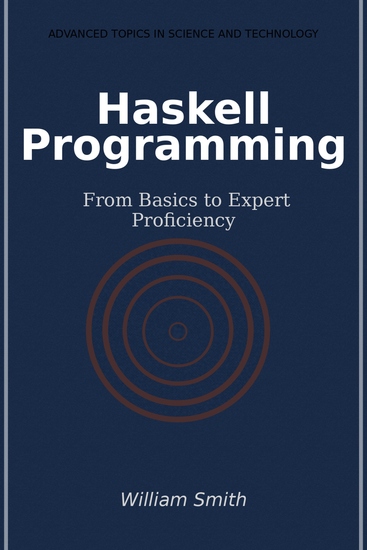
Haskell Programming - From Basics to Expert Proficiency - cover

Haskell Programming - From Basics to Expert Proficiency

William Smith

Verlag: HiTeX Press

  • 0
  • 0
  • 0

Beschreibung

"Haskell Programming: From Basics to Expert Proficiency" is an authoritative guide that takes readers on a comprehensive journey through the Haskell programming language. Designed for both beginners and experienced developers, this book lays a solid foundation by elucidating the core concepts of Haskell, including its unique syntax, functional programming paradigm, and powerful type system. Each chapter builds on the previous one, ensuring a smooth progression from fundamental principles to advanced topics, making the learning experience both effective and engaging.
 
The book delves deep into the intricacies of Haskell, covering essential topics such as functions, recursion, types and type classes, higher-order functions, and modular programming. Readers will gain a profound understanding of data handling, input and output operations, and the powerful abstractions offered by monads and functors. Additionally, the book explores advanced data structures and practical examples, equipping readers with the knowledge and skills needed to leverage Haskell's capabilities for creating robust, efficient, and maintainable software. "Haskell Programming" is not just a textbook but a comprehensive resource that fosters a deep appreciation of Haskell's elegance and power.
Verfügbar seit: 26.07.2024.
Drucklänge: 267 Seiten.

Weitere Bücher, die Sie mögen werden

  • Fundamentals of Machine Learning - A no code no math book on understanding fundamentals of modern ML & AI - cover

    Fundamentals of Machine Learning...

    DSA Shots

    • 0
    • 0
    • 0
    Welcome to "Fundamentals of Machine Learning"! This comprehensive guide is designed to provide an introduction to the fascinating world of machine learning and artificial intelligence. Whether you're a seasoned programmer or just starting out, this book will take you on a journey through the fundamentals of these technologies and their applications in various industries. 
    Artificial Intelligence (AI) has been a buzzword for years, but what does it really mean? In simple terms, AI refers to any software that can perform tasks that typically require human intelligence, such as visual perception, speech recognition, decision-making, and language translation. Machine learning is a subset of AI that focuses on developing algorithms and statistical models that enable computers to learn from data without being explicitly programmed. 
    This book will cover the following topics: 
    * Introduction to Artificial Intelligence and Machine Learning 
    * Differences Between Classical Programming and Artificial Intelligence 
    * Machine Learning Models and their Types (Supervised, Unsupervised, and Reinforcement Learning) 
    * Deep Learning Techniques and Large Language Models (LLMs) 
    * Applications of Machine Learning in various industries such as Healthcare, Finance, Marketing, and more. 
    By the end of this book, you will have a solid understanding of the fundamentals of machine learning and artificial intelligence, and how they can be applied to real-world scenarios. Whether you're looking to start a career in this field or simply want to learn more about it, this book is an excellent starting point for your journey. So, let's get started!
    Zum Buch
  • The Spike - An Epic Journey Through the Brain in 21 Seconds - cover

    The Spike - An Epic Journey...

    Anonym

    • 0
    • 0
    • 0
    This audiobook narrated by Anand Jagatia tells the extraordinary story of a neural impulse and what it reveals about how our brains work
    
    We see the last cookie in the box and think, can I take that? We reach a hand out. In the 2.1 seconds that this impulse travels through our brain, billions of neurons communicate with one another, sending blips of voltage through our sensory and motor regions. Neuroscientists call these blips "spikes." Spikes enable us to do everything: talk, eat, run, see, plan, and decide. In The Spike, Mark Humphries takes readers on the epic journey of a spike through a single, brief reaction. In vivid language, Humphries tells the story of what happens in our brain, what we know about spikes, and what we still have left to understand about them.
    
    Drawing on decades of research in neuroscience, Humphries explores how spikes are born, how they are transmitted, and how they lead us to action. He dives into previously unanswered mysteries: Why are most neurons silent? What causes neurons to fire spikes spontaneously, without input from other neurons or the outside world? Why do most spikes fail to reach any destination? Humphries presents a new vision of the brain, one where fundamental computations are carried out by spontaneous spikes that predict what will happen in the world, helping us to perceive, decide, and react quickly enough for our survival.
    
    Traversing neuroscience's expansive terrain, The Spike follows a single electrical response to illuminate how our extraordinary brains work.
    Zum Buch
  • A Country of Two Agricultures - cover

    A Country of Two Agricultures

    Wandile Sihlobo

    • 0
    • 0
    • 0
    Nearly three decades after the dawn of democracy, South Africa has remained a country of 'two agricultures'. On the one hand we have a subsistence, primarily non-commercial, black farming segment. On the other hand, however, we have a predominantly commercial and white farming sector that is well-resourced and has access to domestic and international trade networks.
    These disparities can be traced back to South Africa's painful history where, for decades, black farmers were on the margins of government support and also experienced land dispossession and livestock plunder.
    A Country of Two Agricultures focuses less on history and more on the present and the future, explaining why these disparities have persisted in the democratic era, and what it will take to overcome them. It aims to contribute to a better understanding of the variety of agricultural forces, taking into account both questions of domestic political economy and external factors, as well as to bring to light new risks and opportunities.
    Wandile Sihlobo offers insights into the role of agriculture in the South African economy from an agricultural economy perspective, and provides political economy insights that are rooted in the experiences of farming communities on the ground and right through the value chain.
    Beyond insights on the realities this book offers the government, the private sector, and anyone interested in the betterment of the South African economy, tools to grapple with this duality, and proposes a framework for bolstering the black farming segment for growth and competitiveness – and ultimately food security.
    Wandile Sihlobo is the Chief Economist of the Agricultural Business Chamber of South Africa (Agbiz) and the author of Finding Common Ground: Land, Equity and Agriculture.
    Zum Buch
  • Sleep hypnosis for healthy eating habits - A guided meditation - DST Hypno with Stu Newman - cover

    Sleep hypnosis for healthy...

    Stuart Newman

    • 0
    • 0
    • 0
    Eating is one of the quickest ways to comfort ourselves, but many comfort foods are low in nutrients and leave us wanting more. 
    Certain foods leave you wanting more, such as doughnuts, because they are high in calories, but contain hardly any nutrients. Instead, choose foods that are rich sources of nutrients without being high in fat or calories. 
    Fruits, vegetables, beans, legumes, herbs, spices, whole grains, nuts, seeds, lean meat, fish, eggs, tofu and pulses, olive oil, olives and avocadosTo support good health and immunity, you should aim to eat at least 30 different plant foods a week along with repeated use of your favourite guided hypnosis session.
    Zum Buch
  • Shopping All the Way to the Woods - How the Outdoor Industry Sold Nature to America - cover

    Shopping All the Way to the...

    Rachel S. Gross

    • 0
    • 0
    • 0
    A fascinating history of the profitable paradox of the American outdoor experience: visiting nature first requires shopping 


    No escape to nature is complete without a trip to an outdoor recreational store or a browse through online offerings. This is the irony of the American outdoor experience: visiting wild spaces supposedly untouched by capitalism first requires shopping. With consumers spending billions of dollars on clothing and equipment each year as they seek out nature, the American outdoor sector grew over the past 150 years from a small collection of outfitters to an industry contributing more than 2 percent of the nation's economic output. 


    Rachel S. Gross argues that this success was predicated not just on creating functional equipment but also on selling an authentic, anticommercial outdoor identity. In other words, shopping for the woods was also about being—or becoming—the right kind of person. Demonstrating that outdoor culture is commercial culture, Gross examines Americans' journey toward outdoor expertise by tracing the development of the nascent outdoor goods industry, the influence of World War II on its growth, and the boom years of outdoor businesses.
    Zum Buch
  • The Unity of Science - Exploring Our Universe from the Big Bang to the Twenty-First Century - cover

    The Unity of Science - Exploring...

    Irwin Shapiro

    • 0
    • 0
    • 0
    A journey guided by science that explores the universe, the earth, and the story of life 


    For Irwin Shapiro, science starts with questions. This book provides a broad and entertaining survey of major scientific discoveries that have changed our views of nature and, in turn, spawned further questions. 


    Shapiro, an award-winning scientist and beloved teacher, separates his inquiry into three parts: looking up at the universe; looking down at the earth and its fossils; and looking in at the story of life. His framework encourages listeners to view science as a detective story—to observe and question nature and natural phenomena, and to base all conclusions on scientific evidence. 


    With his knowledgeable yet conversational approach, Shapiro offers an enjoyable way for the curious to learn about the foundations of a range of scientific topics: the motions of bodies in the cosmos, the history and structure of the earth, the evolution of organisms, and the search for extraterrestrial life and intelligence.
    Zum Buch