Rejoignez-nous pour un voyage dans le monde des livres!
Ajouter ce livre à l'électronique
Grey
Ecrivez un nouveau commentaire Default profile 50px
Grey
Abonnez-vous pour lire le livre complet ou lisez les premières pages gratuitement!
All characters reduced
The Tragedy of Julius Caesar or The Tragedie of Ivlivs Cæsar - cover

The Tragedy of Julius Caesar or The Tragedie of Ivlivs Cæsar

William Shakespeare

Maison d'édition: Memorable Classics eBooks

  • 0
  • 0
  • 0

Synopsis

Julius Caesar by William Shakespeare The Tragedy of Julius Caesar (First Folio title: The Tragedie of Ivlivs Cæsar) is a history play and tragedy by William Shakespeare first performed in 1599.
In the play, Brutus joins a conspiracy led by Cassius to assassinate Julius Caesar, to prevent him from becoming a tyrant. Caesar's right-hand man Antony stirs up hostility against the conspirators and Rome becomes embroiled in a dramatic civil war.

he play opens with two tribunes discovering the commoners of Rome celebrating Julius Caesar's triumphant return from defeating the sons of his military rival, Pompey. The tribunes, insulting the crowd for their change in loyalty from Pompey to Caesar, attempt to end the festivities and break up the commoners, who return the insults.

During the feast of Lupercal, Caesar holds a victory parade and a soothsayer warns him to "Beware the ides of March," which he ignores. Meanwhile, Cassius attempts to convince Brutus to join his conspiracy to kill Caesar. Although Brutus, friendly towards Caesar, is hesitant to kill him, he agrees that Caesar may be abusing his power.

They then hear from Casca that Mark Antony has offered Caesar the crown of Rome three times. Casca tells them that each time Caesar refused it with increasing reluctance, hoping that the crowd watching would insist that he accept the crown. He describes how the crowd applauded Caesar for denying the crown, and how this upset Caesar.

On the eve of the ides of March, the conspirators meet and reveal that they have forged letters of support from the Roman people to tempt Brutus into joining. Brutus reads the letters and, after much moral debate, decides to join the conspiracy, thinking that Caesar should be killed to prevent him from doing anything against the people of Rome if he were ever to be crowned.
Disponible depuis: 01/06/2022.

D'autres livres qui pourraient vous intéresser

  • The Iliad - cover

    The Iliad

    Homer Homer

    • 0
    • 0
    • 0
    "The Iliad" is an ancient Greek epic poem attributed to the poet Homer, thought to have been composed in the 8th century BCE. The poem primarily focuses on the Trojan War and is specifically centered around the wrath of the Greek hero Achilles, whose rage is one of the epic's main themes. "The Iliad" encompasses high drama, heroic feats, and deep philosophies about honor, fate, and the human condition. It is considered one of the cornerstones of Western literature and has been translated into numerous languages over the centuries.
    Voir livre
  • Edges & Fray - on language presence and (invisible) animal architectures - cover

    Edges & Fray - on language...

    Danielle Vogel

    • 0
    • 1
    • 0
    Poetry, prose, and photographs, explore the edges of languageEdges & Fray is an embodied meditation that cultivates receptivity and deep listening to the ways we inhabit language and its ethereal resilience. Combining close observation of birds' nests and the writing process, Danielle Vogel brings the reader into communion with language as a mode of presence. The frayed edges of consciousness are carefully arranged to suggest how writing, and the book, can serve as a site of radical transformation. Experimental and deeply grounded, this work is lyrical and patient. The text creates overlapping ecological fields, wherein each field is a system always in a state of becoming. Finding its strength in fragility, Edges & Fray is personal without feeling private, experimental without feeling programmatic. Its construction is intuitive and masterful, its many threads interwoven and intrinsically linked. This is a beautiful and inspiring book at the intersection of poetry, somatics, ecology, and divination.
    Voir livre
  • Rock Paper Scissors - Three Plays - cover

    Rock Paper Scissors - Three Plays

    Chris Bush

    • 0
    • 0
    • 0
    'Three options, as I see it – they'll kill it off entirely, you'll let it die of natural causes, I'm going to make it live again.'
    When the owner of a Sheffield scissor manufacturer dies, the future of the factory site falls into uncertainty. Can it be reborn as a fashionable music venue, converted into luxury apartments, or somehow reinvigorated so the old business can survive?
    There's more than just money or bricks and mortar at stake. It's about knowing where you fit in the world – knowing that somewhere there's still a place for you.
    Fresh, funny and heartfelt, Rock / Paper / Scissors are three intricately interwoven plays by Chris Bush about family, heritage and legacy. They were first performed simultaneously with the same cast moving between three theatres in Sheffield – the Crucible, the Lyceum and the Studio – as part of Sheffield Theatres' fiftieth birthday celebrations in 2022.
    While the three plays can be enjoyed separately, they also offer a uniquely rewarding opportunity for any company looking to take on the challenge of staging them together.
    Voir livre
  • Dracula: Finding of a Shadow A play - cover

    Dracula: Finding of a Shadow A play

    Lisa Monde

    • 0
    • 0
    • 0
    A new play by Lisa Monde, inspired by the original novel by Bram Stoker, as well as the prequel, Dracul, and the sequel Dracula the Un-Dead by Dacre Stoker, the great-grandnephew of the Irish writer and creator of the literary character of Dracula.  
    Count Dracula, who leads a secluded life in his castle and suffers from the loss of his beloved, is concerned with the possibility of recovering such human privilege as having a shadow.  
    The shadow that separated from Dracula when he turned into a vampire – Alucard, also dwelling in the castle, does not like his master’s idea… Acting each in their own interests, the inhabitants of the castle and members of the vampire community support Dracula in his endeavors: Armand, Flameout, and the three vampiresses.  They come up with a plan to prevent Dracula’s reunion with his reincarnated beloved – Mina Murray.  
    Alucard creates many obstacles on Dracula’s way to acquiring a new shadow. His wiles lead to Dracula’s demise... However, the death of the Master of Darkness doesn’t bring Alucard the long-awaited freedom… What is written in the mysterious will that Dracula left behind? Will destiny bring Mina and Dracula together or keep them apart for all eternity?  
    Winner of the Broadway World Awards 2023, Best New Play; Finalist of the American Fiction Book Awards 2024; Winner of The BookFest Awards 2024; Finalist of the American Writing Awards 2024; Winner of the International Impact Book Awards 2024.   
    Dracula: Finding of a Shadow, Lisa Monde’s third published play, appears in the Anthology of the same name which was released in 2024 and is available on all major platforms. The play had several productions Off-Broadway. Many members of the original cast of the show participated in the recording of this audio drama.
    Voir livre
  • Deaf Republic - A Lyric Essay - cover

    Deaf Republic - A Lyric Essay

    Ilya Kaminsky

    • 0
    • 0
    • 0
    Finalist for the National Book Award; finalist for the PEN/Jean Stein Award; finalist for the National Book Critics Circle Award; winner of the Los Angeles Times Book Prize; winner of the Anisfield-Wolf Book Award; winner of the National Jewish Book Award; finalist for the Kingsley Tufts Poetry Award; finalist for the T. S. Eliot Prize; and a finalist for the Forward Prize for Best Collection 


    Ilya Kaminsky's astonishing parable in poems asks us, What is silence? 


    Deaf Republic opens in an occupied country in a time of political unrest. When soldiers breaking up a protest kill a deaf boy, Petya, the gunshot becomes the last thing the citizens hear—they all have gone deaf, and their dissent becomes coordinated by sign language. The story follows the private lives of townspeople encircled by public violence: a newly married couple, Alfonso and Sonya, expecting a child; the brash Momma Galya, instigating the insurgency from her puppet theater; and Galya's girls, heroically teaching signing by day and by night luring soldiers one by one to their deaths behind the curtain. At once a love story, an elegy, and an urgent plea, Ilya Kaminsky's long-awaited Deaf Republic confronts our time's vicious atrocities and our collective silence in the face of them.
    Voir livre
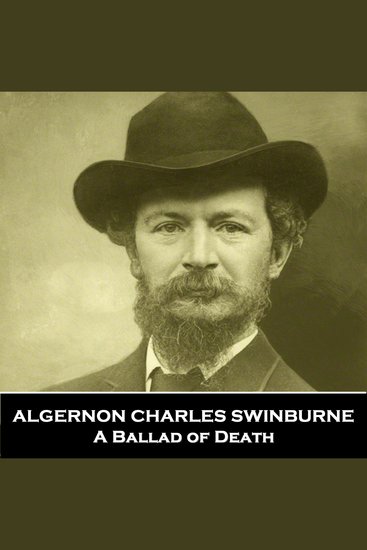
  • A Ballad of Death - A poetic examination of grief and lost love - cover

    A Ballad of Death - A poetic...

    Algernon Charles Swinburne

    • 0
    • 0
    • 0
    Algernon Charles Swinburne was born on April 5th, 1837, in London, into a wealthy Northumbrian family.  He was educated at Eton and at Balliol College, Oxford, but did not complete a degree.  
    In 1860 Swinburne published two verse dramas but achieved his first literary success in 1865 with Atalanta in Calydon, written in the form of classical Greek tragedy. The following year "Poems and Ballads" brought him instant notoriety. He was now identified with "indecent" themes and the precept of art for art's sake.  
    Although he produced much after this success in general his popularity and critical reputation declined. The most important qualities of Swinburne's work are an intense lyricism, his intricately extended and evocative imagery, metrical virtuosity, rich use of assonance and alliteration, and bold, complex rhythms.  
    Swinburne's physical appearance was small, frail, and plagued by several other oddities of physique and temperament. Throughout the 1860s and 1870s he drank excessively and was prone to accidents that often left him bruised, bloody, or unconscious. Until his forties he suffered intermittent physical collapses that necessitated removal to his parents' home while he recovered.  
    Throughout his career Swinburne also published literary criticism of great worth. His deep knowledge of world literatures contributed to a critical style rich in quotation, allusion, and comparison. He is particularly noted for discerning studies of Elizabethan dramatists and of many English and French poets and novelists. As well he was a noted essayist and wrote two novels. 
    In 1879, Swinburne's friend and literary agent, Theodore Watts-Dunton, intervened during a time when Swinburne was dangerously ill. Watts-Dunton isolated Swinburne at a suburban home in Putney and gradually weaned him from alcohol, former companions and many other habits as well.  
    Much of his poetry in this period may be inferior but some individual poems are exceptional; "By the North Sea," "Evening on the Broads," "A Nympholept," "The Lake of Gaube," and "Neap-Tide."  
    Swinburne lived another thirty years with Watts-Dunton. He denied Swinburne's friends access to him, controlled the poet's money, and restricted his activities. It is often quoted that 'he saved the man but killed the poet'.  
    Swinburne died on April 10th, 1909 at the age of seventy-two.
    Voir livre