Rejoignez-nous pour un voyage dans le monde des livres!
Ajouter ce livre à l'électronique
Grey
Ecrivez un nouveau commentaire Default profile 50px
Grey
Abonnez-vous pour lire le livre complet ou lisez les premières pages gratuitement!
All characters reduced
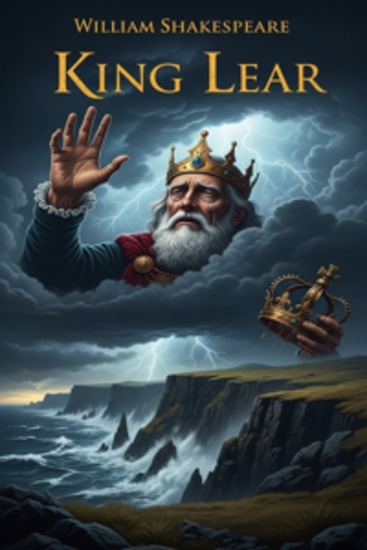
King Lear - cover

King Lear

William Shakespeare

Maison d'édition: Bu Classics Books

  • 0
  • 0
  • 0

Synopsis

Descend into the storm-battered heath with an aging monarch whose vanity and foolishness strip him of his crown, his family, and his sanity. The play relentlessly strips away the trappings of civilization to reveal the raw, vulnerable animal beneath, exploring the cruelty of nature and the silence of the gods. As the subplot of a blinded father mirrors the King's suffering, the tragedy reaches a pitch of nihilistic despair rarely equaled in art. It is a shattering examination of authority, aging, and the limits of human endurance.
Disponible depuis: 29/01/2026.
Longueur d'impression: 1 pages.

D'autres livres qui pourraient vous intéresser

  • Bookshop Memories - From their pens to your ears genius in every story - cover

    Bookshop Memories - From their...

    George Orwell

    • 0
    • 0
    • 0
    Eric Arthur Blair was born on 25th June 1903 in Motihari, Bihar, in what was then British India. When Eric was one his mother took him to England and they settled at Henley-on-Thames in Oxfordshire.  
    His education was at the nearby convent school before moving on to St Cyprian's School at Eastbourne and finally Eton where his academic studies were sidelined in favour of work on college publications. 
    University could not be achieved without a scholarship, which depended on good grades, and so it was decided that Eric should join the Imperial Police. Now 19 he chose a posting in Burma, then a province of British India. He was appointed an Assistant District Superintendent in November 1922. In Burma, he was an outsider. However, he acquired a moustache and some local tattoos—small badly drawn blue circles on his knuckles. 
    In 1927 he contracted dengue fever and returned to England to convalesce. At home he reappraised his life and resigned his job to become a writer. His police experiences were later used for ‘Burmese Days’.  
    By 1932 he had a literary agent who secured him an offer to publish a non-fiction work ‘Down and Out in London and Paris’ for a £40 advance, through the radical and socialist Victor Gollancz publishing house.  It was published in January 1933 as ‘by George Orwell’, it was modestly successful. 
    ‘Burmese Days’ (1934) and ‘A Clergyman's Daughter’ (1935) were published whilst Orwell kept on with writing ‘Keep the Aspidistra Flying’.  In January 1936, he set out by public transport to research life for the ordinary man and woman in Wigan. From these experiences emerged ‘The Road to Wigan Pier’. He also caught the eye of Special Branch who kept him under surveillance until the year before the release of ‘Nineteen Eighty-Four’. 
    Later in December 1936 Orwell set out to fight in the Spanish Civil War. Initially stationed at Alcubierre 1,500 feet above sea level, in the depth of winter on the Aragon Front. Military action was scant as was the lack of munitions, food and firewood. In April, Orwell returned to Barcelona and was caught up in the Barcelona May Days and its factional in-fighting. Returning to the Aragon Front he was almost immediately hit by a sniper's bullet through the throat. The bullet barely missed the artery but he survived.  His experiences were expressed in ‘Homage to Catalonia’ (1938) but, out of fashion with its times, it was a commercial failure.  
    When World War Two started Orwell was declared ‘unfit for any kind of military service’ but finally obtained ‘war work’ with the BBC's Eastern Service.  In September 1943, after two years Orwell left the BBC to concentrate on a new idea: ‘Animal Farm’.  
    By April 1944 ‘Animal Farm’ was ready for publication. It was a huge and resounding success.   
    Orwell left London for the island of Jura in April 1947 to work on ‘Nineteen Eighty-Four’. Once more health became an issue and in December a chest specialist was summoned from Glasgow who diagnosed tuberculosis.  By the end of July Orwell was able to return to Jura to finish ‘Nineteen Eighty-Four’. It was published the following June to immediate critical and popular acclaim. 
    By Christmas Orwell's health had again begun to decline. Early on the morning of 21st January, an artery burst in Orwell's lungs. It was fatal. He was dead at 46.
    Voir livre
  • Found Guilty - cover

    Found Guilty

    Josiah Flynt Willard, Francis...

    • 0
    • 0
    • 0
    Josiah Flynt Willard (1869-1907) was an American sociologist and author. After several years of experience as a vagrant, he wrote fiction and nonfiction as a kind of expert on tramps and tramping. His further works dealing with the lower and criminal classes include Found Guilty, part of a collection of stories written in collaboration with Francis Walton, an American author and attorney. 
    When not in the recording studio, Robert Walcott plays base guitar and sings for his folk band, Dreamscapers. In addition to narrating fiction, he enjoys doing commercial voiceovers and deep river flyfishing in eastern Montana.
    Voir livre
  • Dracula - cover

    Dracula

    Bram Stoker

    • 0
    • 0
    • 0
    A POWERFUL FULL CAST DRAMATIC MARATHON  
     
    “There is a reason why all things are as they are.” 
     
    Dracula author Bram Stoker was born on November 8, 1847 in Dublin. Stoker was bedridden with an unknown illness until he started school at the age of seven when he made a complete recovery. Of this time, Stoker wrote, "I was naturally thoughtful, and the leisure of long illness gave opportunity for many thoughts which were fruitful according to their kind in later years." He was educated in a private school run by the Reverend William Woods. 
     
    Stoker visited the English coastal town of Whitby in 1890, and that visit was said to be part of the inspiration for Dracula. He began writing novels while working as the manager for London's Lyceum Theatre, beginning with The Snake's Pass in 1890 and Dracula in 1897. Stoker was part of the literary staff of The Daily Telegraph in London, and he wrote other fiction, including the horror novels The Lady of the Shroud (1909) and The Lair of the White Worm (1911). 
     
    Dracula is an epistolary novel, written as a collection of realistic but completely fictional diary entries, telegrams, letters, ship's logs, and newspaper clippings, all of which added a level of detailed realism to the story, a skill which Stoker had developed as a newspaper writer. At the time of its publication, Dracula was considered a "straightforward horror novel" based on imaginary creations of supernatural life. "It gave form to a universal fantasy and became a part of popular culture.
    Voir livre
  • Victorian Tales - Short Stories - cover

    Victorian Tales - Short Stories

    Sir Aarthur Conan Doyl, Edith...

    • 0
    • 0
    • 0
    Track List 
     
    A Scandal in Bohemia           Sir Arthur Conan Doyle 
     
    Mrs. Manstey's View Edith Wharton  
     
    A Native of Winby    Sarah Orne Jewett      
     
    A New England Nun Mary E. Wilkins Freeman
    Voir livre
  • The Absence of Mr Glass - From their pens to your ears genius in every story - cover

    The Absence of Mr Glass - From...

    G K Chesterton

    • 0
    • 0
    • 0
    G K Chesterton (29 May 1874 – 14 June 1936) was a poet, novelist, playwright, literary commentator, editor, biographer, journalist, orator and theologian.  He was often dubbed as the “prince of paradox” for his light whimsical style that often addressed serious issues such as politics and religion.  The latter was as a member and defender of the Christian faith and the former was shaped by a distrust of concentrated wealth and power.  He advocated Distributionism and said that every man should be allowed to own "three acres and a cow."  These political views have spread round the world, crediting Chesterton as the father of the “small is beautiful” movement.  It is also said to have influenced Gandhi in seeking a genuine nationalism for India rather than imitating the British state.   
    Chesterton was remarkably prolific but perhaps his most famous creation is Father Brown.  Within this character Chesterton’s clever writing and profound ideas reveal truths, often with humour as the detective priest pursues the answers to his cases.
    Voir livre
  • A Jury of Her Peers - cover

    A Jury of Her Peers

    Susan Glaspell

    • 0
    • 0
    • 0
    In a quiet farmhouse, the ordinary folds into the unseen. A Jury of Her Peers turns a simple domestic scene into a mirror of justice, conscience, and the unspoken weight of women's lives. With spare, careful strokes, Susan Glaspell reveals how silence can testify and how understanding sometimes takes root where authority fails.
    A landmark short story of early feminist fiction, it remains haunting not for what is said — but for what is noticed.
    Voir livre