Rejoignez-nous pour un voyage dans le monde des livres!
Ajouter ce livre à l'électronique
Grey
Ecrivez un nouveau commentaire Default profile 50px
Grey
Abonnez-vous pour lire le livre complet ou lisez les premières pages gratuitement!
All characters reduced
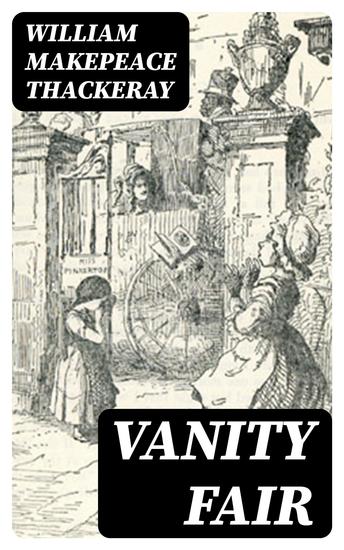
Vanity Fair - cover

Vanity Fair

William Makepeace Thackeray

Maison d'édition: DigiCat

  • 0
  • 0
  • 0

Synopsis

In "Vanity Fair," William Makepeace Thackeray crafts a masterful satire that explores the moral vacuity and social ambition of early 19th-century British society. Through the intertwined lives of its two central characters, Becky Sharp and Amelia Sedley, the novel critiques the artifice and hypocrisy prevalent in a world dominated by vanity and class struggle. Employing an ironic and conversational narrative style, Thackeray invites readers to question societal norms while engaging them with vivid characterization and sharp wit, reflecting the complexities of human nature amidst the backdrop of the Napoleonic Wars. Thackeray, a prominent figure in 19th-century literature, wielded his pen with keen observation, drawing from his own experiences as a journalist and a social commentator. His personal familiarity with the vices and virtues of the upper classes, along with his disillusionment with societal pretenses, informed his creation of "Vanity Fair," which remains a landmark in English literature. Thackeray's background in art and literature enriched his descriptive prowess, allowing him to create an astute, yet scathing look at the materialism that characterized his time. "Vanity Fair" is highly recommended for readers seeking a nuanced portrayal of society and morality, woven with humor and critical insight. Its timeless themes of ambition, betrayal, and the relentless pursuit of status render it an enduring classic, relevant to contemporary discussions on identity and social dynamics. As an incisive exploration of human folly, this work continues to resonate, making it a must-read for those interested in the intricate dance of vanity and reality.
Disponible depuis: 11/10/2022.
Longueur d'impression: 783 pages.
D'autres livres qui pourraient vous intéresser

  • Pictures - cover

    Pictures

    Katherine Mansfield

    • 0
    • 0
    • 0
    "Pictures" is a 1917 short story by Katherine Mansfield. It was first published under the title of The Common Round in the New Age on 31 May 1917 and later as The Pictures in Art and Letters in Autumn 1919. It was then reprinted as Pictures in Bliss and Other Stories.
    Miss Moss wakes up in the morning and she is hungry because she didn't have dinner the night before, nor is she going to have breakfast: she cannot afford it. Then her landlady turns up and gives her a letter hoping that it would be the rent, but it is note from an employment agency, saying they will get back to her.
    Voir livre
  • The Adventure of the Copper Beeches - cover

    The Adventure of the Copper Beeches

    Arthur Conan Doyle

    • 0
    • 0
    • 0
    The Adventure of the Copper Beeches, one of the 56 short Sherlock Holmes stories written by Sir Arthur Conan Doyle, is the last of the twelve collected in The Adventures of Sherlock Holmes. It was first published in Strand Magazine in June 1892.Violet Hunter visits Holmes, asking whether she should accept a job as governess; a job with very strange conditions. She is enticed by the phenomenal salary which, as originally offered, is £100 a year, later increased to £120 when Miss Hunter baulks at having to cut her long hair short (her previous position paid £48 a year). This is only one of many peculiar provisos to which she must agree. The employer, Jephro Rucastle, seems pleasant enough, yet Miss Hunter obviously has her suspicions.She announces to Holmes, after the raised salary offer, that she will take the job, and Holmes suggests that if he is needed, a telegram will bring him to Hampshire, where Mr Rucastle's country estate, the Copper Beeches, is situated.After a fortnight, Holmes receives such a message, beseeching him to come and see her in Winchester. Miss Hunter tells them one of the most singular stories that they have ever heard. Mr. Rucastle would sometimes have Miss Hunter wear a particular electric blue dress and sit in the front room reading, with her back to the front window. She began to suspect that she was not supposed to see something outside the window, and a small mirror shard hidden in her handkerchief showed her that she was right: there was a man standing there on the road looking towards the house.Famous works of the author Arthur Conan Doyle's: "A Study in Scarlet", "Silver Blaze", "The Hound of the Baskervilles", "The Yellow Face", "A Scandal in Bohemia", "The Red-Headed League", A Case of Identity", "The Boscombe Valley Mystery", "The Five Orange Pips", "The Man with the Twisted Lip", "The Blue Carbuncle", "The Speckled Band", "The Engineer's Thumb", "The Noble Bachelor", "The Beryl Coronet", "The Copper Beeches" and many more.
    Voir livre
  • Candide - cover

    Candide

    Voltaire

    • 0
    • 0
    • 0
    Candide is characterised by its sarcastic tone, as well as by its erratic, fantastical and fast-moving plot. A picaresque novel with a story similar to that of a more serious bildungsroman, it parodies many adventure and romance clichés, the struggles of which are caricatured in a tone that is mordantly matter-of-fact. Still, the events discussed are often based on historical happenings, such as the Seven Years' War and the 1755 Lisbon earthquake. As philosophers of Voltaire's day contended with the problem of evil, so too does Candide in this short novel, albeit more directly and humorously.    Voltaire ridicules religion, theologians, governments, armies, philosophies, and philosophers through allegory; most conspicuously, he assaults Leibniz and his optimism. Voltaire's men and women point his case against optimism by starting high and falling low. A modern could not go about it after this fashion. He would not plunge his people into an unfamiliar misery. He would just keep them in the misery they were born to. But such an account of Voltaire's procedure is as misleading as the plaster cast of a dance.    Look at his procedure again. Mademoiselle Cunégonde, the illustrious Westphalian, sprung from a family that could prove seventy-one quarterings, descends and descends until we find her earning her keep by washing dishes in the Propontis. The aged faithful attendant, victim of a hundred acts of rape by negro pirates, remembers that she is the daughter of a pope, and that in honor of her approaching marriage with a Prince of Massa-Carrara all Italy wrote sonnets of which not one was passable. We do not need to know French literature before Voltaire in order to feel, although the lurking parody may escape us, that he is poking fun at us and at himself. His laughter at his own methods grows more unmistakable at the last, when he caricatures them by casually assembling six fallen monarchs in an inn at Venice.    A modern assailant of optimism would arm himself with social pity. There is no social pity in "Candide." Voltaire, whose light touch on familiar institutions opens them and reveals their absurdity, likes to remind us that the slaughter and pillage and murder which Candide witnessed among the Bulgarians was perfectly regular, having been conducted according to the laws and usages of war. Had Voltaire lived today he would have done to poverty what he did to war. Pitying the poor, he would have shown us poverty as a ridiculous anachronism, and both the ridicule and the pity would have expressed his indignation.
    Voir livre
  • The Haunted Man and the Ghost's Bargain The Lost Christmas Classic - cover

    The Haunted Man and the Ghost's...

    Charles Dickens

    • 0
    • 0
    • 0
    The Haunted Man and the Ghost's Bargain, A Fancy for Christmas-Time (better known as The Haunted Man and the Ghost's Bargain is a novella by Charles Dickens first published in 1848. It is the fifth and last of Dickens's Christmas novellas. The story is more about the spirit of Christmas than about the holiday itself, harking back to the first in the series, A Christmas Carol. Produced by Macc KayProduction executive Avalon GiulianoICON Intern Eden Garret Giuliano©2021 Eden Garret Giuliano (P) 2021 Eden Garret GiulianoGeoffrey Giuliano is the author of over thirty internationally bestselling biographies, including the London Sunday Times bestseller 'Blackbird: The Life and Times of Paul McCartney' and 'Dark Horse: The Private Life of George Harrison'. He can be heard on the Westwood One Radio Network and has written and produced over seven hundred original spoken word albums and documentaries on various aspects of popular culture. In addition, Giuliano is an occasional lecturer at Northwestern University. He is also a well-known movie actor in such films as 'Squid Game', 'Mechanic Resurrection', 'Hard Target 2' and the 'Scorpion King' series, among many.  Geoffrey is a near lifelong devotee of Sri Krsna and an ardent animal rights advocate. He makes his home in Bangkok, Vrndavana, and Jaipur India with his son Eden Garret Giuliano
    Voir livre
  • The King of Elfland's Daughter - cover

    The King of Elfland's Daughter

    Lord Dunsany

    • 0
    • 0
    • 0
    From “one of the greatest writers of this century,” a fantasy masterpiece about the aftermath of a marriage between a mortal prince and an elfin princess. —Arthur C. Clarke   Before the fellowships and wardrobes and dire wolves . . .    . . . there was the village of Erl and the Kingdom of Elfland.   Considered formative to the development of the fairy tale and high fantasy subgenres, The King of Elfland's Daughter follows Alveric, who leaves home on a quest with a few basic instructions: locate the Princess Lirazel in Elfland, convince her to return to Erl and marry him, and together produce the first magical Lord of Erl.   But what happens when a village gets exactly what it asked for?   How does an elf learn to live as a human?   Is love lost once, lost forever?   The people of Erl are about to find out.   Take a walk through the fields we know and see if you can spot the pale-blue peaks of the Elfland Mountains. Fans of J. R. R. Tolkien, C. S. Lewis, and Neil Gaiman will adore Lord Dunsany’s influential 1924 classic as much as those authors themselves did.   “No amount of mere description can convey more than a fraction of Lord Dunsany's pervasive charm.” —H. P. Lovecraft   “We find that he has but tranfigured with beauty the common sights of the world.” —William Butler Yeats   “No one can understand modern fantasy without understanding its roots, and Lord Dunsany's work is immediately significant as well as enjoyable even today.” —Katharine Kerr   “A fantasy novel in a class with the Tolkien books.”—L. Sprague de Camp
    Voir livre
  • Hide And Seek - From their pens to your ears genius in every story - cover

    Hide And Seek - From their pens...

    Fyodor Sologub

    • 0
    • 0
    • 0
    Fyodor Kuzmich Teternikov was born on 1st March 1863 in St. Petersburg into the family of a poor tailor.  When his father died of tuberculosis in 1867, his illiterate mother was forced to become a servant in the home of an aristocrat, where Sologub and his younger sister grew up.  
    Seeing how difficult his mother's life was, Sologub was determined to rescue her from it, and after graduating from the St. Petersburg Teachers' Institute in 1882 he took his mother and sister with him to his first teaching post in Kresttsy.  It was here he began his literary career in 1884 with his poem ‘The Fox and the Hedgehog’ under the name Te-rnikov. 
    It would be another decade before he could escape his various jobs to move to Moscow and begin his literary career on what would be his most famous novel, ‘The Petty Demon’.  It was now suggested that he use a pseudonym and so Sologub became his new identity. 
    In 1896 he published a book of poems, a collection of short stories, and his first novel, ‘Bad Dreams’, which is considered one of the first decadent Russian novels. 
    In 1905 ‘The Petty Demon’, was published, initially in serial form. But life was still difficult unrewarding jobs, little time to write and a small, cramped apartment lightened only by gatherings of friends, poets and writers. 
    By the October Revolution his work was becoming popular and with the novel of ‘The Petty Demon’, finally published as a book, he now had a growing income. 
    His sister's tuberculosis could now be more easily treated with treatments in proper sanitoria, even as far away as Finland, but in June 1907 she passed. 
    He returned to St. Petersburg and retired.  The following year he married the translator Anastasia Chebotarevskaya who reordered his life.  A big new apartment was rented, small gilt chairs were bought, and the walls of the large cold office were decorated with paintings. 
    Sologub continued to write and publish poems, plays, and translations and in 1914 he started a magazine, Writers' Journals, but the outbreak of World War I put an end to it.  
    The October Revolution, with publishing under Bolshevik control, ensured he now had no outlets for his writing and could only lecture. 
    His wife’s suicide in September 1921, mainly due to deprivation and uncertainty, as they prepared for a new life abroad, grieved him for the rest of his life. 
    In May 1927 Sologub became seriously ill, and by summer he could leave his bed only rarely.  
    After a long struggle, Fyodor Sologub died on 5th December 1927 in Leningrad.  He was 64.
    Voir livre