Rejoignez-nous pour un voyage dans le monde des livres!
Ajouter ce livre à l'électronique
Grey
Ecrivez un nouveau commentaire Default profile 50px
Grey
Abonnez-vous pour lire le livre complet ou lisez les premières pages gratuitement!
All characters reduced
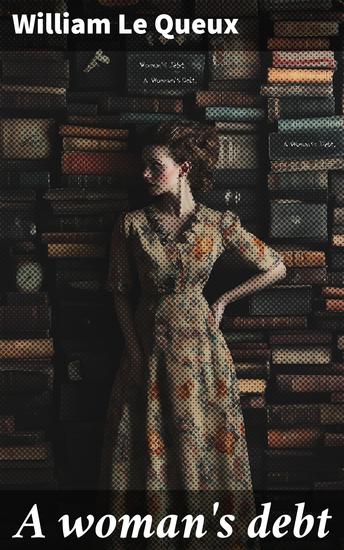
A woman's debt - cover

A woman's debt

William Le Queux

Maison d'édition: Good Press

  • 0
  • 0
  • 0

Synopsis

In "A Woman's Debt," William Le Queux masterfully intertwines elements of suspense, romance, and social commentary, crafting a narrative that delves into the complexities of gender dynamics in early 20th-century society. Set against a backdrop of financial constraints and social upheaval, the novel follows the life of its protagonist as she grapples with her precarious situation and the sacrifices she must make. Le Queux's writing is characterized by its vivid imagery and compelling dialogue, rendering the emotional landscape of his characters with both sensitivity and intensity, while providing insight into the era's moral and societal expectations. William Le Queux, a prolific and versatile writer, was deeply influenced by the shifting societal norms of his time. His diverse background, which included experiences in journalism and espionage, infused his works with a unique perspective on the interplay of love, sacrifice, and societal pressures. This novel is a reflection of his keen interest in women's issues and the challenges they faced, showcasing his ability to create relatable and formidable female characters who defy the constraints of their era. Readers seeking a thought-provoking narrative that resonates with contemporary themes of resilience and empowerment will find "A Woman's Debt" to be an engaging read. Le Queux's deft exploration of personal sacrifice and moral dilemmas invites readers to reflect on the enduring complexities of gender and societal expectations, making this novel a timeless addition to the literary canon.
Disponible depuis: 02/03/2025.
Longueur d'impression: 150 pages.


D'autres livres qui pourraient vous intéresser

  • Fading Voices - From their pens to your ears genius in every story - cover

    Fading Voices - From their pens...

    Boleslaw Prus

    • 0
    • 0
    • 0
    Aleksander Głowacki who wrote under the nom de plume Boleslaw Prus was born on 20th August 1847 at Hrubieszów in the Kingdom of Poland, at that time, controlled by the Russian Empire. 
    At three his mother died and then at nine his father.  Female relatives helped raise him but at 15 he joined the Polish uprising against the might of Imperial Russia.  Wounded on the battlefield, arrested and imprisoned, he was later released into the care of a relative and resumed secondary school and then Warsaw University but poverty forced him to leave after two years.  At some point he developed agoraphobia which often caused problems. 
    In 1869, he enrolled in the Forestry Department at Puławy but was soon sacked and so he began a system of self-education that led to work as a newspaper columnist on a wide-ranging series of topics that eventually became the ‘Weekly Chronicles’ and spanned 40 years. 
    With his finances now stabilized he married and then adopted his late brother-in-law’s son.  
    It seems he had doubts as to the scale of his talents and early on adopted the name ‘Boleslaw Prus’ for both his journalistic and literary offerings. 
    His work as a short-story writer met with much acclaim. He wrote several dozen of them, originally published in newspapers and ranging in length from micro-story to novella. His keen observation of everyday life and sense of humor are evident in them.  
    During his career he also wrote novels. After ‘Pharoah’, in 1895, he embarked on a four-month journey taking in Berlin, Dresden, Nuremberg, Rapperswil in Switzerland, where he stayed for two months, and his final destination, Paris.  Here his agoraphobia was so bad he couldn’t cross the Seine.  
    However, his writing continued and in 1911 his novel ‘Changes’, though uncompleted, began to be serialised.  It was never finished. 
    Boleslaw Prus died on 19th May 1912, at his Warsaw apartment.  He was 64.  A National Hero, thousands attended both his funeral service and interment.
    Voir livre
  • The black arrow A tale of two roses - cover

    The black arrow A tale of two roses

    Robert Louis Stevenson

    • 0
    • 0
    • 0
    "The Black Arrow" is a swashbuckling adventure that follows the protagonist, Richard Shelton, as he becomes embroiled in the conflict between the House of Lancaster and the House of York during the tumultuous Wars of the Roses. The novel is filled with action, intrigue, and romance, as Richard navigates through political and personal challenges.
    Voir livre
  • A Farewell to Arms - cover

    A Farewell to Arms

    Ernest Hemingway

    • 0
    • 0
    • 0
    'A Farewell to Arms'' is Hemingway's classic set during the Italian campaign of World War I. The book, published in 1929, is a first-person account of American Frederic Henry, serving as a Lieutenant ("Tenente") in the ambulance corps of the Italian Army.It's about a love affair between the expatriate American Henry and Catherine Barkley against the backdrop of the First World War, cynical soldiers, fighting and the displacement of populations. The publication of ''A Farewell to Arms'' cemented Hemingway's stature as a modern American writer, became his first best-seller, and is described by biographer Michael Reynolds as "the premier American war novel from that debacle World War I."
    Voir livre
  • The Brothers Karamazov - cover

    The Brothers Karamazov

    Fyodor Dostoyevsky

    • 0
    • 0
    • 0
    The Brothers Karamazov is a murder mystery, a courtroom drama, and an exploration of erotic rivalry in a series of triangular love affairs involving the "wicked and sentimental" Fyodor Pavlovich Karamazov and his three sons―the impulsive and sensual Dmitri; the coldly rational Ivan; and the healthy, red-cheeked young novice Alyosha. Through the gripping events of their story, Dostoevsky portrays the whole of Russian life, is social and spiritual striving, in what was both the golden age and a tragic turning point in Russian culture.
    Voir livre
  • Edgar Allan Poe - Selected Tales - cover

    Edgar Allan Poe - Selected Tales

    Edgar Allan Poe

    • 0
    • 0
    • 0
    Edgar Allan Poe will always be associated with the macabre and mysterious. In this selection of 11 of his short stories Poe's unique voice can be heard in all its Gothic splendour. 
    "The Fall of the House of Usher" a death obsessed man, in his desperate attempt to save his sister from premature burial, seals his own fate. 
    "The Masque of the Red Death" A nobleman uses his wealth to protect himself from the Red Death only to find it stalks his palace of pleasure and privilege as a guest. 
    " The Premature Burial" Fearful that his cataleptic illness may lead to premature interment, the narrator becomes obsessed with avoiding such an horrific end. 
    "The Tell-Tale Heart" A murderer's frenzied guilt over his deadly deed manifests itself in a bizarre incriminating manner. 
    "The Murders in the Rue Morgue" A macabre and violent double murder in Paris attracts the attention of Dupin, an amateur detective whose powers of deduction foreshadow the techniques of Sherlock Holmes nearly 50 years later. 
    "The Oblong Box" While on a sea voyage the narrator mistakes his old friend's mysterious reticence regarding his cargo of an "Oblong Box" for rudeness, with tragic consequences. 
    "The Oval Portrait" While convalescing in an old castle, a man becomes intrigued by a portrait of a young woman and soon learns of its sad history. 
    "The Black Cat" A Man spirals down into an existence of increasing drunkenness and violence. Those he once loved are dragged down with him, but one is bent on revenge. 
    "The Raven" A short poem in which a Raven enters a lovelorn man's room only to be the unexpected prophet of the poet's bleak and lonely future. 
    "The Sphinx" The oppressive atmosphere of a Cholera epidemic causes the writer to overestimate the evidence of his own eyes. 
    "The Pit and the Pendulum" A claustrophobic masterpiece, describing the experience of a man undergoing the tortures of the Spanish Inquisition.
    Voir livre
  • War and Peace - Second Epilogue (Unabridged) - cover

    War and Peace - Second Epilogue...

    Leo Tolstoy

    • 0
    • 0
    • 0
    War and Peace is a literary work mixed with chapters on history and philosophy by the Russian author Leo Tolstoy. It was first published serially, then published in its entirety in 1869. It is regarded as one of Tolstoy's finest literary achievements and remains an internationally praised classic of world literature.
    Second Epilogue: History is the life of nations and of humanity. To seize and put into words, to describe directly the life of humanity or even of a single nation, appears impossible. The ancient historians all employed one and the same method to describe and seize the apparently elusive the life of a people. They described the activity of individuals who ruled the people, and regarded the activity of those men as representing the activity of the whole nation.
    Voir livre