
Begleiten Sie uns auf eine literarische Weltreise!
Buch zum Bücherregal hinzufügen
Grey
Einen neuen Kommentar schreiben Default profile 50px
Grey
Jetzt das ganze Buch im Abo oder die ersten Seiten gratis lesen!
All characters reduced
The Ethics of Belief - cover

The Ethics of Belief

William Kingdon Clifford

Verlag: DigiCat

  • 0
  • 0
  • 0

Beschreibung

In "The Ethics of Belief," William Kingdon Clifford presents a profound exploration of the moral implications surrounding the act of believing. The essay, originally published in 1877, adopts a rationalist approach, arguing that beliefs must be supported by evidence and that it is unethical to hold beliefs without sufficient justification. Clifford's signature literary style combines clarity of thought with rigorous logical argumentation, positioning his work in the context of Victorian rationalism and the burgeoning debate between faith and reason. Through his memorable assertion, "It is wrong always, everywhere, and for anyone, to believe anything upon insufficient evidence," he challenges the reader to scrutinize their belief systems critically and underscores broader ethical considerations of intellectual honesty and responsibility in society. William Kingdon Clifford, a prominent British philosopher, mathematician, and advocate for empiricism, was influenced by contemporaneous thinkers such as John Stuart Mill and Charles Darwin. His background in mathematics and philosophy shaped his rigorous analytical approach, focusing on the relationship between knowledge, belief, and ethics. Clifford's commitment to rational inquiry and social reform resonates throughout his work, reflecting the intellectual currents of an era grappling with rapid scientific advances. "The Ethics of Belief" is a compelling treatise for anyone seeking to understand the intersection of epistemology and morality. Its impact on subsequent philosophical discourse makes it essential reading for students of philosophy, ethics, and critical thinking. Clifford's accessible yet profound arguments invite readers to reflect critically on their own beliefs and the ethical implications of holding them, making this work a timeless contribution to the discourse on rational belief.
Verfügbar seit: 29.05.2022.
Drucklänge: 25 Seiten.

Weitere Bücher, die Sie mögen werden

  • The Picnic - A Dream of Freedom and the Collapse of the Iron Curtain - cover

    The Picnic - A Dream of Freedom...

    Matthew Longo

    • 0
    • 0
    • 0
    In August 1989, a group of Hungarian activists organized a picnic on the border of Hungary and Austria. But this was not an ordinary picnic—it was located on the dangerous militarized frontier known as the Iron Curtain. Tacit permission from the highest state authorities could be revoked at any moment. On wisps of rumor, thousands of East German "vacationers" packed Hungarian campgrounds, awaiting an opportunity, fearing prison, surveilled by lurking Stasi agents. The Pan-European Picnic set the stage for the greatest border breach in Cold War history: hundreds crossed from the Communist East to the longed-for freedom of the West. 


    Drawing on dozens of original interviews, Matthew Longo tells a gripping and revelatory tale of the unraveling of the Iron Curtain and the birth of a new world order. Just a few months after the Picnic, the Berlin Wall fell, and the freedom for which the activists and refugees had risked imprisonment was suddenly available to everyone. But were they really free? And why, three decades since the Iron Curtain was torn down, have so many sought once again to build walls? 


    Cinematically told, The Picnic recovers a time when it seemed possible for the world to change. With insight and panache, Longo explores the opportunities taken—and the opportunities we failed to take—in that pivotal moment.
    Zum Buch
  • Starting a World War: The History of the Events and Battles that Began World War I and World War II - cover

    Starting a World War: The...

    Editors Charles River

    • 0
    • 0
    • 0
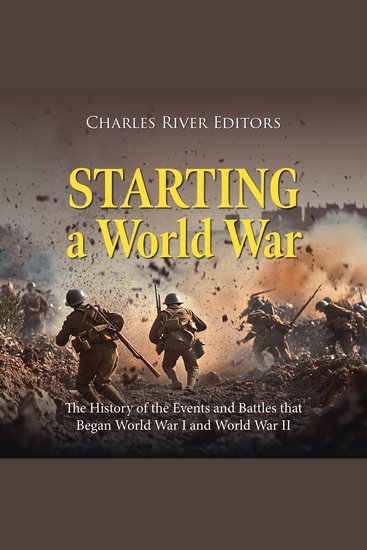
    By the 20th century, warfare was nothing new to the European powers, especially when it came to fighting each other. Conflicts had been a mainstay on the European continent for over two millennia. Even after the Napoleonic wars had enveloped Europe in large scale war for nearly 20 years in the 19th century, the Europeans’ imperialism continued unabated. It would take the devastation of World War I to shock Europe and jolt the world’s superpowers out of their imperialistic tendencies.  
    	With Europe anticipating a potential war, all that was missing was a conflagration. That would start in 1908, when Austria-Hungary annexed Bosnia-Herzegovina in the Balkan Peninsula, drawing it into dispute with Russia. Moreover, this upset neighboring Serbia, which was an independent nation. From 1912-1913, a conflict was fought in the Balkans between the Balkan League and the Ottoman Empire, resulting in the weakening of the Ottoman Turks. After the First Balkan War, a second was fought months later between members of the Balkan League itself. The final straw came June 28, 1914, when a Serbian assassinated Archduke Franz Ferdinand, the heir to the throne of Austria-Hungary, in Sarajevo, Bosnia.   
    The Munich Agreement is widely reviled today and is held up as the epitome of appeasement, but historians still debate its effects on the Second World War, as well as Neville Chamberlain's character and motivations. Some believe the attempted appeasement of Nazi Germany hastened, or even caused, the mayhem occupying the next seven years. Others believe that the pact merely failed to alter war's inevitable arrival in either direction.  
    Of course, as most people now know, the invasion of Poland was merely the preface to the Nazi blitzkrieg of most of Western Europe, which would include Denmark, Belgium, and France by the summer of 1940
    Zum Buch
  • Isaac Newton - His Theories on Gravity His Inventions and His Philosophy - cover

    Isaac Newton - His Theories on...

    Kelly Mass

    • 0
    • 0
    • 0
    We often think about Newton when we see an apple falling from a tree: The man who came up with the gravity theory, a physics scientist who gave said event and others significant thought. 
    Sir Isaac Newton was an English mathematician, physicist, astronomer, theologian, and writer who was commonly seen as one of the best mathematicians, physicists, and most prominent researchers of perpetuity. He was hailed as a "natural theorist" in his time. He was a considerable player in the Knowledge thought movement. In the year 1687, he wrote Mathematical Concepts of Natural Philosophy, which established classical mechanics. Newton also made considerable advances to optics, and he shares credit for developing infinitesimal calculus with German mathematician Gottfried Wilhelm Leibniz. 
    Newton created the concepts of movement and universal gravitation in Principia, which controlled clinical thought till the idea of relativity surpassed it. Newton used his math clarification of gravity to determine Kepler's laws of planetary movement, represent tides, comet trajectories, equinox precession, and other phenomena, showing the heliocentricity of the Planetary system. He showed that the exact same ideas could be used to clarify the movement of items in the world and celestial bodies. The geodetic observations of Maupertuis, La Condamine, and others later substantiated Newton's reduction that the Earth is an oblate spheroid, convincing most European researchers of Newtonian mechanics' supremacy over older systems. 
    Let’s learn more about this fascinating genius.
    Zum Buch
  • Why Privacy Matters - cover

    Why Privacy Matters

    Neil Richards

    • 0
    • 0
    • 0
    Everywhere we look, companies and governments are spying on us—seeking information about us and everyone we know. Ad networks monitor our web—surfing to send us "more relevant" ads. Databases of human information are assembled for purposes of "training" artificial intelligence programs designed to predict everything from traffic patterns to the location of undocumented migrants. We're even tracking ourselves, using personal electronics like Apple watches, Fitbits, and other gadgets. As Mark Zuckerberg once put it, "the Age of Privacy is over." But Zuckerberg and others who say "privacy is dead" are wrong. In Why Privacy Matters, Neil Richards explains that privacy isn't dead, but rather up for grabs. 


    Richards shows how the fight for privacy is a fight for power that will determine what our future will look like, and whether it will remain fair and free. Privacy matters because good privacy rules can promote the essential human values of identity, power, freedom, and trust. If we want to preserve our commitments to these precious yet fragile values, we will need privacy rules. Richards explains why privacy remains so important and offers strategies that can help us protect it from the forces that are working to undermine it. Pithy and forceful, this is a must-listen for anyone interested in a topic that sits at the center of so many current problems.
    Zum Buch
  • Meaning - A Very Short Introduction - cover

    Meaning - A Very Short Introduction

    Emma Borg, Sarah A. Fisher

    • 0
    • 0
    • 0
    Our ability to find meaning in things is one of the most important aspects of human life. But it is also one of the most mysterious. Where does meaning come from? What sorts of things have meaning? And how do we grasp the meaning others want to convey? Meaning: A Very Short Introduction is shaped by exploring possible answers to these questions. 


    Human societies have one particularly important device for expressing and sharing meaning: language. Since our words are paradigm examples of things which have meaning, in this book, Emma Borg and Sarah Fisher use meaning in language as a case study for exploring meaning more generally. They focus on three possible sources for word meaning: things in the world, things in the mind, and social practices, exploring the key approaches thinkers have put forward in each of these arenas. Finally, they end by looking at some concrete applications of the ideas and approaches introduced in the book.
    Zum Buch
  • Genocides - Historic Details of the Armenian Cambodian Rwandan Yugoslavian Sudanese and Nazi Genocide - cover

    Genocides - Historic Details of...

    Kelly Mass

    • 0
    • 0
    • 0
    This book consists of 6 topics, all selected to describe some of the worst atrocities of mankind: Genocides, mass rapes, abuse, mutilation and murder. It contains these topics: 
    Armenian Genocide: At the time of World War I, the Ottoman Empire committed the Armenian genocide, which led to the organized death of around one million ethnic Armenians. It was primarily achieved by mass executions, death marches resulting in the Syrian Desert, and the pushed Islamization of Armenian women and kids. 
    Cambodian Genocide: The Cambodian genocide was the methodical abuse and death of Cambodians by the Khmer Rouge, led by Pol Pot, the general secretary of the Communist Party of Kampuchea, who pushed Cambodia towards being an entirely self-dependent agrarian socialist state.  
    Genocide in Darfur: The Darfur genocide describes the methodical killing of ethnic Darfuri people in Western Sudan throughout the existing dispute. It's considered the first genocide of the twenty-first century. The International Bad Guy Court (ICC) has prosecuted many individuals for criminal offenses against mankind, rape, mass relocations and deportations, and abuse because of the genocide being committed. 
    Holocaust: At the time of WWII, the Holocaust, was a genocide of European Jews. Between 1941 and 1945, Nazi Germany and its allies killed around 6 million Jews in German-occupied Europe, representing about two-thirds of Europe's Jewish population. 
    Rwandan Genocide: Throughout the Rwandan Civil War, between April seventh and July fifteenth, 1994, the Rwandan genocide happened. Equipped militias murdered members of the Tutsi minority ethnic group, and some moderate Hutu and Twa. 
    Yugoslavian Genocide: Throughout the Bosnian War of 1992-- 1995, the Yugoslavian or Bosnian genocide describes either the Srebrenica massacre or the larger criminal activities against mankind in areas controlled by the Army of Republika Srpska (VRS).
    Zum Buch