Rejoignez-nous pour un voyage dans le monde des livres!
Ajouter ce livre à l'électronique
Grey
Ecrivez un nouveau commentaire Default profile 50px
Grey
Abonnez-vous pour lire le livre complet ou lisez les premières pages gratuitement!
All characters reduced
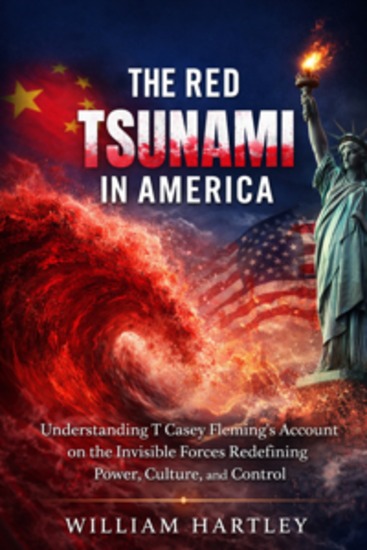
The Red Tsunami in America - Understanding T Casey Fleming’s Account on the Invisible Forces Redefining Power Culture and Control - cover

The Red Tsunami in America - Understanding T Casey Fleming’s Account on the Invisible Forces Redefining Power Culture and Control

William Hartley

Maison d'édition: AUSTIN M HERNANDEZ

  • 0
  • 0
  • 0

Synopsis

Something is happening in America that feels bigger than politics, louder than culture wars, and more unsettling than any single crisis. Chaos feels constant. Division feels permanent. Confusion feels normal. Yet beneath the noise lies a deeper truth most people sense but struggle to name: what we are experiencing is not random, and it is not accidental.The Red Tsunami in America is a clear-eyed examination of how modern power operates without announcing itself. It explores how influence now moves through psychology, culture, technology, economics, and information rather than armies and borders. This is not a book about partisan loyalty or political talking points. It is about patterns. Patterns of pressure that exhaust societies. Patterns of division that weaken communities. Patterns of control that advance quietly while citizens argue over surface-level conflicts.Step by step, this book connects the dots others leave disconnected. It explains why crises never seem to end, why recovery never fully arrives, and why so many people feel emotionally drained yet constantly alert. It reveals how fear, fatigue, and outrage are weaponized, how institutions weaken without collapsing, how freedom erodes without formal loss, and how silence replaces dissent long before force is ever needed.But this is not a message of despair. It is a call to awareness.The Red Tsunami in America shows why awareness is the first line of defense in an age of engineered chaos. It explores how individuals reclaim mental independence, how communities rebuild trust, and how shared values provide resilience when systems falter. It argues that the most effective resistance to manipulation is not panic or extremism, but clarity, discipline, and connection.This book is for readers who feel that something fundamental has shifted and want to understand why. It is for those who refuse to accept perpetual chaos as normal, who still believe that freedom depends on responsibility, and who recognize that the future will not be decided only by institutions, but by the choices ordinary people make every day.Once you see the patterns, you cannot unsee them.And once you see them, the question is no longer what is happening, but what will you choose to do next.
Disponible depuis: 02/02/2026.
Longueur d'impression: 145 pages.


D'autres livres qui pourraient vous intéresser

  • Hearty - On Cooking Eating and Growing Food for Pleasure and Subsistence - cover

    Hearty - On Cooking Eating and...

    Andrea Bennett

    • 0
    • 0
    • 0
    Thoughtful, wide-ranging essays exploring food as a source of pleasure, practical creativity, and sustenance
    		 
    Food is the primary way andrea bennett connects with the world. They worked in the restaurant industry for a decade, and though they don’t eat much meat and can’t eat gluten, they take as much pleasure in food as Jeffrey Steingarten, Anthony Bourdain, or Guy Fieri. When they want to show someone they care, they cook them a meal. The essays in Hearty offer a snapshot of the North American cultural relationship to food and eating. Hearty dives deep into specific foods, such as chutney, carrots, and ice cream, but also explores appetite and desire in food media, the art of substitution, seed saving and the triumphs and trials of being a home gardener, how the food system works (and doesn’t), and complex societal narratives around health and pleasure. Combining journalism, cultural commentary, and personal reflection, Hearty follows bennett’s curiosity into kitchens, gardens, fields, and factories, offering a compassionate and compelling perspective on food from seed to table.
    Voir livre
  • How America Dismantled the British Empire - cover

    How America Dismantled the...

    Aaron North

    • 0
    • 0
    • 0
    In "How America Dismantled the British Empire," journey through one of the most transformative periods in modern history, where the balance of global power shifted decisively from the British Empire to the United States. This meticulously detailed account delves into the political machinations, strategic decisions, and international pressures that culminated in the Suez Crisis of 1956—a pivotal event that signaled the end of Britain's imperial dominance and heralded the ascent of American influence. 
    Explore the intricate dynamics between key figures like British Prime Ministers Winston Churchill and Anthony Eden, U.S. Presidents Dwight D. Eisenhower, and Egyptian leader Gamal Abdel Nasser. Uncover the layers of frustration, miscommunication, and strategic realignment that characterized the era. From the corridors of power in London and Washington to the volatile landscapes of the Middle East, this book paints a comprehensive picture of the geopolitical shifts that reshaped the world order. 
    "How America Dismantled the British Empire" offers an in-depth analysis of the decline of British influence and the concurrent rise of American hegemony, set against the backdrop of Cold War tensions and emerging post-colonial movements. The narrative captures the essence of a time when global leadership was contested, alliances were tested, and the future of international relations was irrevocably altered. 
    Whether you are a history enthusiast, a student of international relations, or simply curious about the forces that shaped the contemporary world, "How America Dismantled the British Empire" provides a compelling, insightful, and richly detailed chronicle of an era that defined the trajectory of modern geopolitics.
    Voir livre
  • Nations in the Balance - The India-Burma Campaigns December 1943–August 1944 - cover

    Nations in the Balance - The...

    Christopher L. Kolakowski

    • 0
    • 0
    • 0
    An account of the decisive WWII battles that helped shape Asia’s future: “Reminds us of the high stakes at risk for both Allies and Axis powers in Burma.” —Military Review   From December 1943 to August 1944, Allied and Japanese forces fought the decisive battles of World War II in Southeast Asia. Fighting centered around North Burma, Imphal, Kohima, and the Arakan, involving troops from all over the world along a battlefront the combined size of Pennsylvania and Ohio. The campaigns brought nations into collision for the highest stakes: British and Indian troops fighting for Empire, the Indo-Japanese forces seeking a prestige victory with an invasion of India and the Americans and Chinese focused on helping China and reopening the Burma Road.   Events turned on the decisions of the principal commanders—Admiral Louis Mountbatten and Generals Joseph Stilwell, William Slim, Orde Wingate, and Mutaguchi Renya, among many others. The impact of the fighting was felt in London, Tokyo, Washington, and other places far away from the battlefront, with effects that presaged postwar political relationships. This was also the first U.S. involvement in Southeast Asia, and Stilwell’s operations in some ways foreshadowed battles in Vietnam two decades later.  Nations in the Balance recounts these battles, offering dramatic and compelling stories of people fighting in difficult conditions against high odds, with far-reaching results. It also shows how they proved important to the postwar future of the participant nations and Asia as a whole, with effects that still reverberate decades after the war.
    Voir livre
  • Anatolia and the Bronze Age: The History of the Earliest Kingdoms and Cities that Dominated the Region - cover

    Anatolia and the Bronze Age: The...

    Editors Charles River

    • 0
    • 0
    • 0
    While the Bronze Age is recognized as one of history’s most important phases, it’s been hard for historians to precisely date. The idea of the Bronze Age comes from a three-age system developed in the 19th century through which archaeologists and historians believe cultures evolve. These three ages are the Stone Age, the Bronze Age, and the Iron Age, and the concept of the system stems from the simultaneous development of museums in Europe during that time. In the Royal Museum of Nordic Antiquities in Denmark, Christian Jürgensen Thomsen, the director of the museum, began classifying objects of stone, bronze, or iron to better categorize and exhibit them. Each archaeological artifact was thus sorted according to their materials and further organized by shape and style. Through such methodology, working alongside archaeological reports, he was able to show how certain objects changed over time. 
    	During the Late Bronze Age, from about 1500-1200 BCE, the Near East was a time and place where great kingdoms and empires vied for land and influence, playing high stakes diplomatic games, trading, and occasionally going to war with each other in the process. The Egyptians, Hittites, Babylonians, Assyrians, and several smaller Canaanite kingdoms were all part of this system, which was one of the first true “global” systems in world history and also one of the most materially prosperous eras in antiquity. The major kingdoms are well-known to most people, but among them were powerful neighbors, many of whom have been mostly overlooked.  
    The transition from the Bronze to the Iron Age during the late 13th and early 12th centuries BCE arguably changed the structure and course of world history more fundamentally than any period before or since, and at the center of this period of turmoil was a group of people known today as the Sea Peoples, the English translation of the name given to them by the Egyptians.
    Voir livre
  • Yet Another Costume Party Debacle - Why Racial Ignorance Persists on Elite College Campuses - cover

    Yet Another Costume Party...

    Ingrid A. Nelson

    • 0
    • 0
    • 0
    How the policies of elite colleges allow racially themed parties to continue by perpetuating the status quo. On a cold February evening, a group of students at Bowdoin College, an elite and historically white liberal arts college in Maine, gathered to drink tequila at a party referred to as “not not a fiesta.” By noon the next day, Instagram videos of students sporting miniature sombreros had spread like wildfire through campus. Over the next few weeks, national media outlets would broadcast the embarrassing fallout. But the frequency with which similar parties recur on campuses across the United States begs the question: what, if anything, do undergraduates learn about race and racism from these encounters?
     
    Drawing on interviews and archival research, Yet Another Costume Party Debacle shows us how colleges both contest and reproduce racialized systems of power. Sociologist Ingrid A. Nelson juxtaposes how students and administrators discuss race with how they behave in the aftermath of racially charged campus controversies. Nelson spoke in-depth with students and other key players in several controversial parties—“Cracksgiving,” a “gangster party,” and the “not not a fiesta” tequila party—at Bowdoin. The college’s administrative response failed to encourage productive dialogue or address larger questions about race on campus. Nelson shows how the underlying campus structures at elite liberal arts colleges foster an environment that is ripe for racially charged incidents; we shouldn’t be surprised when we read about yet another costume party debacle. Nelson advises how we can take charge of diversity on our campuses by changing the systems that bring students together and drive them apart.
    Voir livre
  • Indefinite - Doing Time in Jail - cover

    Indefinite - Doing Time in Jail

    Michael L. Walker

    • 0
    • 0
    • 0
    Jails are the principal people-processing machines of the criminal justice system. Mostly they hold persons awaiting trial who cannot afford or have been denied bail. Although jail sentences max out at a year, some spend years awaiting trial in jail—especially in counties where courts are jammed with cases. City and county jails, detention centers, police lockups, and other temporary holding facilities are regularly overcrowded, poorly funded, and the buildings are often in disrepair. American jails admit over ten million people every year, but very little is known about what happens to 
    them while they're locked away. 


    Indefinite is an ethnographic study of a California county jail that reflects on what it means to do jail time and what it does to men. Michael L. Walker spent several extended spells in jail, having been arrested while trying to pay parking tickets in graduate school. This book is an intimate account of his experience and in it he shares the routines, rhythms, and subtle meanings that come with being incarcerated. Walker shows how punishment in jail is much more than the deprivation of liberties. It is, he argues, purposefully degrading. Jail creates a racial politics that organizes daily life, moves men from clock time to event time, normalizes trauma, and imbues residents with substantial measures of vulnerability.
    Voir livre