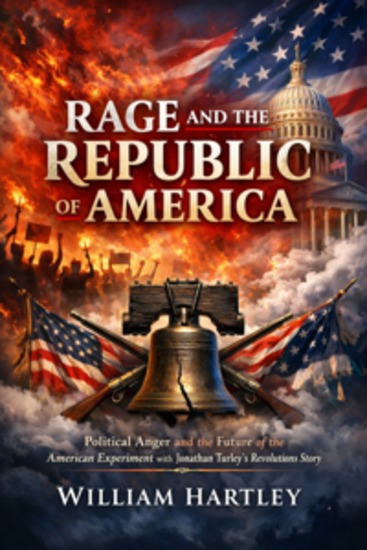
Rage and the Republic of America - Political Anger and the Future of the American Experiment with Jonathan Turley’s Revolutions Story
William Hartley
Verlag: AUSTIN M HERNANDEZ
Beschreibung
America is angry.Not in flashes, not in isolated moments, but in a sustained, simmering way that now defines elections, media, institutions, and even personal identity. Political disagreement has hardened into moral conflict. Opponents are no longer rivals but threats. Institutions meant to manage conflict are accused of betrayal. Democracy itself is increasingly spoken of not as a shared achievement, but as a system on the brink.Rage and the Republic of America is a sweeping, deeply researched examination of how political anger has shaped the United States from its founding to the present moment—and what that anger means for the future of American democracy. Drawing on history, political theory, psychology, and contemporary analysis, this book argues that rage is not an aberration in American life. It is one of its most persistent forces. The danger lies not in anger itself, but in what happens when anger becomes identity, replaces restraint, and overtakes the institutions designed to contain it.Beginning with the revolutionary origins of the republic, the book traces how the founders sought to harness passion without surrendering to chaos. From early factional battles to slavery and the Civil War, from Reconstruction violence to twentieth-century labor unrest and civil rights struggles, rage has repeatedly tested the nation’s capacity for self-government. Each era reveals a pattern: when anger is acknowledged, channeled, and disciplined, democracy adapts; when it is denied or weaponized, the republic fractures.The book then turns to the modern age, where polarization, populism, racial conflict, and technological disruption have transformed rage into a permanent feature of political life. Social media amplifies outrage. Algorithms reward extremism. Elections feel existential. Political violence, once unthinkable, becomes imaginable. Trust in institutions declines, not only because they fail, but because citizens no longer agree on what legitimacy means.Yet this is not a book of despair.Rage and the Republic of America resists the idea that democratic collapse is inevitable. By examining historic recoveries from division, global comparisons, and moments of renewal, it shows that democracies often survive their most dangerous periods—not by eliminating anger, but by learning how to live with it. The book explores paths toward democratic resilience, including institutional reform, electoral legitimacy, civic education, economic dignity, and renewed norms of restraint. It argues that civil society, not just government, holds the key to renewal.At its heart, this book asks a defining question of the twenty-first century: Can a republic built on disagreement survive when disagreement becomes rage without limits? And if so, what kind of republic must America choose to become?Written in a clear, engaging, and accessible style, Rage and the Republic of America speaks to readers across the political spectrum who sense that something fundamental is at stake but refuse to accept cynicism as the final answer. It neither flatters outrage nor dismisses it. Instead, it treats anger as a warning signal—one that reveals injustice, fear, and unmet promises, but also demands responsibility.This is a book about democracy under pressure. About identity in flux. About institutions stretched thin but not yet broken. And ultimately, about the enduring question at the core of the American experiment: whether a people divided by rage can still govern themselves together.For readers seeking to understand the forces reshaping American politics—and what it will take to keep the republic intact—this book offers history, clarity, and a sober, hard-earned hope.
Verfügbar seit: 05.02.2026.
Drucklänge: 155 Seiten.