Begleiten Sie uns auf eine literarische Weltreise!
Buch zum Bücherregal hinzufügen
Grey
Einen neuen Kommentar schreiben Default profile 50px
Grey
Jetzt das ganze Buch im Abo oder die ersten Seiten gratis lesen!
All characters reduced
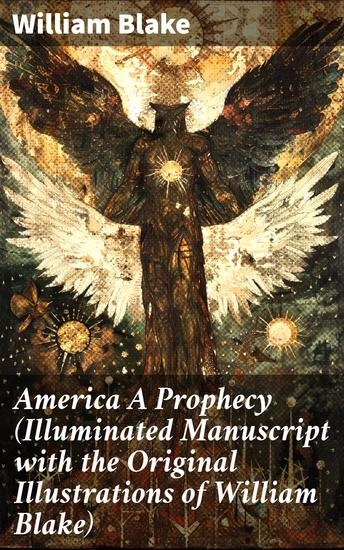
America A Prophecy (Illuminated Manuscript with the Original Illustrations of William Blake) - A Visionary Illumination of America's Revolutionary Spirit - cover

America A Prophecy (Illuminated Manuscript with the Original Illustrations of William Blake) - A Visionary Illumination of America's Revolutionary Spirit

William Blake

Verlag: Good Press

  • 0
  • 0
  • 0

Beschreibung

In "America A Prophecy," William Blake masterfully intertwines poetic verse and visual artistry, creating an illuminated manuscript that speaks to the revolutionary spirit of late 18th-century America. The work serves as a poetic exploration of the dichotomy between oppression and freedom, employing a prophetic tone that engages readers in a visionary discourse. Blake's innovative use of symbolism and mythology, alongside his distinctive engraving technique, enhances the thematic depth of the text, positioning it within the context of Romanticism and the broader currents of political upheaval and spiritual awakening of his time. William Blake (1757-1827), an enigmatic figure in the history of English literature and art, drew inspiration from his experiences as an engraver, poet, and visionary. Living through the tumultuous period of the American and French Revolutions, Blake's fierce commitment to individual liberty and social justice profoundly shaped his creative output. This work reflects his profound belief in the potential for personal and societal transformation, influenced by his critical view of institutional power and organized religion. "America A Prophecy" is essential reading for anyone interested in the intersections of art, poetry, and politics. Blake's vivid imagery and challenging themes beckon contemporary readers to reflect upon their own societal landscapes, encouraging a deep engagement with the ideals of freedom, creativity, and spiritual inquiry.
Verfügbar seit: 14.12.2023.
Drucklänge: 21 Seiten.

Weitere Bücher, die Sie mögen werden

  • On the Subject of Blackberries - cover

    On the Subject of Blackberries

    Stephanie M. Wytovich

    • 0
    • 0
    • 0
    Winner of the Bram Stoker Award for Superior Achievement in Poetry 
    Welcome to the garden. Here we poison our fruits, pierce ourselves with thorns, and transform under the light of the full moon. Mad and unhinged, we fall through rabbit holes, walk willingly into fairy rings, and dance in the song of witchcraft, two snakes around our ankles, the juice of berries on our tongues. 
    Inspired by Shirley Jackson’s We Have Always Lived in the Castle, these poems are meditations on female rage, postpartum depression, compulsion, and intrusive thoughts. They pull from periods of sleep deprivation, soul exhaustion, and nightmarish delusions, and each is left untitled, a nod to the stream-of-conscious mind of a new mother. 
    Using found poetry and under the influence of bibliomancy, Wytovich harnesses the occult power of her imagery and words and aligns it with a new, more vulnerable, darkness. These pieces are not only visions of the madwoman in the attic, but ghostly visitations that explore the raw mental torture women sometimes experience after giving birth. 
    This collection heals as much as it scars, and is an honest look at how trauma seeps into the soil of our bodies. Her poems are imagined horrors, fictional fears, and all the unspoken murmurs of a mind lost between reality and dream. What she leaves in her wake is nothing short of horror—the children lost, the garden dead, the women feral, ready to pounce.
    Zum Buch
  • suddenly we - cover

    suddenly we

    Evie Shockley

    • 0
    • 0
    • 0
    Finalist for the 2024 National Book Award for PoetryIn her new poetry collection, Evie Shockley mobilizes visual art, sound, and multilayered language to chart routes towards openings for the collective dreaming of a more capacious "we." How do we navigate between the urgency of our own becoming and the imperative insight that whoever we are, we are in relation to each other? Beginning with the visionary art of Black women like Alison Saar and Alma Thomas, Shockley's poems draw and forge a widening constellation of connections that help make visible the interdependence of everyone and everything on Earth.perchedi am black, comely,a girl on the cusp of desire.my dangling toes take the restthe rest of my body refuses. spine upright,my pose proposes anticipation. i poisein copper-colored tension, intent onmanifesting my soul in the discouraging world.under the rough eyes of others, i stiffen.if i must be hard, it will be as a tree, alivewith change. inside me, a love of beauty riseslike sap, sprouts from my scalpand stretches forth. i send out my song, an ariablue and feathered, and grow toward it,choirs bare, but soon to bud. i amblack and becoming.         —after Alison Saar's Blue Bird
    Zum Buch
  • The Rubaiyat of Omar Khayyam - cover

    The Rubaiyat of Omar Khayyam

    Omar Khayyam, Edward FitzGerald

    • 0
    • 0
    • 0
    The Rubaiyat of Omar Khayyam is a collection of quatrains (four-line verses) attributed to the 12th-century Persian poet, mathematician, and astronomer, Omar Khayyam. While the original Persian text is complex and open to interpretation, it is the English translation by Edward Fitzgerald that popularized the work in the Western world. 
    Fitzgerald's translation portrays a world view that is often characterized as: 
    Carpe Diem: Seize the day, emphasizing the fleeting nature of life and the importance of enjoying the present moment. 
    Skepticism: Questioning traditional beliefs and religious dogma, particularly in relation to the afterlife. 
    Epicureanism: Focusing on pleasure and the senses as the primary goods in life. 
    Fatalism: Accepting one's fate and the inherent unpredictability of existence.
    Zum Buch
  • Do Jewish Lives Matter? - A Play - cover

    Do Jewish Lives Matter? - A Play

    Beverly Taylor

    • 0
    • 0
    • 0
    The play, “Do Jewish Lives Matter” arose out of the Crown Heights Riot in Brooklyn, a Pogrom where a Black boy was accidentally killed by a Hasidic driver with devastating results. James Baldwin, the famous Negro writer, as far back as 1948 wrote, “Georgia has the Negro as a target of hatred. Harlem has the Jew.” 
     In 1973 Rabbi Kahane wrote, “In no way should we refuse to see the danger to Jews that comes from Black hatred. It is of epidemic proportions.” And again in 1977, when addressing an audience, he said, “In Crown Heights, where poor Jews live side by side with Blacks and are regularly robbed, mugged, terrorized, a Black explosion against them is inevitable.”
    Zum Buch
  • The Father and the Assassin - cover

    The Father and the Assassin

    Anupama Chandrasekhar

    • 0
    • 0
    • 0
    'Our wars may come in many forms. On the battlefields. Within ourselves.'
    Mahatma Gandhi: lawyer, champion of non-violence, beloved leader. Nathuram Godse: journalist, nationalist – and the man who murdered him.
    Anupama Chandrasekhar's play The Father and the Assassin traces Godse's life over thirty years during India's fight for independence: from a devout follower of Gandhi, through to his radicalisation and their tragic final encounter in Delhi in 1948.
    An essential exploration of oppression and extremism, this gripping play opened to critical acclaim at the National Theatre, London, in May 2022, directed by Indhu Rubasingham – and was revived there the following year. It was a finalist for the 2022-23 Susan Smith Blackburn Prize.
    Zum Buch
  • Tintern Abbey - Glorious poem evoking the beauty of a church monument - cover

    Tintern Abbey - Glorious poem...

    William Wordsworth

    • 0
    • 0
    • 0
    William Wordsworth was born on 7 April, 1770 in Cockermouth, in Cumbria, northwest England.  
    Wordsworth spent his early years in his beloved Lake District often with his sister, Dorothy. The English lakes could terrify as well as nurture, and as Wordsworth would write “I grew up fostered alike by beauty and by fear,” 
    After being schooled at Hawkshead he went to St. John’s College, Cambridge but not liking the competitive nature of the place idled his way through saying he “was not for that hour, nor for that place.”  
    Whilst still at Cambridge he travelled to France.  He was immediately taken by the Revolutionary fervor and the confluence of a set of great ideals and rallying calls for the people of France. 
    In his early twenties he ventured again to France and fathered an illegitimate child. He would not see that daughter till she was 9 owing to the tensions and hostilities between England and France. 
    There now followed a period of three to four years that plagued Wordsworth with doubt.  He was now in his early thirties but had no profession, was rootless and virtually penniless.  
    Although his career was not on track he did manage to publish two volumes, both in 1793;  An Evening Walk and Descriptive Sketches. 
    This dark period ended in 1795. A legacy of £900 received from Raisley Calvert enabled Wordsworth to pursue a literary career in earnest.  
    In 1797 he became great friends with a fellow poet, Samuel Taylor Coleridge. They formed a partnership that would change both their lives and the course of English poetry. 
    Their aim was for a decisive break with the strictures of Neoclassical verse. In 1798 the ground breaking Lyrical Ballads was published. Wordsworth wrote in the preface “the spontaneous overflow of powerful feelings: it takes its origin from emotion recollected in tranquility.” Most of the poems were dramatic in form, designed to reveal the character of the speaker. Thus the poems set forth a new style, a new vocabulary, and new subjects for poetry. 
    Coleridge had also conceived of an enormous poem to be called “The Brook,” in which he proposed to treat all science, philosophy, and religion, but soon laid the burden of writing it to Wordsworth.  To test his powers for that endeavour, Wordsworth began writing the autobiographical poem that would absorb him for the next 40 years, and which was eventually published as The Prelude, or, Growth of a Poet’s Mind.  
    By the 1820s, the critical acclaim for Wordsworth was growing, but perhaps his best years of work were behind him. Nonetheless he continued to write and to revise previous works.  
    With the death is 1843 of his friend and Poet Laureate Robert Southey, Wordsworth was offered the position. He accepted despite saying he wouldn’t write any poetry as Poet Laureate. And indeed he didn’t. 
    Wordsworth died of pleurisy on 23 April 1850. He was buried in St Oswald’s church Grasmere.
    Zum Buch