Begleiten Sie uns auf eine literarische Weltreise!
Buch zum Bücherregal hinzufügen
Grey
Einen neuen Kommentar schreiben Default profile 50px
Grey
Jetzt das ganze Buch im Abo oder die ersten Seiten gratis lesen!
All characters reduced
Bartram's Travels - Travels Through North and South Carolina Georgia East and West Florida - cover

Bartram's Travels - Travels Through North and South Carolina Georgia East and West Florida

William Bartram

Verlag: DigiCat

  • 0
  • 0
  • 0

Beschreibung

In "Bartram's Travels," William Bartram offers an evocative and richly detailed account of his explorations through the American Southeast during the 18th century. This seminal work melds natural history, ethnography, and travelogue, showcasing Bartram's keen observations of the diverse flora, fauna, and indigenous cultures he encountered. His lyrical prose is imbued with the aesthetics of romanticism, reflecting the Enlightenment intrigue with nature and its sublime beauty. The book stands as a crucial contribution to American literature, intertwining the romanticized ideals of wilderness with scientific inquiry, thus placing Bartram among the early naturalists and writers of the American exploration narrative. William Bartram, an influential figure in the early American natural sciences, was heavily influenced by his upbringing in a family of botanists and his discussions with Native American tribes. His background provided him with a profound appreciation for nature and deep insights into the indigenous ways of life, which he deftly weaves into his narrative. Bartram's journeys from 1773 to 1776 led him through vast landscapes, offering him an unparalleled chance to document a burgeoning nation's natural heritage at a pivotal time in American history. "Bartram's Travels" is a must-read for scholars, nature enthusiasts, and casual readers alike. It invites readers to experience the untamed beauty of the American landscape through the eyes of an astute observer and to engage with the complex interactions between humans and the natural world. This book not only enriches our understanding of America's past but also serves as a timeless reminder of our connection to nature.
Verfügbar seit: 25.11.2023.
Drucklänge: 387 Seiten.

Weitere Bücher, die Sie mögen werden

  • ASE A5 - Turbocharge Automotive Service Excellence A5 Success! Master the test with powerful audio lessons - cover

    ASE A5 - Turbocharge Automotive...

    Thane Barrett

    • 0
    • 0
    • 0
    ASE A5 Audiobook Description:  
    ⭐⭐ Simplified Guide & Explanations Included⭐⭐ 
    Are you eager to advance your career and deepen your knowledge by successfully passing the ASE A5 Exam 2024-2025? 
    Looking for a comprehensive guide that covers all essential elements to ace the ASE A5 Exam 2024-2025? 
    Your search ends here! 
    This guide is your ultimate companion for enhancing your understanding, applying your skills, and engaging in hands-on exercises. With this, you're prepared for success. 
    Updated for the ASE A5 2024-2025 Exam Structure. 
    Key features of this enriched guide: 
    - Profound insights about the ASE A5 Exam 2024-2025 Certification 
    - Detailed explanation of the Automotive Service Excellence A5 
    - Effective strategies for exam preparation and tackling 
    Our guide distinguishes itself through comprehensive coverage, which is essential for your exam victory. Concepts aren't merely skimmed; they are delved into with precision. 
    Please note that this guide is not affiliated with any official ASE entity and is purely an independent resource for your benefit. 
    Designed with a clear structure and easy-to-understand language, our ASE A5 Exam Guide 2024-2025 ensures smooth transitions between topics. Say goodbye to dense jargon and welcome clear, precise, and technically accurate content. 
    So, why wait? Click the BUY NOW button, secure your guide, and begin your journey to ASE A5 Exam 2024-2025 success!
    Zum Buch
  • How to Lose the Hounds - Maroon Geographies and a World Beyond Policing - cover

    How to Lose the Hounds - Maroon...

    Celeste Winston

    • 0
    • 0
    • 0
    In How to Lose the Hounds Celeste Winston explores marronage—the practice of flight from and placemaking beyond slavery—as a guide to police abolition. She examines historically Black maroon communities in the Maryland suburbs of Washington, DC, that have been subjected to violent excesses of police power from slavery until the present day. Tracing the long and ongoing historical geography of Black freedom struggles in the face of anti-Black police violence in these communities, Winston shows how marronage provides critical lessons for reimagining public safety and community well-being. These freedom struggles take place in what Winston calls maroon geographies—sites of flight from slavery and the spaces of freedom produced in multigenerational Black communities. Maroon geographies constitute part of a Black placemaking tradition that asserts life-affirming forms of community. Winston contends that maroon geographies operate as a central method of Black flight, holding ground, and constructing places of freedom in ways that imagine and plan a world beyond policing.
    Zum Buch
  • Artificial Intelligence - Concepts Evolution and Future Prospects - cover

    Artificial Intelligence -...

    Bright Mills

    • 0
    • 0
    • 0
    Artificial Intelligence (AI) is a transformative field of computer science dedicated to building systems that can perform tasks typically requiring human intelligence. These tasks include learning, reasoning, problem-solving, perception, language understanding, and decision-making. This comprehensive guide explores the foundational principles of AI, its historical evolution, methodologies, real-world applications, ethical challenges, and the future it holds. The document begins by defining AI, its goals, and its place in the broader field of computer science. It discusses the major branches, such as machine learning, natural language processing, computer vision, robotics, and expert systems. Following that, the paper delves into the historical timeline of AI from early philosophical concepts to the rise of neural networks and deep learning in the 21st century. The core methodologies are explored in-depth, including supervised, unsupervised, and reinforcement learning, as well as symbolic AI, heuristic approaches, and hybrid models. It further illustrates how AI is integrated across industries like healthcare, finance, manufacturing, education, transportation, and defense. The guide also addresses the critical ethical and societal questions surrounding AI: data privacy, algorithmic bias, surveillance, job displacement, and the need for regulation and responsible AI development. 
    Finally, it speculates on the future trajectory of AI, including artificial general intelligence (AGI), quantum AI, and human-AI symbiosis. It highlights both the immense opportunities AI offers and the serious challenges it poses. 
    This 10,000-word exposition aims to serve students, researchers, policymakers, and enthusiasts by offering a detailed, accessible, and balanced perspective on one of the most powerful technologies of the 21st century.
    Zum Buch
  • Artificial Intelligence in the Modern World: Transformative Technologies and Ethical Implications - Navigating the Impact of AI on Society Economy and Culture - cover

    Artificial Intelligence in the...

    David Chang

    • 0
    • 0
    • 0
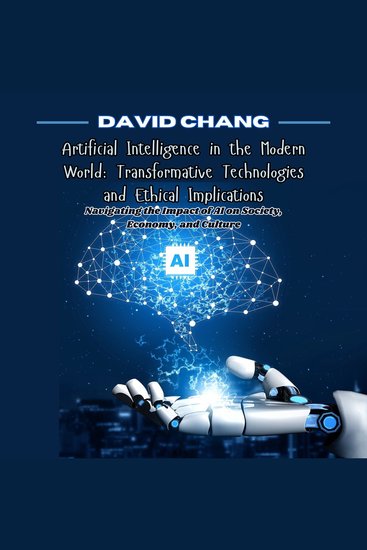
    The book "Artificial Intelligence in the Modern World: Transformative Technologies and Ethical Implications" explores both the revolutionary potential of AI and the ethical issues it raises, delving into the enormous effects of AI on modern society. This book gives readers a comprehensive grasp of AI's capabilities and uses by deeply analyzing how AI is changing several industries, including healthcare, finance, education, and entertainment. 
    The book highlights AI's revolutionary potential to solve complicated issues, boost productivity, and spur economic growth, but it also stresses the importance of responsible AI development. It covers important topics like discrimination, privacy, loss of employment, and the need for strong legal structures. Using comprehensive examination and varied viewpoints, the writer promotes openness, responsibility, and the incorporation of moral factors into the management of artificial intelligence. 
    To guarantee that AI's advantages are distributed fairly, the book emphasizes the significance of international cooperation and urges global initiatives to create common standards and exchange best practices. For technologists, policymakers, and anybody else interested in comprehending AI's transformational potential and navigating its ethical environment, "Artificial Intelligence in the Modern World" is an indispensable read.
    Zum Buch
  • Restless Devices - Recovering Personhood Presence and Place in the Digital Age - cover

    Restless Devices - Recovering...

    Felicia Wu Song

    • 0
    • 0
    • 0
    We're being formed by our devices. Today's digital technologies are designed to captivate our attention and encroach on our boundaries, shaping how we relate to time and space, to ourselves and others, even to God. While we enjoy the benefits of digital tech, many of us feel troubled with its power and exhausted by its demands for permanent connectivity. Yet even as we grow disenchanted, attempting to resist the digital "powers that be" might seem like a losing battle. 


    Sociologist Felicia Wu Song has spent years considering the personal and collective dynamics of living in digital ecosystems. In this book she combines psychological, neurological, and sociological insights with theological reflection to explore two major questions: What kind of people are we becoming with personal technologies in hand? and who do we really want to be? 


    Song unpacks the soft tyranny of the digital age, including the values embedded in our apps and the economic systems that drive our habits and their subtle yet pervasive effects. She then explores pathways of meaningful resistance that can be found in Christian tradition, especially counter-narratives about human worth, embodiment, relationality, and time. Considering digital practices through the lens of "liturgy" and formation, she offers practical experiments for individual and communal change.
    Zum Buch
  • Humanoid Robots & Drones: How the Age of Smart Machines Will Revolutionize Our World - cover

    Humanoid Robots & Drones: How...

    Dr. Nick Coman, I. A.I.

    • 0
    • 0
    • 0
    “Humanoid Robots & Drones: How the Age of Smart Machines Will Revolutionize Our World” is a 24‑lecture audio expedition for anyone who likes their wonder with measurements. We chase robots, humanoids, and drones through restaurants, farms, warehouses, hospitals, disaster scenes, stadiums, and city skies—treating each as a solvable puzzle. How does a drone hold position in wind? Why does a humanoid’s shape matter for doors and stairs? When does a non‑humanoid robot beat a humanoid? More often than you’d guess.
     
    You’ll learn the working grammar of the field: motors, cameras, lidar, batteries, and the ugly truth about friction, glare, and radio noise. You’ll see how a drone’s navigation, thermal views, and geofences turn into defect lists, not pretty video; how warehouse robots schedule intersections; why “stop distance” and “payload versus endurance” make or break a plan; and how soft‑skinned humanoids handle the “last ten centimeters” that buildings were designed for human hands. We translate regulation and risk into simple playbooks you can actually use—what the rules permit, what insurers demand, and what keeps neighbors calm.
     
    Expect case studies with receipts: drone light shows that replace fireworks with quiet pixels; roof and bridge inspections before breakfast; farm rigs that spray where plants actually are; hospital runners and delivery bots that save steps and shoulders; telepresence poles and companion robots that help real people on real Tuesdays. The tone is sharp, funny, and unromantic: we puncture hype, celebrate craft, and name failure modes out loud.
     
    By the end, you’ll be able to read a spec sheet like a mechanic, design a credible first deployment, and argue—politely but mercilessly—about the next 10, 25, and 50 years. If you want an operator’s guide to the robots, humanoids, and drones that already work (and the ones that almost do), buckle in. The robots are clocked in, the drones are charged, and class is wheels‑up.
    Zum Buch