Rejoignez-nous pour un voyage dans le monde des livres!
Ajouter ce livre à l'électronique
Grey
Ecrivez un nouveau commentaire Default profile 50px
Grey
Abonnez-vous pour lire le livre complet ou lisez les premières pages gratuitement!
All characters reduced
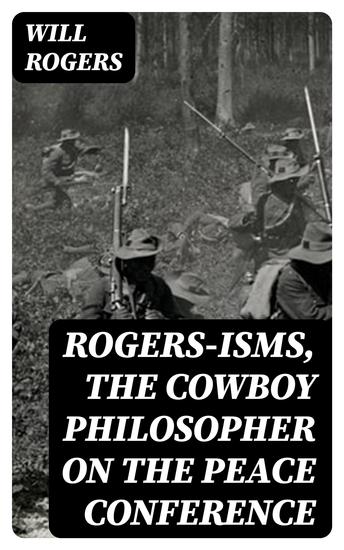
Rogers-isms the Cowboy Philosopher on the Peace Conference - cover

Rogers-isms the Cowboy Philosopher on the Peace Conference

Will Rogers

Maison d'édition: DigiCat

  • 0
  • 0
  • 0

Synopsis

In "Rogers-isms, the Cowboy Philosopher on the Peace Conference," Will Rogers employs his signature blend of humor and wit to reflect on the complexities of international diplomacy in the wake of World War I. Drawing from his experiences as a performer and commentator, Rogers captures the absurdities and challenges of the peace process, utilizing a conversational style infused with folksy wisdom that engages readers while provoking thought. This collection of reflections, published in 1919, serves as both a critique and an endorsement of political figures and their decisions, highlighting the dissonance between public opinion and bureaucratic action during a tumultuous period in history. Will Rogers, a self-proclaimed "Cowboy Philosopher," emerged as a beloved cultural icon through his insightful commentary on contemporary issues. His unique perspective, shaped by his upbringing in Oklahoma and experiences in vaudeville and film, allowed him to translate complex political ideas into relatable concepts for the everyday American. The sincerity and clarity of his messages resonated with a broad audience, reflecting the collective sentiments of a nation grappling with the aftermath of conflict. Rogers' work remains relevant today, making his observations essential reading for anyone interested in politics, philosophy, or the human condition. "Rogers-isms" not only delights with its humor but also challenges readers to consider the broader implications of peace and governance. This book is a treasure trove for scholars, students, and anyone seeking insight into the societal mindset of post-war America.
Disponible depuis: 16/09/2022.
Longueur d'impression: 11 pages.

D'autres livres qui pourraient vous intéresser

  • Public Sector Marketing Pro - The Definitive Guide to Digital Marketing and Social Media for Government and Public Sector - cover

    Public Sector Marketing Pro -...

    Joanne Sweeney

    • 0
    • 0
    • 0
    Do you need to transform your communications department into a specialist digital and social media team? The newly revised Public Sector Marketing Pro is the definitive guide for government and public sector agencies, politicians, political parties and NGOs on how to successfully reach and engage with the public in the Digital Age. With over 20 years' experience in journalism, digital marketing, and communications, Joanne Sweeney highlights how communication has changed in our post-pandemic world. New and updated chapters include case studies from public health officials on how they modified their tactics as the public demanded more information quicker than ever before. This crash course in digital public engagement will teach you how to: 
    - Transform outdated communications strategy into agile digital plans 
    - Respond to the public in real time on social media-even if you're understaffed 
    - Effectively respond to crises online 
    - Leverage digital communications to meet your organisation's larger objectives 
    - Understand and adapt to the changes that occurred during the pandemic 
    Public Sector Marketing Pro is your ultimate training manual to becoming a skilled leader in your field and online.
    Voir livre
  • Family Abolition - Capitalism and the Communizing of Care - cover

    Family Abolition - Capitalism...

    M.E. O’Brien

    • 0
    • 0
    • 0
    For some of us, the family is a source of love and support. But for many others, the family is a place of private horror, coercion, and personal domination. In a capitalist society, the private family carries the impossible demands of interpersonal care and social reproductive labor. Can we imagine a different future? 


    In Family Abolition, author M. E. O'Brien uncovers the history of struggles to create radical alternatives to the private family. O'Brien traces the changing family politics of racial capitalism in the industrial cities of Europe and the slave plantations and settler frontier of North America, explaining the rise and fall of the housewife-based family form. From early Marxists to Black and queer insurrectionists to today's mass protest movements, O'Brien finds revolutionaries seeking better ways of loving, caring, and living. Family Abolition takes us through the past and present of family politics into a speculative future of the commune, imagining how care could be organized in a free society.
    Voir livre
  • Populism Vs Liberalism - A Comparative Analysis of Political Ideologies - cover

    Populism Vs Liberalism - A...

    Arlo Holders

    • 0
    • 0
    • 0
    Political ideologies form the foundation of how societies organize governance, economics, and social structures. They are systems of ideas and beliefs that provide a framework for political thought and action, influencing policies, institutions, and the behavior of individuals and groups. Among the diverse range of ideologies, populism and liberalism have emerged as two of the most significant and often opposing forces in modern political discourse. This chapter introduces the concepts of populism and liberalism, highlights their importance, and sets the stage for the comparative analysis that follows. 
    Populism is a political approach that champions the rights and concerns of the common people against an established elite. It is often characterized by a rhetoric that emphasizes “the people” as a unified and virtuous entity, contrasted with a corrupt and self-serving elite. While populism can manifest across the political spectrum, its appeal lies in its simplicity and directness, offering solutions that often resonate with those who feel excluded or marginalized by traditional institutions. Populist movements frequently arise in periods of social upheaval or economic insecurity, presenting themselves as corrective forces against perceived injustices. 
    In contrast, liberalism is a political ideology rooted in the principles of individual rights, equality, and the rule of law. It advocates for democratic governance, free markets, and the protection of civil liberties. Liberalism’s historical development is closely linked with movements such as the Enlightenment and the rise of constitutional democracies. As a flexible and adaptive ideology, liberalism has evolved to address modern issues such as social justice, environmental concerns, and global cooperation while maintaining its foundational emphasis on freedom and equality.
    Voir livre
  • Party People - Candidates and Party Evolution - cover

    Party People - Candidates and...

    Allan Sikk, Phillip Koker

    • 0
    • 0
    • 0
    Candidates are the literal "face" of political parties, yet they are not wedded to them permanently: candidates can enter or leave politics, switch parties, move along or stay behind when parties split or merge. Even in parties that look stable, candidate change happens below the surface, ultimately altering what the parties stand for. Inspired by evolutionary theories, Party People: Candidates and Party Evolution conceptualizes candidates as "party genes" and develops a candidate-based approach to party evolution. Tracking candidates between elections and parties opens up new perspectives on party development in complex and dynamic settings in Central and Eastern Europe (CEE) and beyond. Based on a new database of 200,000 electoral candidates from over sixty elections across nine CEE democracies, this book presents a groundbreaking study of party evolution using candidate change as an indicator of party change. Allan Sikk and Philipp Köker offer a series of methodological and conceptual advances for the measurement of candidate turnover, party fission and fusion, programmatic change, and party leadership change; the resulting analyses make a significant contribution to the study of CEE party politics as well as to the general scholarship on elections, parties, and political change.
    Voir livre
  • Wage Labour and Capital - cover

    Wage Labour and Capital

    Karl Marx

    • 0
    • 0
    • 0
    *Wage-Labour and Capital* by Karl Marx is a foundational text in Marxist economic theory that explores the exploitative dynamics of capitalist societies. Originally delivered as a series of lectures, the work delves into the relationship between wage laborers and capitalists, emphasizing how workers sell their labor power for wages that merely sustain their existence, while the capitalists appropriate the surplus value created by the workers. Marx unpacks the mechanisms of capital accumulation, the commodification of labor, and the inherent inequalities that sustain the capitalist system. Serving as a precursor to his seminal work *Das Kapital*, this concise and accessible text provides a critical framework for understanding the economic forces underpinning modern industrial society and the cyclical crises that arise from its contradictions.
    Voir livre
  • Economic Theories and Policies - Understanding Key Economic Systems and Strategies (4 in 1) - cover

    Economic Theories and Policies -...

    Arlo Holders

    • 0
    • 0
    • 0
    Take a look at this book bundle! It contains the following books: 
      - Mercantilism Explained: Mercantilism, a dominant economic theory from the 16th to the 18th century, played a pivotal role in shaping the economic and political landscape of early modern Europe. Rooted in the belief that a nation's wealth and power were measured by its stockpile of precious metals, particularly gold and silver, mercantilism emphasized the importance of maintaining a favorable balance of trade. Nations sought to maximize exports while minimizing imports, often employing protectionist policies to achieve this goal. This approach reflected the belief that global wealth was finite, creating fierce competition among nations to secure the largest share of resources and economic advantage. 
      - The Neoliberal Revolution: Neoliberalism is a term widely used to describe a set of economic policies and ideas that emphasize the importance of free markets, deregulation, privatization, and limited government intervention. Emerging in the mid-20th century, neoliberalism represented a distinct shift away from the welfare state and Keynesian economics, which had dominated Western economies in the post-World War II era. 
      - The Venture Capital Playbook: Venture capitalists, typically investors or firms, provide capital in exchange for equity ownership in the company. This investment is usually made in industries that are considered innovative or disruptive, such as technology, healthcare, and biotechnology. 
      - Venture Capital Explained: The venture capital industry is an essential component of the startup ecosystem, providing financial backing to companies that may not yet be profitable but have strong potential. Many of the world’s most successful companies, including Amazon, Google, and Facebook, received early funding from venture capital firms. 
     
    Voir livre