

Join us on a literary world trip!
Add this book to bookshelf
Grey
Write a new comment Default profile 50px
Grey
Subscribe to read the full book or read the first pages for free!
All characters reduced
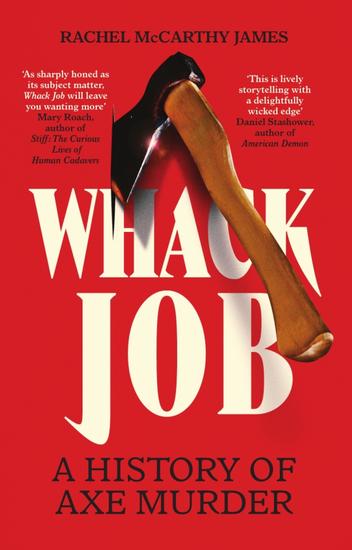
Whack Job - A History of Axe Murder - cover

Sorry, the publisher does not allow users to read this book from the country from which you are connecting.

Whack Job - A History of Axe Murder

Rachel McCarthy James

Publisher: Icon Books

  • 0
  • 0
  • 0

Summary

A brilliant and bloody examination of the axe's foundational role in human history, from prehistoric violence, to war and executions, splashed across newspaper headlines and popular culture.


For as long as the axe has been in our hands, we have used it to kill.


Much like the wheel, the boat, and the telephone, the axe is a transformative piece of technology ― one that has been with us since prehistory. And just as early humans used the axe to chop down trees, hunt for food, and whittle tools, they also used it to murder. Over time, this particular use has endured: as the axe evolved over centuries to fit the needs of new agricultural, architectural, and social development, so have our lethal uses for it.

Whack Job is the story of the axe, first as a convenient danger and then an anachronism, as told through the murders it has been employed in throughout history: from the first axe murder nearly half a million years ago, to the brutal harnessing of the axe in warfare, and from its use in King Henry VIII's favourite method of execution, to Lizzie Borden and the birth of modern pop culture. Whack Job sheds brilliant light on this familiar implement, this most human of weapons. This is a critical examination of violence, an exploration of how technology shapes human conflict, the cruel and sacred rituals of execution and battle, and the ways humanity fits even the most savage impulses into narratives of the past and present.
Available since: 05/22/2025.
Print length: 288 pages.

Other books that might interest you

  • A Man of Bad Reputation - The Murder of John Stephens and the Contested Landscape of North Carolina Reconstruction - cover

    A Man of Bad Reputation - The...

    Drew A. Swanson

    • 0
    • 0
    • 0
    Five years after the Civil War, North Carolina Republican state senator John W. Stephens was found murdered inside the Caswell County Courthouse. Stephens fought for the rights of freedpeople, and his killing by the Ku Klux Klan ultimately led to insurrection, Governor William W. Holden's impeachment, and the early unwinding of Reconstruction in North Carolina. In recounting Stephens's murder, the subsequent investigation and court proceedings, and the long-delayed confessions that revealed what actually happened at the courthouse in 1870, Drew A. Swanson tells a story of race, politics, and social power shaped by violence and profit. The struggle for dominance in Reconstruction-era rural North Carolina, Swanson argues, was an economic and ecological transformation. Arson, beating, and murder became tools to control people and landscapes, and the ramifications of this violence continued long afterward. The failure to prosecute anyone for decades after John Stephens's assassination left behind a vacuum, as each side shaped its own memory of Stephens and his murder. 


    The malleability of and contested storytelling around Stephens's legacy presents a window into the struggle to control the future of the South.
    Show book
  • Going Under - Kidnapping Murder and a Life Undercover - cover

    Going Under - Kidnapping Murder...

    John Madinger

    • 0
    • 0
    • 0
    A former law enforcement agent details his adventures during his career working undercover in this memoir. 
     
    “I just want to make sure I’ve got this right. You hanged all three of them? . . .”  
     
    That’s how it began, a case where the cops are crooks and the crooks are cops, a kidnapping where the victim is the bad guy, and the good guys must cross some lines to get him back. Welcome to the upside down and backward world of the undercover agent, where nothing is as it seems, and people—including the undercover—may not be what they appear. Going Under: Kidnapping, Murder, and A Life Undercover by former undercover agent John Madinger takes you into that world, and closer to the truth of the undercover experience than any other law enforcement memoir has ever gone. 
     
    “What is it like to work undercover?” You’re a sheepdog in wolf’s clothing, running with the pack, and Madinger ran with the wolves for almost two decades. Now he shares his story to give you a unique look at American crime and the “War on Drugs” from the perspective of both cops and criminals. You’ll go with the undercover cops to meetings with street-corner hustlers and rip-off artists and into the lives of America’s biggest rock stars, the world’s richest man, an Academy Award–winning actor, the marijuana traffickers conspiring to assassinate a federal judge, and the President of the United States. It’s an amazing ride, and there has never been another story like it.
    Show book
  • Early Years Part II The - The 1930s - The Goerge Hill Hodel Murders - cover

    Early Years Part II The - The...

    Steve Hodel

    • 0
    • 0
    • 0
    Twenty years before shocking the world in Los Angeles in 1947 as “The Black Dahlia Avenger”, did George Hodel terrorize California by committing some of its most infamous crimes and serial murders? 
    From the introduction: 
    In writing The Further Serial Crimes of George Hill Hodel, MD, The Early Years Part 1: 1920s, my original intent was to present all my father’s suspected crimes from the 1920s and 1930s in one edition. I have found this is simply not possible as it would require a book that would dwarf Dostoevsky’s nearly 700-page opus Crime and Punishment. Therefore, I will present “The Early Years” in two parts—two editions. This edition is part one and presents my investigations of his suspected crimes in the 1920s. Note that I said “suspected crimes”. I want to be crystal clear on this point. My two-part “Early Years” investigations are just that—a search for the truth. 
    In the presentation of these crimes from long ago (the first one goes back 100 years), I make no claim to a “solution”. I am not saying that my father, George Hill Hodel, committed any of these crimes beyond a “reasonable doubt”—which would be the legal requirement to find him guilty. 
    Several of these crimes—without the introduction of hard physical evidence or DNA—are not solvable. Others have been claimed “solved” by law enforcement and are considered “case closed”. To be clear: These crimes from the '20s and '30s did not present themselves to me post-Black Dahlia Avenger, published in 2003. I was aware of them and his possible involvement in them as early as the year 2000, a full three years before I presented my father to the world as the killer of Elizabeth “Black Dahlia” Short and the other LA Lone Woman Murders.
    Show book
  • The Boys of the Dark - A Story of Betrayal and Redemption in the Deep South - cover

    The Boys of the Dark - A Story...

    Robin Gaby Fisher, Michael...

    • 0
    • 0
    • 0
    The harrowing true story of the abuses two boys suffered at a Florida reform school and how they came together fifty years later to confront their attackers. 
     
    “[The Boys of the Dark] reads seamlessly… . . . A worthy exploration of a regrettably long-lasting true-crime nightmare.” —Kirkus Reviews 
     
    Michael O’McCarthy and Robert W. Straley were teens when they were termed “incorrigible youth” by authorities and ordered to attend the Florida School for Boys. They discovered in Marianna, the “City of Southern Charm,” an immaculately groomed campus that looked more like an idyllic university than a reform school. But hidden behind the gates of the Florida School for Boys was a hell unlike any they could have imagined. The school’s guards and administrators acted as their jailers and tormentors. The boys allegedly bore witness to assault, rape, and possibly even murder. 
     
    For fifty years, both men—and countless others like them—carried their torment in silence. But a series of unlikely events brought O’McCarthy, now a successful rights activist, and Straley together, and they became determined to expose the Florida School for Boys for what they believed it to be: a youth prison with a century-long history of abuse. They embarked upon a campaign that would change their lives and inspire others. 
     
    Robin Gaby Fisher, a Pulitzer Prize–winning journalist and author of the New York Times–bestselling After the Fire, collaborates with Straley and O’McCarthy to offer a riveting account of their harrowing ordeal. The book goes beyond the story of the two men to expose the truth about a century-old institution and a town that adopted a Nuremberg-like code of secrecy and a government that failed to address its own wrongdoing. What emerges is a tale of strength, resolve, and vindication in the face of the kinds of terror few can imagine. 
     
    “Haunting and disturbing. The voices of the victims will forever touch my heart. To turn a deaf ear to this type of injustice is to give permission for it to continue. As a people, as a society, we should be outraged.” —Jennifer Thompson, coauthor of Picking Cotton 
     
    “This deeply moving story is highly recommended to readers of heart-wrenching memoirs, 20th-century American studies, or true crime.” —Library Journal
    Show book
  • Evil People - cover

    Evil People

    Raphael Terra

    • 0
    • 0
    • 0
    This audiobook has been recorded using Text to speech (TTS). 
     
    History is full with psychotic killers. A horrific and utterly barbarous a list of murders and slayings. From the first documented serial killer who killed over 200 people to the one they called the Night Stalker, who used numerous weapons such as handguns, knives, a machete, a tire iron, and a hammer. The gruesome and depraved list is long... 
     
    The 16th century Hungarian Countess who holds the record being the most prolific female serial killer of all time with over 650 victims. 
     
    A serial killer in India hammered over 70 people to death. 
     
    In fact the list is almost endless. There is a darkness in some humans so deep and so black it is unfathomable to most... an evil we cannot escape... 
     
    This is the story of that darkness that haunts our souls and takes some over the precipice into a realm of abomination beyond description.
    Show book
  • The Golden State Killer Case - cover

    The Golden State Killer Case

    William Thorp

    • 0
    • 0
    • 0
    In 2018, police announced that they had finally arrested the "Golden State Killer," a man responsible for over 140 burglaries, fifty rapes, and at least thirteen murders committed in California throughout the 1970s and '80s. That man turned out to be a former California police officer, Joseph James DeAngelo Jr. 


    Just two months earlier, the publication of I'll Be Gone in the Dark by Michelle McNamara had rocked the world of true crime. Published two years after her death, the book charts McNamara's obsessive search for the prolific criminal who had been known over the years as the East Area Rapist, the Original Night Stalker, and the Visalia Ransacker, among other epithets. McNamara is credited with coining the "Golden State Killer" moniker and heightening public awareness of the—at the time—still unsolved case. 


    William Thorp dives into the investigation, exploring the dark side of sunny California, the advances in forensic innovation that made solving this case possible, and the story inside the story—one of an amateur sleuth who dedicated the last years of her life to understanding how one of the country's worst criminals could have spent so many decades undetected.
    Show book
