Begleiten Sie uns auf eine literarische Weltreise!
Buch zum Bücherregal hinzufügen
Grey
Einen neuen Kommentar schreiben Default profile 50px
Grey
Jetzt das ganze Buch im Abo oder die ersten Seiten gratis lesen!
All characters reduced
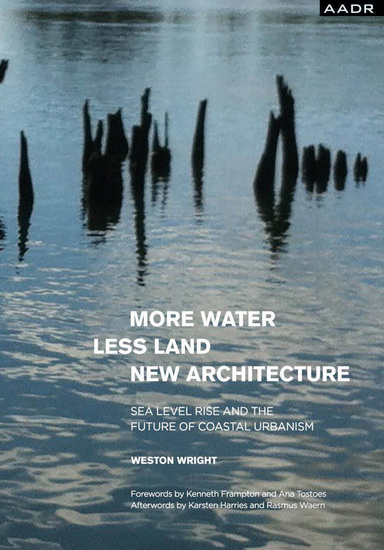
More water less land new architecture - sea level rise and the future of coastal urbanism - cover

More water less land new architecture - sea level rise and the future of coastal urbanism

Weston Wright

Verlag: AADR – Art Architecture Design Research

  • 0
  • 0
  • 0

Beschreibung

Climate change, and the inevitability of sea level rise, will require much more of us than simply pulling back from the coastline. The thesis of Weston Wright's More Water Less Land New Architecture is that we need to start thinking in an entirely different way about the relationship of cities to waterfront sites and of the relationship of buildings to water, which means rethinking many of architecture's implicit premises. If architecture has been confrontational with water—think bold towers erected beside the sea, as if to dare the water to challenge them—Wright's argument is that we will need to be modest, accommodating, and accepting of the power and presence of water if our cities are to survive. He knows that nature is stronger than we are, and that best chance mankind has to build successfully will be to build with, not against, the reality of water. This is an important book, not least because its quiet, sober tone balances natural history with architectural history, and reaches across the world to show examples of architecture that accommodates to the water ranging from small vernacular houses on stilts to huge megastructures anchored like islands in the sea. Although Wright's argument transcends aesthetics or style, his book is, in the end, a case for the strength that comes from restraint, and perhaps even for the lasting power of gentlenes
Verfügbar seit: 26.09.2023.
Drucklänge: 176 Seiten.

Weitere Bücher, die Sie mögen werden

  • The Cultural Politics of Affect and Emotion - A Case Study of Chinese Reality TV - cover

    The Cultural Politics of Affect...

    Wei Dong

    • 0
    • 0
    • 0
    Against the background of the media commercialization reform since the 1990s in China and drawing on the case of »X-Change« (2006-2019), Wei Dong investigates the affective meaning-making mechanism in the multimodal text of Chinese reality TV. The focus lies on the ways in which emotions are appropriated and disciplined by regimes of power and identity, and the ways in which affect - in this case primarily kuqing (bitter emotions) communicated by the material and the body - have the potential to challenge or exceed existing relations of power in the mediascape. Wei Dong shows how Chinese reality TV provides a historical and theoretical opportunity for understanding the affective structures of contemporary China in the dynamic process of fracture and integration.
    Zum Buch
  • Austin Osman Spare - The Life and Legend of London's Lost Artist; Revised & Expanded Edition - cover

    Austin Osman Spare - The Life...

    Phil Baker, Alan Moore

    • 0
    • 0
    • 0
    London has harbored many curious characters, but few more curious than the artist and visionary Austin Osman Spare (1886–1956). 


    A controversial enfant terrible of the Edwardian art world, the young Spare was hailed as a genius and a new Aubrey Beardsley, while George Bernard Shaw reportedly said "Spare's medicine is too strong for the average man." 


    But Spare was never made for worldly success and he went underground, falling out of the gallery system to live in poverty and obscurity south of the river. Absorbed in occultism and sorcery, voyaging into inner dimensions, and surrounding himself with cats and familiar spirits, he continued to produce extraordinary art while developing a magical philosophy of pleasure, obsession, and the subjective nature of reality. 


    Today Spare is both forgotten and famous, a cult figure whose modest life has been much mythologized since his death. This groundbreaking biographical study offers wide-ranging insights into Spare's art, mind, and world, reconnecting him with the art history that ignored him and exploring his parallel London; a bygone place of pub pianists, wealthy alchemists, and monstrous owls.
    Zum Buch
  • Louvre and the Hermitage The: The History and Contents of Europe’s Biggest Art Museums - cover

    Louvre and the Hermitage The:...

    Editors Charles River

    • 0
    • 0
    • 0
    The very name of the Louvre conjures up scenes of art and elegance, and of long halls filled with beauty and people strolling through them whispering quietly among themselves about the glories they are witnessing. Even those who have never been to the Louvre know some of its most prized possessions, from ancient statues to Leonardo Da Vinci’s “Mona Lisa”. As the world’s largest museum, the Louvre is unquestionably the cultural highpoint of Paris, a city that has long been considered the cultural center of Europe. 
    However, life is rarely as simple as one imagines, and the life of the Louvre is no different. While just about everyone is familiar with its history as an art museum, the Louvre’s history goes back over 800 years, and it used to have far different purposes, both as a medieval fortress and a palatial residence for French kings. The Louvre bore witness to mass murder during the French Revolution, and there have been countless accusations of theft and other questionable actions since its opening. 
    Catherine the Great came to power in the midst of the Enlightenment, which was flourishing in France and Britain, and she would rule as an Enlightened ruler. A known correspondent of Voltaire’s, Catherine sought to modernize Russia and turn it into a force in its own right, creating a rich and cultured court at the same time. Over the course of nearly 35 years in power, Catherine ushered in the Russian Enlightenment and presided over a period of time known as the Golden Age of the Russian Empire. 
    Moreover, Catherine had an unmatched passion for the arts, and she began a private art collection that would eventually evolve into galleries upon galleries of historical treasures shipped in from all over the world. This fabled museum was none other than the Hermitage, located in the heart of Saint Petersburg, a city founded by the imperial empire's very own Peter the Great.
    Zum Buch
  • The Truth Behind the Knights Templar - Warriors Secrets and the Rise and Fall of a Legendary Order - cover

    The Truth Behind the Knights...

    Tony Bailey

    • 0
    • 0
    • 0
    The Knights Templar were one of the most powerful military orders of the Middle Ages—warriors, bankers, and legends wrapped in mystery. But were they truly protectors of Christendom, or was there something more to their secretive rituals? 
    This audiobook explores the real history, myths, and conspiracies surrounding the Templars. Learn about their role in the Crusades, their banking empire, their rumored connection to the Holy Grail, and their dramatic downfall at the hands of King Philip IV and the Catholic Church. 
    The Truth Behind the Knights Templar is a must-listen for history lovers, medieval enthusiasts, and anyone fascinated by secret societies and legendary warriors.
    Zum Buch
  • How Do We Look - The Body the Divine and the Question of Civilization - cover

    How Do We Look - The Body the...

    Mary Beard

    • 0
    • 0
    • 0
    From prehistoric Mexico to modern Istanbul, Mary Beard looks beyond the familiar canon of Western imagery to explore the history of art, religion, and humanity. 
      
    Conceived as an accompaniment to “How Do We Look” and “The Eye of Faith,” the famed Civilisations shows on PBS, renowned classicist Mary Beard has created this elegant volume on how we have looked at art. Focusing in Part I on the Olmec heads of early Mesoamerica, the colossal statues of the pharaoh Amenhotep III, and the nudes of classical Greece, Beard explores the power, hierarchy, and gender politics of the art of the ancient world, and explains how it came to define the so-called civilized world. In Part II, Beard chronicles some of the most breathtaking religious imagery ever made—whether at Angkor Wat, Ravenna, Venice, or in the art of Jewish and Islamic calligraphers—to show how all religions, ancient and modern, have faced irreconcilable problems in trying to picture the divine. With this classic volume, Beard redefines the Western- and male-centric legacies of Ernst Gombrich and Kenneth Clark. 
      
    "Readers will be grateful to have wise, witty Beard as guide and companion … Beard is charming and insightful piece by piece."—San Francisco Chronicle
    Zum Buch
  • The Jewel in Mumbai - cover

    The Jewel in Mumbai

    Bikram Dandiya

    • 0
    • 0
    • 0
    The Global Vipassana Pagoda in Mumbai was built to mark the birth centenary year of Sayagyi U Ba Khin, the Burmese Dhamma teacher of S.N. Goenka. The monument is built in the Myanmar style of the Shwedagon pagoda, as a token of gratitude to that country where the essence of the Buddha’s teachings was maintained in its pristine purity, and from where it is now spreading throughout India, and via India to the rest of the world. Mr. S.N. Goenka became the vehicle to make this happen and was the inspiring guide for every important aspect of this building project. Tremendous volition and effort went into the building of this staggering monument, and it is interesting and educative to explore the journey. Mr. Bikram Dandiya has beautifully chronicled some of these experiences in this booklet, The Jewel in Mumbai, the story of the making of the crystal bud atop the Global Vipassana Pagoda.
    Zum Buch