Rejoignez-nous pour un voyage dans le monde des livres!
Ajouter ce livre à l'électronique
Grey
Ecrivez un nouveau commentaire Default profile 50px
Grey
Abonnez-vous pour lire le livre complet ou lisez les premières pages gratuitement!
All characters reduced
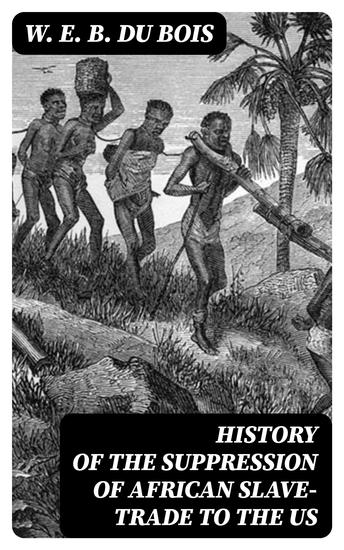
History of the Suppression of African Slave-Trade to the US - Enriched edition - cover

History of the Suppression of African Slave-Trade to the US - Enriched edition

W.E.B. Du Bois

Maison d'édition: DigiCat

  • 0
  • 0
  • 0

Synopsis

In "History of the Suppression of African Slave-Trade to the US," W. E. B. Du Bois meticulously chronicles the historical context surrounding the transatlantic slave trade, its economic implications, and the political shifts that contributed to its eventual suppression. Employing a rigorous analytical style enriched with primary sources and quantitative data, Du Bois positions the slave trade not merely as a relic of cruelty but as a critical element in the socio-economic fabric of American history. This work serves as a foundational text within African American studies and leaves an indelible mark on environmental history by connecting ecological perspectives to the exploitation of African peoples. W. E. B. Du Bois, a preeminent sociologist, historian, and civil rights activist, utilized his extensive background in sociology and history to shed light on injustices faced by African Americans. His landmark dual exposure to both African American and European sociocultural perspectives fueled a passion for uncovering the complexities of race relations in the United States. Du Bois's own experiences as a descendant of enslaved people imbued his scholarship with personal urgency and depth. "History of the Suppression of African Slave-Trade to the US" is recommended for scholars, educators, and anyone interested in understanding the historical underpinnings of race and inequality in America. Du Bois's incisive arguments and rich historical analysis provide the reader with essential insights into the American identity, making this book a pivotal read for historians and activists alike.

In this enriched edition, we have carefully created added value for your reading experience:
- A succinct Introduction situates the work's timeless appeal and themes.
- The Synopsis outlines the central plot, highlighting key developments without spoiling critical twists.
- A detailed Historical Context immerses you in the era's events and influences that shaped the writing.
- An Author Biography reveals milestones in the author's life, illuminating the personal insights behind the text.
- A thorough Analysis dissects symbols, motifs, and character arcs to unearth underlying meanings.
- Reflection questions prompt you to engage personally with the work's messages, connecting them to modern life.
- Hand‐picked Memorable Quotes shine a spotlight on moments of literary brilliance.
- Interactive footnotes clarify unusual references, historical allusions, and archaic phrases for an effortless, more informed read.
Disponible depuis: 13/11/2022.
Longueur d'impression: 286 pages.
D'autres livres qui pourraient vous intéresser

  • The Science of Reading - Information Media and Mind in Modern America - cover

    The Science of Reading -...

    Adrian Johns

    • 0
    • 0
    • 0
    For the first time, the story of how and why we have plumbed the mysteries of reading, and why it matters today. 
      
    Reading is perhaps the essential practice of modern civilization. For centuries, it has been seen as key to both personal fulfillment and social progress, and millions today depend on it to participate fully in our society. Yet, at its heart, reading is a surprisingly elusive practice. This book tells for the first time the story of how American scientists and others have sought to understand reading, and, by understanding it, to improve how people do it. 
     
    Starting around 1900, researchers—convinced of the urgent need to comprehend a practice central to industrial democracy—began to devise instruments and experiments to investigate what happened to people when they read. They traced how a good reader’s eyes moved across a page of printed characters, and they asked how their mind apprehended meanings as they did so. In schools across the country, millions of Americans learned to read through the application of this science of reading. At the same time, workers fanned out across the land to extend the science of reading into the social realm, mapping the very geography of information for the first time. Their pioneering efforts revealed that the nation’s most pressing problems were rooted in drastic informational inequities, between North and South, city and country, and white and Black—and they suggested ways to tackle those problems. 
     
    Today, much of how we experience our information society reflects the influence of these enterprises. This book explains both how the science of reading shaped our age and why, with so-called reading wars still plaguing schools across the nation, it remains bitterly contested.
    Voir livre
  • THINK Again to Embrace Change - "Unlock your potential! Experience dynamic audio lessons that empower transformative change and success" - cover

    THINK Again to Embrace Change -...

    Jasper Eldridge

    • 0
    • 0
    • 0
    THINK Again to Embrace Change 
    ⭐⭐ A Simplified Guide & Explanations Included ⭐⭐ 
    Are you eager to advance in your career and reinforce your knowledge to successfully pass the A0 Exam? 
    Searching for an all-encompassing guide that covers every essential aspect to ace the A0 Exam? 
    Your quest ends here! 
    This guide is your ultimate companion for enhancing your understanding, honing your skills, and participating in practical exercises. With this resource, you are set for success. 
    Updated to reflect the current A0 Exam Structure. 
    Key features of this enhanced guide: 
    - In-depth insights into A0 Exam Certification 
    - Comprehensive explanations of the A0: Challenge beliefs, expand understanding, unlock new possibilities 
    - Effective strategies for exam preparation and problem-solving 
    This guide stands out through its thorough coverage, which is crucial for your success in the exam. Concepts are explored in detail rather than just skimmed over. 
    Please note that this guide is not connected to any official A0 entity and serves solely as an independent resource for your benefit. 
    Crafted with a clear and logical layout, our A0 Exam Guide enables smooth transitions between topics. Say farewell to complex jargon and embrace straightforward, precise, and technically sound content. 
    So, why hesitate? Click the BUY NOW button, get your guide, and embark on your path to A0 Exam success!
    Voir livre
  • History's Turn - Understanding the Fragile Moments in History That Determined Our Future (2 Titles) - cover

    History's Turn - Understanding...

    Marcus Draysun

    • 0
    • 0
    • 0
    This book contains the following two titles: 
    If the South Had Won: The American Civil War's Alternate Ending - The outcome of the Civil War changed dramatically in this alternate history, with the South emerging victorious. The Confederacy’s early victories redefined the course of the conflict and set the stage for a dramatically different future. One of the key factors in the South’s triumph was the strategic advantage gained in the opening years of the war. With superior military leadership, especially from General Robert E. Lee, the Confederacy was able to exploit the Union’s weaknesses and win crucial battles that would eventually shift the momentum in their favor. The Battle of Gettysburg, for instance, saw Confederate forces turning the tide of battle in their favor. With the Union forces retreating, the South captured key northern territories, including Washington D.C., which became a symbol of Confederate dominance. 
    Red Dawn: What If the Soviets Had Prevailed in the Cold War? - The Cold War, which dominated much of the 20th century, was a clash of ideologies, political ambitions, and global power struggles. It was a battle between two superpowers, the United States and the Soviet Union, each determined to impose its vision of the future upon the world. The Cold War never boiled over into full-scale war, but the fear of nuclear annihilation and the constant threat of conflict shaped the political landscape. But what if the Soviet Union had won this prolonged battle, and the world as we know it had unfolded differently?
    Voir livre
  • Contentment - The Peaceful Mind - Finding Satisfaction in the Present - cover

    Contentment - The Peaceful Mind...

    Esther Jameson

    • 0
    • 0
    • 0
    Contentment is the quiet acceptance of life as it unfolds, embracing both the moments of joy and the challenges that shape our experience. It is not a fleeting emotion or a temporary state of mind, but a deeper sense of peace and fulfillment that comes from within. In a world driven by the pursuit of more—more success, more wealth, more recognition—contentment offers a counterbalance, inviting us to find satisfaction in the present rather than constantly striving for an elusive future. 
    This chapter explores the concept of contentment as a way of life, emphasizing that true satisfaction is rooted in our ability to appreciate the here and now. Instead of measuring our worth by external achievements or comparing ourselves to others, contentment encourages us to turn inward and acknowledge our inherent value. It is a state of mind that nurtures self-acceptance and a profound sense of inner calm, even when circumstances around us may be less than ideal. 
    The journey towards contentment begins with understanding the nature of our desires and the societal pressures that often drive us to chase after more. By questioning the idea that constant accumulation or the relentless pursuit of goals equates to happiness, we open the door to a more balanced and meaningful existence. In this light, contentment is not about complacency or settling for mediocrity; rather, it is about recognizing and celebrating the small moments that enrich our lives and contribute to our overall well-being.
    Voir livre
  • Capitalism and Inequality - Exploring the Economic Divide in a Capitalist Society - cover

    Capitalism and Inequality -...

    Arlo Holders

    • 0
    • 0
    • 0
    Capitalism, as an economic system, is based on private ownership of the means of production and the creation of goods or services for profit. In capitalist societies, market forces—supply and demand—determine the distribution of resources and wealth. This system is characterized by competition, limited government intervention, and the pursuit of profit. Over time, capitalism has evolved in response to global events, technological advancements, and changes in social and political structures. However, a fundamental aspect of capitalism that persists is the inherent inequality it creates. 
    Inequality in capitalist societies can be understood in several forms: wealth inequality, income inequality, and social inequality. Wealth inequality refers to the uneven distribution of assets like property, stocks, and savings, where a small percentage of the population controls a large share of the wealth. Income inequality, on the other hand, concerns the differences in wages and salaries among workers, managers, and capital owners. Social inequality arises from disparities in access to resources like education, healthcare, and housing, which are often shaped by economic factors. 
    At the heart of capitalist inequality is the idea that economic success is determined by individual effort, entrepreneurship, and market performance. While this promotes competition and innovation, it also leads to stark divides between the wealthy and the poor. Those who control capital—such as land, factories, or intellectual property—are in a position to accumulate wealth far faster than those who rely solely on their labor. This uneven accumulation of wealth deepens the divide between rich and poor, creating a cycle where the wealthy continue to grow their resources, while those at the bottom struggle to access basic needs.
    Voir livre
  • Global Capitalism - How the World's Economies Are Interconnected and Influenced - cover

    Global Capitalism - How the...

    Arlo Holders

    • 0
    • 0
    • 0
    Global capitalism refers to the interconnected economic system that spans across national borders, where capital, goods, services, and labor move freely to create a global market. The emergence of global capitalism is deeply intertwined with historical shifts in political, technological, and economic structures, particularly the acceleration of trade and investment in the late 20th and early 21st centuries. At its core, global capitalism is driven by the logic of profit maximization, competition, and the pursuit of economic efficiency on a global scale. 
    The roots of global capitalism can be traced to the rise of industrial capitalism in the 18th and 19th centuries, which laid the foundation for an interconnected global economy. With the expansion of imperialism, the development of transportation technologies like steamships and railways, and the establishment of international financial institutions, economic activity increasingly transcended national boundaries. The post-World War II period saw an unprecedented acceleration of this trend, with institutions like the International Monetary Fund (IMF) and the World Bank being established to facilitate international economic cooperation and development. The creation of the World Trade Organization (WTO) in 1995 further integrated global markets by promoting free trade and reducing trade barriers.
    Voir livre