Rejoignez-nous pour un voyage dans le monde des livres!
Ajouter ce livre à l'électronique
Grey
Ecrivez un nouveau commentaire Default profile 50px
Grey
Abonnez-vous pour lire le livre complet ou lisez les premières pages gratuitement!
All characters reduced
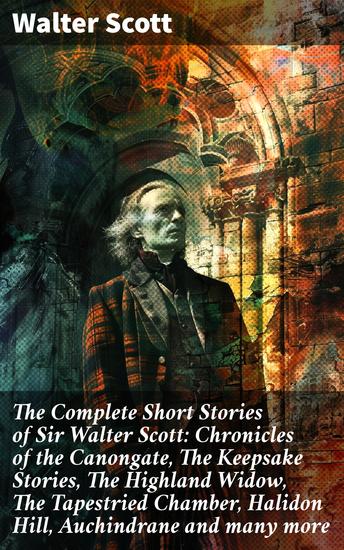
The Complete Short Stories of Sir Walter Scott: Chronicles of the Canongate The Keepsake Stories The Highland Widow The Tapestried Chamber Halidon Hill Auchindrane and many more - cover

The Complete Short Stories of Sir Walter Scott: Chronicles of the Canongate The Keepsake Stories The Highland Widow The Tapestried Chamber Halidon Hill Auchindrane and many more

Walter Scott

Maison d'édition: Good Press

  • 0
  • 0
  • 0

Synopsis

In "The Complete Short Stories of Sir Walter Scott," the esteemed author weaves a rich tapestry of narrative that delves into the cultural and historical fabric of Scotland. This collection showcases Scott's masterful storytelling, blending elements of folklore, romance, and adventure, while addressing social issues of his time. Literary techniques such as vivid characterization and atmospheric descriptions anchor the reader in the Scottish landscape, making the tales resonate within their historical contexts, from the idyllic beauty of the Highlands to the turbulent history encapsulated in stories like "Halidon Hill" and "The Highland Widow." Walter Scott, a pivotal figure in the Scottish literary revival, was deeply influenced by his own heritage, political affairs, and the rich oral traditions of Scotland. His works reflect a keen interest in the past, as well as a desire to forge a national identity through literature during the early 19th century. Scott'Äôs dedication to the revival of Scottish history and culture is evident in these stories, reflecting both his widespread popularity and enduring legacy in romantic and historical literature. For readers seeking to immerse themselves in the enchanting world of Scottish folklore and history, Scott's collection is an invaluable treasure. The tales offer unique insights into human nature, community struggles, and resilience against adversity, making this anthology a compelling read for connoisseurs of classic literature and those new to Scott's imaginative realms.
Disponible depuis: 06/01/2024.
Longueur d'impression: 390 pages.
D'autres livres qui pourraient vous intéresser

  • A Hunger Artist - A study in artistic pursuit and the sacrifices one must make - cover

    A Hunger Artist - A study in...

    Franz Kafka

    • 0
    • 0
    • 0
    Franz Kafka was born on 3rd July 1883 in Prague, then in Bohemia, the eldest of 6, into a middle-class Jewish family. 
     
    Life for the young Kafka and his passion for literature was often made an ordeal by his over-bearing and domineering entrepreneur of a father.   
     
    In 1889 Kafka was sent to the Deutsche Knabenschule, an elementary school in Prague. His father would only allow him to be educated in German-speaking schools and even went so far as to limit visits to the synagogue to four a year. 
     
    In 1901 he graduated from the classics-oriented Altstädter Gymnasium. Kafka did well there and across a large range of subjects.  He now enrolled at the Charles Ferdinand University, to study chemistry, but quickly switched to law for which he obtained his degree in June 1906 and then performed the mandatory year of unpaid service as clerk at the civil and criminal courts. 
     
    A job at an Italian insurance company left him little time to write and after a year he took another job with the Worker's Accident Insurance Institute for the Kingdom of Bohemia where he stayed until ill health led to his resignation in 1922. 
     
    Although he saw work as a means to pay the bills and to allow him time to write, he received several promotions and was noted as a good employee. 
     
    By 1917 Kafka was suffering from tuberculosis, which required frequent periods of convalescence. Interspersed with this, were several intense affairs before he settled in Berlin with Dora Diamant, a 25-year-old kindergarten teacher who herself having left the ghetto now influenced Kafka's interest in the book of Jewish law, the Talmud. 
     
    Kafka’s on-going health was littered with problems. Apart from TB there were several other ailments, including migraines, insomnia, boils, depression, all usually brought on by excessive stresses and strains. He attempted to counteract all of this by naturopathic treatments, a vegetarian diet and consuming large quantities of unpasteurized milk. 
     
    His tuberculosis still worsened. He returned to Prague, where he died on 3rd June 1924. He was 40. 
     
    His literary works are few in number but towering in influence.  His masterpieces include ‘The Trial’, ‘The Metamorphosis’ as well as a number of short stories which reveal facets of humankind that truthfully could only be born from Kafka’s brain and pen.
    Voir livre
  • The Encantadas - cover

    The Encantadas

    Herman Melville

    • 0
    • 0
    • 0
    "The Encantadas, or Enchanted Isles" is a novella by American author Herman Melville. First published in Putnam's Magazine in 1854, it consists of ten philosophical "Sketches" on the Encantadas, or Galápagos Islands. It was collected in The Piazza Tales in 1856. The Encantadas was a success with the critics, and contained some of Melville's "most memorable prose".
    An anonymous narrator unites the ten disparate "Sketches", each of which begin with a few lines of poetry, mostly taken from Edmund Spenser's The Faerie Queene. All of the stories are replete with symbolism reinforcing the cruelty of life on the Encantadas. "Sketch First" is a description of the islands; though they are the Enchanted Isles they are depicted as desolate and hellish. "Sketch Second" is a meditation on the narrator's encounter with ancient Galápagos tortoises, while "Sketch Third" concerns the narrator's trip up the enormous tower called the Rock Rodondo. "Sketch Fourth" details the narrator's musings from atop the tower, and his recollection of the islands' accidental discovery by Juan Fernández. "Sketch Fifth" describes the USS Essex' encounter with a phantom British ship near the area during the War of 1812.
    Voir livre
  • The Green Mouse - cover

    The Green Mouse

    Anonyme

    • 0
    • 0
    • 0
    In this whimsical tale, two inventors unveil a device that reveals one’s ideal romantic partner, inadvertently sparking chaos throughout New York. Their experiment entangles a skeptical journalist and a spirited heiress in a humorous chase of fate, coincidences, and unexpected affection, testing whether scientific matchmaking can truly guide the human heart. Amid public frenzy, they learn love defies prediction, and their invention forges bonds.
    Voir livre
  • The Odd Women - cover

    The Odd Women

    George Gissing

    • 0
    • 0
    • 0
    Before he was 21 George Gissing conceived the ambition of writing a long series of novels, somewhat in the manner of Balzac, whom he admired. The first of these, Workers in the Dawn, appeared in 1880, to be followed by 21 others. Between 1886 and 1895 he published one or more novels every year. He also wrote Charles Dickens: A Critical Study (1898), a perceptive piece of literary criticism.Gissing's work has a good deal of documentary interest for its detailed and accurate accounts of lower-middle-class London life. On the social position and psychology of women, he is particularly acute: The Odd Women is a powerful study of female frustration. He did not lack human sympathies, but his obvious contempt for so many of his characters reflects an artistic limitation. Gissing was deeply critical, in an almost wholly negative way, of contemporary society. Of his novels, New Grub Street, considered by some critics to be his only great book, is unique in its merciless analysis of the compromises required by the literary life.Gissing's 1893 novel takes on the 19th century "Woman Question" by looking at themes of feminism, marriage, and love. The novel raises these issues through the lives of several contrasting women: Mary Barfoot, a feminist philanthropist who helps train women for careers; her close friend Rhoda Nunn, who believes marriage is a disastrous choice for women; and Monica Madden, who starts out as one of their protegees but chooses to marry a seemingly kind older man. As Monica experiences the challenges of married life, Rhoda finds herself drawn to Mary's cousin, the charming but apparently profligate Everard
    Voir livre
  • David Swan - From their pens to your ears genius in every story - cover

    David Swan - From their pens to...

    Nathaniel Hawthorne

    • 0
    • 0
    • 0
    Nathaniel Hawthorne was born on 4th July 1804 in Salem, Massachusetts, a town synonymous with the earlier Salem Witch Trials. It was instrumental in Hawthorne’s later use of American Gothic and dark romanticism in his writing. 
    He was a mere four years old when his father died and his mother took him and his two sisters to live with her family and then on to their own home in Raymond, Maine. The young Hawthorne had a passion for fiction and poetry and voraciously read the works of Ann Radcliffe, Henry Fielding and Lord Byron.  
    He was sent to college at his maternal uncle’s insistence. During these years he met and befriended Henry Wadsworth Longfellow and future U S president Franklin Pierce. These friendships were lifelong and to have a crucial impact on his writings and career.  
    At college Hawthorne had made attempts at writing short stories and essays but without opportunities to publish. It was only in 1828 that he finally published his novel ‘Franshawe’ to little success and so he began work as editor for the American Magazine of Useful and Entertaining Knowledge.  
    Hawthorne’s short stories were first published in magazines but in 1837 were collected and published as ‘Twice-Told Tales’. A steady literary career still did not come his way and so he worked in a good position at Salem’s port and married the love of his life Sophia Peabody. They moved to live in ‘The Old Manse’ at Concord, Massachusetts.   
    Finally. in 1850 came spectacular literary and commercial success with ‘The Scarlet Letter’ followed by ‘The House of the Seven Gables’ the following year.  
    In 1852, Hawthorne published a biography of presidential candidate Franklin Pierce. After Pierce’s victory he was appointed consul in Liverpool, a position that offered prestige, money and fame. At the end of this appointment he returned several times to Europe before settling in Massachusetts and resuming writing and publication. 
    During the early 1860’s his health declined and on 19th May 1864 during a trip to Plymouth, New Hampshire. He was 59 and was buried in Sleepy Hollow Cemetery in Concord, Massachusetts.
    Voir livre
  • Boiled Beef of New England The (Unabridged) - cover

    Boiled Beef of New England The...

    Charles Dickens

    • 0
    • 0
    • 0
    Charles Dickens was a writer and social critic who created some of the world's best-known fictional characters and is regarded as the greatest novelist of the Victorian era. His works enjoyed unprecedented popularity during his lifetime, and by the twentieth century critics and scholars had recognised him as a literary genius. His novels and short stories enjoy lasting popularity.
    THE BOILED BEEF OF NEW ENGLAND: The shabbiness of our English capital, as compared with Paris, Bordeaux, Frankfort, Milan, Geneva almost any important town on the continent of Europe I find very striking after an absence of any duration in foreign parts.
    Voir livre