Rejoignez-nous pour un voyage dans le monde des livres!
Ajouter ce livre à l'électronique
Grey
Ecrivez un nouveau commentaire Default profile 50px
Grey
Abonnez-vous pour lire le livre complet ou lisez les premières pages gratuitement!
All characters reduced
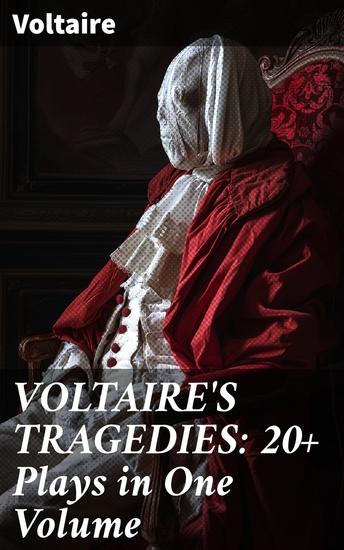
VOLTAIRE'S TRAGEDIES: 20+ Plays in One Volume - Dramatic Enlightenment: Voltaire's Tragic Masterpieces - cover

VOLTAIRE'S TRAGEDIES: 20+ Plays in One Volume - Dramatic Enlightenment: Voltaire's Tragic Masterpieces

Voltaire

Traducteur William F. Fleming

Maison d'édition: Good Press

  • 0
  • 0
  • 0

Synopsis

In "Voltaire's Tragedies: 20+ Plays in One Volume," readers are invited into the intricate world of dramatic expression as the renowned philosopher and playwright Voltaire explores themes of fate, justice, and the human condition. Comprising over twenty plays, this collection embodies Voltaire's distinctive literary style'Äîcharacterized by sharp wit, persuasive dialogue, and a masterful use of dramatic irony. Set against the backdrop of the Enlightenment, these tragedies critique society and challenge moral conventions, offering a rich commentary on the politics and philosophies of Voltaire's time. Voltaire, a pivotal figure of the Enlightenment, used his literary talents as a vehicle for social critique and philosophical inquiry. Born Fran√ßois-Marie Arouet in 1694, his tumultuous life experience'Äîincluding imprisonment and exile'Äîshaped his views on tyranny and injustice, manifesting powerfully in his dramatic works. Influenced by classical tragedy and contemporary social issues, Voltaire's ability to weave complex characters into moral dilemmas highlights his keen insight into human nature and societal flaws. This collection is highly recommended for scholars, students, and fans of drama alike. It not only offers an extensive overview of Voltaire's theatrical prowess but also invites contemporary audiences to engage with timeless themes of power, suffering, and the quest for truth. Readers will find in these pages not only entertainment but also profound reflections on the intricacies of human existence.
Disponible depuis: 10/01/2024.
Longueur d'impression: 1030 pages.

D'autres livres qui pourraient vous intéresser

  • Sinuous Heart - cover

    Sinuous Heart

    Fay van Burg

    • 0
    • 0
    • 0
    In our timeless, fast-paced world, Sinuous Heart delves into the haunting emotional landscapes of our relationships, both romantic and platonic. This poignant poetry collection captures the essence of loneliness that often lingers in empty connections, leaving us yearning for authenticity and companionship.  
    Through vivid imagery and heartfelt language, Fay van Burg delves into the struggles of maintaining intimacy and sincerity in a time when distractions abound, and meaningful encounters are fleeting. With lines that pulse with both pain and beauty, Sinuous Heart paints a striking portrait of the heart’s journey, a whirlwind of reality where joy and sorrow exist side by side.  
    Readers will find solace in these verses, reflecting on their own emotional battles of the shared human experience when seeking connection in a disconnected world. This collection is a testament to the strength of vulnerability. The words within are an invitation to embrace the complexity of our hearts as we, as one, navigate love, loss, and everything in between.
    Voir livre
  • The Two Voices - An autobiographical poem written by Tennyson after his friend committed suicide - cover

    The Two Voices - An...

    Alfred Lord Tennyson

    • 0
    • 0
    • 0
    Alfred Tennyson was born on August 6th, 1809, in Somersby, Lincolnshire, the fourth of twelve children. 
    Most of Tennyson's early education was under the direction of his father, although he did spend four unhappy years at a nearby grammar school.  He also showed an early and burgeoning talent for writing; by the age of twelve he had written a 6,000-line epic poem.  
    In the 1820s, however, Tennyson’s father began to suffer frequent mental breakdowns exacerbated by his alcoholism. One brother had frequent violent quarrels with his father, a second would be confined to an insane asylum, and another was later an opium addict. 
    Tennyson left home in 1827 to join his brothers at Trinity College, Cambridge and with it escape from Somersby. At Trinity he was those who knew little of the problems that clouded his life. Although shy he was keen to make new friends; he was handsome, intelligent, humorous, and a gifted impersonator. 
    That same year, he and his brother Charles published Poems by Two Brothers. It attracted the attention of the “Apostles," a select undergraduate literary club led by Arthur Hallam. They provided friendship and confidence. Hallam and Tennyson became the best of friends. 
    The pair, in the summer of 1830, were involved in a ridiculous jaunt to take money and secret messages to revolutionaries plotting to overthrow the Spanish king. Tennyson's political enthusiasm was marginal compared to Hallam's, but he was glad to make his first trip abroad.  
    The landscape and atmosphere of the Pyrenees generated such wonderful poems as "Oenone," "The Lotus-Eaters;" inspired by a waterfall in the mountains; and "The Eagle;" invoked from the sight of the great hunters circling above them. The small village of Cauteretz and the surrounding valley became a location Tennyson would return to many times over the next sixty years. 
    In 1830, he published Poems, ‘Chiefly Lyrical’ and in 1832 a volume entitled ‘Poems’.  Tennyson, stung by the harshness of several reviews, would not publish again for nine years.  
    In the autumn of 1833, in what was meant as a gesture of gratitude and reconciliation to his father, Hallam accompanied him to the Continent. In Vienna Hallam died suddenly of apoplexy as a result of a congenital malformation of the brain.  
    Hallam’s death, together with that of his father and a myriad of anxieties, stem-ming mainly from the belief that his family were grimly attached to poverty, and fears that he might become a victim of epilepsy, madness, alcohol, and drugs, as others in his family had, or that he might die like Hallam, conspired to upset the delicate balance of Tennyson's emotions.  
    In 1836, he became engaged to Emily Sellwood. From their correspondence it is clear that she was very much in love with him. He seems to excessively worry about not having the financial means to marry.  He was also falling into trances, which he thought were connected with the epilepsy from which other family members suffered. To marry, he thought, would mean passing on the disease to any children he might father. He broke off the engagement. 
    During these years he used the dark feelings and events to write many of his finest works; "Ulysses," "Morte d'Arthur," "Tithonus," "Tiresias," and "Break, break, break."  
    In 1842 Tennyson’s Poems (in two volumes) was a tremendous critical and popular success.  
    In 1845 he was granted a government pension of £200 a year in recognition of his poetic achievements and his financial need.  Despite this financial support his doubts persisted.  
    Life for Tennyson was becoming increasingly productive and more lucrative.  By 1849 ‘The Princess’ had been published. He was now offered a large advance if he would assemble his elegies on Hallam into one complete poem.  
    Tennyson had now also resumed his relationship with Emily Sellwood and by the following year was talking again of marrying her. 
    In the Spring of 1850 the Poet Laureate William Wordsworth died and a new Laureate was
    Voir livre
  • Partners - cover

    Partners

    D.M. D.M.McGowan

    • 0
    • 0
    • 0
    Thomas Brash is trying to escape, but knows he never will. No thinking person can escape from their past. Pursuing him is the memory of the family he lost to cholera. Perhaps he believes that traveling alone in a wild, dangerous land will end all his memories; there is no doubt he wishes to be alone. Whatever his intentions, the appearance of Frank Clement and the circumstances of that meeting upset those plans. 
    Brash views Clement as an uneducated child who requires fatherly protection and guidance. Clement views Brash as a tenderfoot and can not understand how anyone who knows so little could live so long. These two loners are joined by others, and they all become partners. Having achieved relative sanctuary and surrounded by civilization, their wilderness past comes back to haunt them.
    Voir livre
  • Rhyme A Dozen A - Friendship - 12 Poets 12 Poems 1 Topic - cover

    Rhyme A Dozen A - Friendship -...

    Jane Austen, Michael Drayton, A...

    • 0
    • 0
    • 0
    ‘A dime a dozen’ as known in America, is perhaps equal to the English ‘cheap as chips’ but whatever the lingua franca of your choice in this series we hereby submit ‘A Rhyme a Dozen’ as 12 poems on many given subjects that are a well-rounded gathering, maybe even an essential guide, from the knowing pens of classic poets and their beautifully spoken verse to the comfort of your ears. 
     
    01 - A Rhyme A Dozen - 12 Poems, 12 Poets, 1 Topic - Friendship - An Introduction 
    02 - Mock Panegyric On A Young Friend by Jane Austen 
    03 - To My Most Dearly Beloved Friend by Michael Drayton 
    04 - My Friend by James Elroy Flecker 
    05 - The Lost Friend by Amy Levy 
    06 - The Best Friend by Meribah Abbott 
    07 - Friendship's Mystery To My Dearest Lucasia by Katherine Philips 
    08 - To My Best Friend by Francis Ledwidge 
    09 - The Value of Friendship by Confucius 
    10 - Friendship by Pieter Cornelisazoon Hooft 
    11 - Friends Departed by Henry Vaughan 
    12 - From Love To Friendship by Voltaire 
    13 - A Shropshire Lad LVII - You Smile Upon Your Friend Today by A E Housman
    Voir livre
  • A Doll's House - cover

    A Doll's House

    Henrik Ibsen

    • 0
    • 0
    • 0
    Immerse yourself in the timeless drama of "A Doll's House" by Henrik Ibsen, now available as a captivating audiobook. Follow the gripping story of Nora Helmer, a woman trapped in a suffocating marriage and societal expectations, as she embarks on a journey of self-discovery and empowerment. 
    In this groundbreaking play, Ibsen confronts themes of gender roles, identity, and autonomy with piercing insight and emotional depth. As listeners follow Nora's courageous quest for freedom and independence, they'll be drawn into a world of secrets, deception, and moral complexity. 
    Perfect for lovers of classic literature and thought-provoking drama, "A Doll's House" offers a compelling exploration of the human condition and the quest for personal fulfillment. Whether you're a fan of Ibsen's work or discovering it for the first time, this audiobook promises to captivate and inspire. 
    So, if you're ready to experience the power and poignancy of one of the greatest plays in theatrical history, start listening to "A Doll's House" today and immerse yourself in the timeless beauty of Henrik Ibsen's masterpiece.
    Voir livre
  • Loss-iLahleko (A National Choreopoem) - The Audio Experience - cover

    Loss-iLahleko (A National...

    Qhali, Sanela Lasta Mkhize,...

    • 0
    • 0
    • 0
    Loss-iLahleko (A National Choreopoem): The Audio Experience invites you on a heartfelt journey of loss and return. This audio adaptation brings the choreopoem from the full-length book Loss-iLahleko (A National Choreopoem) to life, offering a deeply moving literary and sonic experience. 
    The full-length book is a richly layered work with four parts: a multilingual choreopoem exploring loss through songs and poems by South African female authors in Indigenous languages and English; short South African stories reflecting the lived experiences of countless women and children, including Finding Katlego and Palesa's Lockdown Escape by Elaine Pillay, Elo Phupho by Bulelwa Sigcau, and Fizza by Qhali; motivational reminders offering hope; and key information on Gender-Based Violence (GBV). Each piece sensitively weaves forms of GBV into a tapestry of voices that speak to resilience, suffering, and healing. 
    This audiobook immerses listeners in the vivid worlds of the choreopoem, seamlessly moving between English and South Africa’s Indigenous languages. It reflects the resilience, trauma, and strength of women and children while echoing the languages of their mothers, bearing witness to the persistent uncertainty and lack of security in the land they call home. 
    Loss-iLahleko is SA’s first multilingualised book series on GBV, written and translated into 11 books by extraordinary South African female writers in all the country’s official languages. To explore the full book, visit the publisher’s website. 
    Trigger Warning: This experience includes themes of GBV which may be distressing for some listeners. Please listen with care. 
    Executive Producer, Producer, Creative Director, Curator, Music Co-Producer & Arranger: Qhali 
    Music Composer, Sound Engineer, Sound Design & Post Production: Yaw Bannerman  
    Music Co-Producer, Lead Music Performer, Arranger: Lasta 
    Music Performer 2: Nonkuthalo Kolweni
    Voir livre