Join us on a literary world trip!
Add this book to bookshelf
Grey
Write a new comment Default profile 50px
Grey
Subscribe to read the full book or read the first pages for free!
All characters reduced
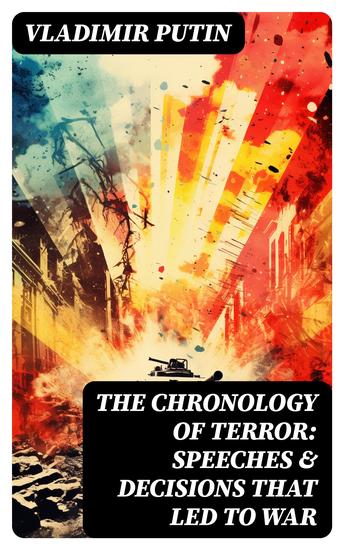
The Chronology of Terror: Speeches & Decisions That Led to War - President Putin's Essays Statements Executive Orders and Speeches - cover

The Chronology of Terror: Speeches & Decisions That Led to War - President Putin's Essays Statements Executive Orders and Speeches

Vladimir Putin

Publisher: DigiCat

  • 0
  • 0
  • 0

Summary

In "The Chronology of Terror: Speeches & Decisions That Led to War," Vladimir Putin presents an incisive examination of the geopolitical events that have shaped contemporary warfare, especially in the context of Russia's role in global conflicts. Written in a direct and analytical style, the book weaves a narrative that connects historical speeches and strategic decisions, revealing the interplay between rhetoric and military action. Putin employs a chronological approach, utilizing primary sources and personal reflections to illustrate his arguments, thus offering readers a framework to understand the complexities of modern warfare and its roots in past actions. Vladimir Putin, a former intelligence officer and the long-standing President of Russia, draws inspiration from his extensive experience in Russian and global politics. His unique perspective as a leader who has navigated through various crises and conflicts informs this work, as it encapsulates his views on statecraft and the necessity of assertive leadership in turbulent times. Putin's position allows him to access key historical moments, making his analysis not just relevant but critically significant for understanding contemporary issues. This compelling book is essential for anyone interested in global politics, military history, and the profound effects of leadership decisions in times of crisis. Readers will find that Putin's reflections encourage deeper contemplation about the moral and strategic implications of war in the modern world, making it a thought-provoking addition to the discourse surrounding international relations.
Available since: 11/26/2023.
Print length: 932 pages.

Other books that might interest you

  • Taming Urban Indians - Outlook on Urban India's lack of Civic Sensibilities - cover

    Taming Urban Indians - Outlook...

    Allister Robert

    • 0
    • 0
    • 0
    Callousness towards lack of civic sense which you would have experienced and insights on desired etiquettes are drawn in this publication on non-prescriptive tangents. 
    Intriguing and inspiring, it throws light on propriety deficiencies widely considered trivial in urban India, through compelling stories and real life experiences.
    Show book
  • The Duty of Civil Disobedience - cover

    The Duty of Civil Disobedience

    Henry David Thoreau

    • 0
    • 0
    • 0
    The Duty of Civil Disobedience by Henry David Thoreau, narrated by Marcus Locke, is a thought-provoking essay that explores the individual's moral responsibility to resist unjust government actions. Written in 1849, Thoreau's work has become a cornerstone of political philosophy, advocating for peaceful protest and nonviolent resistance to oppressive authority. Thoreau emphasizes the importance of following one's conscience over conforming to laws that violate fundamental human rights. 
    Narrator Marcus Locke brings Thoreau’s powerful message to life, delivering the essay with clarity and conviction. His narration invites listeners to reflect on their role in society and the power of individual action against injustice. Locke’s voice captures the calm yet resolute tone of Thoreau’s work, making this audiobook an engaging and inspiring experience for those interested in civil rights, social justice, and personal activism. 
    This audiobook is perfect for listeners drawn to philosophical works and the history of social movements, as well as anyone seeking inspiration for standing up for their beliefs. The Duty of Civil Disobedience remains a timeless call to action, encouraging peaceful resistance to unjust laws and policies.
    Show book
  • Liberal Tradition in America The: Book Summary & Analysis - cover

    Liberal Tradition in America...

    Briefly Summaries

    • 0
    • 0
    • 0
    This is a concise summary and analysis of The Liberal Tradition in America, by Louis Hartz.
     
    It is not the original book and is not affiliated with or endorsed by Louis Hartz.
    Ideal those seeking a quick and insightful overview.
     
    The Liberal Tradition in America is a profound exploration of the unique development of liberal thought in the United States. This seminal work examines the absence of a feudal past and its impact on the country's ideological trajectory, arguing that America's political culture has been defined by an enduring commitment to individualism, property rights, and liberal values. Through incisive historical analysis, the book sheds light on the nation's distinct political identity, its influence on domestic and foreign policy, and the limitations of liberalism in addressing social inequalities. Essential for students of American history and political philosophy, this work offers an enduring framework for understanding the nation's intellectual heritage.
    Show book
  • Repeat - A Warning from History - cover

    Repeat - A Warning from History

    Dennis Glover

    • 0
    • 0
    • 0
    Are we seeing history repeat itself?
    An urgent, surprising and altogether persuasive read, Repeat: A Warning from History will open your eyes.
    We live in an age that seems eerily familiar. A time of dictators, populists, organised lying, European wars, grabs for territory, ideological extremism and antisemitism. A time when things are falling apart and the centre is struggling to hold. The insurrection on the Capitol in January 2021 evoked chilling memories of the calamity of Hitler in the 1920s and 30s. The world needs to learn the lessons of these decades, and fast. Dennis Glover retells the story of the interwar years in a series of lessons drawn from unfolding events and the unheeded omens of those who spoke out but were ignored.
    Show book
  • Not so Black and White - A History of Race from White Supremacy to Identity Politics - cover

    Not so Black and White - A...

    Kenan Malik

    • 0
    • 0
    • 0
    A powerful new history of the idea of race, forcing us to rethink today’s culture wars. 
     
    Is white privilege real? How racist is the working class? Why has left-wing antisemitism grown? Who benefits most when anti-racists speak in racial terms? 
     
    The ‘culture wars’ have generated ferocious argument, but little clarity. This book takes the long view, explaining the real origins of ‘race’ in Western thought, and tracing its path from those beginnings in the Enlightenment all the way to our own fractious world. In doing so, leading thinker Kenan Malik upends many assumptions underpinning today’s heated debates around race, culture, whiteness and privilege. 
     
    Malik interweaves this history of ideas with a parallel narrative: the story of the modern West’s long, failed struggle to escape ideas of race, leaving us with a world riven by identity politics. Through these accounts, he challenges received wisdom, revealing the forgotten history of a racialised working class, and questioning fashionable concepts like cultural appropriation. 
     
    Not So Black and White is both a lucid history rewriting the story of race, and an elegant polemic making an anti-racist case against the politics of identity.
    Show book
  • Why Palestine?: Reflections From Singapore - cover

    Why Palestine?: Reflections From...

    Walid Jumblatt Abdullah

    • 0
    • 0
    • 0
    If you’ve ever wondered why people keep talking about Palestine, or the point of keeping up with a long-drawn conflict in the Middle East and what difference you could possibly make, this book is for you. Political analyst and podcaster Walid Jumblatt Abdullah takes on questions that Singaporeans have often raised about Palestine, laying out answers that clarify and inform. 
     
    Walid examines myths (“Could Gaza Have Been Singapore?”) and sheds light on the double standards of Western powers, to whom human rights seem to matter, except for where Palestine is concerned. Explaining how the Palestinians have been systematically dehumanised for decades, the book highlights how they continue to exist nevertheless, their very existence an act of resistance. 
     
    Why Palestine? is an illuminating starting point for newcomers to the issue, and a passionate primer that seasoned activists will welcome for capturing the heart and hope of a long-disenfranchised people and those who support them.
    Show book