Begleiten Sie uns auf eine literarische Weltreise!
Buch zum Bücherregal hinzufügen
Grey
Einen neuen Kommentar schreiben Default profile 50px
Grey
Jetzt das ganze Buch im Abo oder die ersten Seiten gratis lesen!
All characters reduced
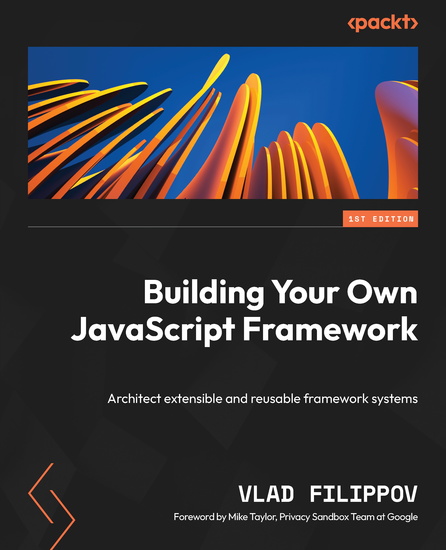
Building Your Own JavaScript Framework - Architect extensible and reusable framework systems - cover

Building Your Own JavaScript Framework - Architect extensible and reusable framework systems

Vlad Filippov

Verlag: Packt Publishing

  • 0
  • 0
  • 0

Beschreibung

JavaScript frameworks play an essential role in web application development; however, no single framework works perfectly for all projects. This book will help you understand existing projects, design new software architecture, and maintain projects as they grow. You’ll go through software architecture principles with JavaScript, along with a guided example of structuring your project and maintenance guidance.
This book covers framework planning aspects, enabling you to identify key stakeholders, understand JavaScript API design, and leverage complex abstraction. The second part of the book takes a practical programming approach to building your own framework by showing you how to structure modules and interfaces. As you advance, you’ll discover how to develop data-binding components, work with JavaScript APIs, and much more. While writing a framework is half the job, continuing to develop it requires effort from everyone involved. The concluding chapters help to achieve this by teaching you the crucial aspects of software maintenance and highlighting the constants of framework development.
By the end of this book, you’ll have gained a clear understanding of the JavaScript framework landscape, along with the ability to build frameworks for your use cases.
Verfügbar seit: 03.11.2023.
Drucklänge: 236 Seiten.

Weitere Bücher, die Sie mögen werden

  • Sit Stay Heal - What Dogs Can Teach Us About Living Well - cover

    Sit Stay Heal - What Dogs Can...

    Renee Alsarraf

    • 0
    • 0
    • 0
    “Written with grace and emotional honesty, Sit, Stay, Heal will live with you long after the last page.”— John Grogan, bestselling author of Marley & Me 
    For more than two decades, esteemed veterinary oncologist Dr. Renee Alsarraf treated cancer in her beloved canine patients. Then, at age fifty-one, she was diagnosed with cancer herself. 
    Sit, Stay, Heal: What Dogs Can Teach Us About Living Well is Dr. Renee’s unforgettable testament to the extraordinary healing nature of dogs. Every day in her veterinary practice, she bears witness to the undeniable bond between pets and their people. However, while we are busy teaching them to “sit” and “stay,” they have their own, more profound, lessons to impart. In Sit, Stay, Heal, we meet Cosmo, the golden retriever who arrives at Renee’s office just before his fourteenth family vacation to the beach; Daisy, the cocker spaniel, an emotional support dog for a special needs child; and Franny, the bloodhound, a police dog who wasn’t ready to retire from the force. Then there’s Dr. Renee’s own dog Newtie, who falls ill when she needs him most. 
    Our dogs are wise in ways humans are not. For Dr. Renee, it was her patients—those furry, four-legged, slobbering animals—who seemed to uniquely understand her difficult journey and who showed her the true power of positivity and unconditional love. Full of life lessons and healing metaphors, perfect dogs and their imperfect humans, Sit, Stay, Heal is a captivating, heartwarming story for dog lovers far and wide.
    Zum Buch
  • Classical Mechanics - A Detailed Study of Mechanics and Dynamics - cover

    Classical Mechanics - A Detailed...

    Mark Hedges

    • 0
    • 0
    • 0
    Classical mechanics is the foundation of physics, describing the motion of objects under the influence of forces. It is based on Newtonian principles and provides the groundwork for various fields such as engineering, astronomy, and applied sciences. This chapter introduces the fundamental concepts, historical context, and different approaches to classical mechanics. 
    Classical mechanics originated with the pioneering work of Galileo Galilei and Sir Isaac Newton. Galileo’s studies of motion laid the foundation for Newton’s laws, which were later formalized in Philosophiæ Naturalis Principia Mathematica (1687). These laws revolutionized the understanding of motion and force, enabling precise predictions of mechanical systems. Before Newton, the Aristotelian view dominated, which incorrectly stated that objects require a continuous force to remain in motion. Newton’s insights replaced this with the concept of inertia, fundamentally changing physics. 
    At its core, classical mechanics describes the relationship between forces, motion, and energy. It assumes that time and space are absolute and independent entities. Unlike quantum mechanics and relativity, which describe extreme conditions, classical mechanics applies to everyday objects moving at speeds much lower than the speed of light. The field is traditionally divided into several branches, including kinematics, which studies motion without considering forces, and dynamics, which examines forces and their effects.
    Zum Buch
  • The Role of Technology in Business - Tools and Strategies - cover

    The Role of Technology in...

    Craig Dames

    • 0
    • 0
    • 0
    Technology has played a crucial role in shaping business operations throughout history. From the earliest tools used in trade to the sophisticated digital solutions of today, technological advancements have continually transformed how businesses operate, compete, and innovate. Understanding this evolution provides insight into how businesses can adapt to ongoing technological changes and leverage them for growth and efficiency. 
    In the earliest days of commerce, businesses relied on manual processes, basic tools, and rudimentary systems to conduct trade. The invention of writing and accounting methods, such as the use of clay tablets in Mesopotamia, marked the first major technological leap in business operations. These early records enabled merchants to track transactions and manage resources more effectively. Over time, the development of paper money, banking systems, and mechanical tools further revolutionized trade and commerce, laying the foundation for more complex economic structures. 
    The Industrial Revolution in the 18th and 19th centuries marked another significant turning point in business technology. The introduction of steam engines, mechanized production, and telecommunication systems drastically increased efficiency and productivity. Factories replaced traditional handcrafting methods, allowing mass production and global trade expansion. The telegraph and telephone revolutionized communication, enabling businesses to operate over long distances and conduct transactions more quickly than ever before.
    Zum Buch
  • Social Capital: Life online in the shadow of Ireland’s tech boom - cover

    Social Capital: Life online in...

    Aoife Barry

    • 0
    • 0
    • 0
    A David and Goliath story about Ireland’s role as prime real estate for the world’s largest tech multinationals, and the considerable impact it has had on us as individuals. 
    At the start of the millennium, the Tech giants landed on Ireland’s shores. Dublin, once one of Europe’s poorest cities, became a beacon of Silicon Valley’s promise of progress and power. As the face of the capital was remade in the image of Big Tech, Irish society embraced technology like no other. Romantic Ireland was dead and gone: social media was here to stay. 
    In this provocative account, Aoife Barry explores the human cost of Ireland’s Faustian pact with Big Tech, from the local communities uprooted by Google to the traumatised moderators squirrelled in the capital’s pockets, keeping the internet safe at a terrible price. Unsettling, insightful, and wryly funny, she paints a portrait of a country addicted to the internet, refreshing the news, refreshing Twitter, scrolling and scrolling towards a feverish future. She turns an equally honest eye on her own life online, from her humble beginnings using dial-up in her parent’s kitchen to working for Ireland’s first digital-only newsroom, and asks what we bargain in exchange for life in the metaverse. 
    Social Capital is the coming of age story of Ireland 3.0: set against the backdrop of the tech revolution, it chronicles how we collapse the boundary between physical and virtual reality, and where we might go from here. 
    Barry's new book, Social Capital, is a popular science exploration into the world of computers and information technology. It's a top pick for anyone interested in the intersection of culture, economics, and the latest developments in the tech industry. 
    For fans of Bill Gifford (Ledyard), Britney Spears (The woman in me), Dolly Alderton (Everything I Know About Love), Bono (Surrender), and Ian H. Robertson (How Confidence Works). 
    HarperCollins 2023
    Zum Buch
  • Artificial Intelligence - Machine Learning and Data Science in the 21st Century - cover

    Artificial Intelligence -...

    Victor Servings

    • 0
    • 0
    • 0
    The principle of artificial intelligence has been around since the 1970s. Originally, the primary objective was for computers to make choices with no input from people. However, it never ever caught on, partially because system administrators could not find out how to utilize all the information. Even if some could understand the value in the data, it was really difficult to utilize, even for engineers. 
      
    On top of that, the challenge of extracting data from the simple databases of 3 decades ago was huge. Early AI applications would spit out reams of data, most of which wasn't sharable or adaptive to different business needs.
    Zum Buch
  • Mystical Matter - Unlocking the Secrets of the Universe's Dark Ingredients - cover

    Mystical Matter - Unlocking the...

    Dirk Fallon

    • 0
    • 0
    • 0
    The universe we see is only a small fraction of what actually exists. All the stars, planets, galaxies, and nebulae make up less than five percent of the total mass and energy in the cosmos. The rest remains invisible, undetectable by traditional telescopes, and yet it shapes the structure and evolution of everything. Scientists refer to this unseen majority as dark matter and dark energy — mysterious ingredients that hold the key to understanding the true nature of the universe. 
    The mystery began when astronomers started noticing something strange in the way galaxies moved. Based on the visible matter alone, galaxies should not hold together. They rotate so fast that stars on the outer edges should fly off into space. But they don’t. Something must be providing the extra gravity needed to keep them in place. This unseen substance is what scientists call dark matter. It does not emit light, reflect it, or interact with electromagnetic radiation in any detectable way. Yet its gravitational effects are undeniable. 
    In the 1930s, Swiss astronomer Fritz Zwicky was one of the first to point out this discrepancy. He observed clusters of galaxies and found that there wasn’t enough visible mass to account for the gravitational forces at work. He proposed the existence of “dunkle Materie,” or dark matter, to explain the missing mass. His ideas were largely ignored at the time, but decades later, further evidence confirmed his observations. Today, dark matter is widely accepted as a fundamental part of the universe, even though we still don’t know what it’s made of.
    Zum Buch