Begleiten Sie uns auf eine literarische Weltreise!
Buch zum Bücherregal hinzufügen
Grey
Einen neuen Kommentar schreiben Default profile 50px
Grey
Jetzt das ganze Buch im Abo oder die ersten Seiten gratis lesen!
All characters reduced
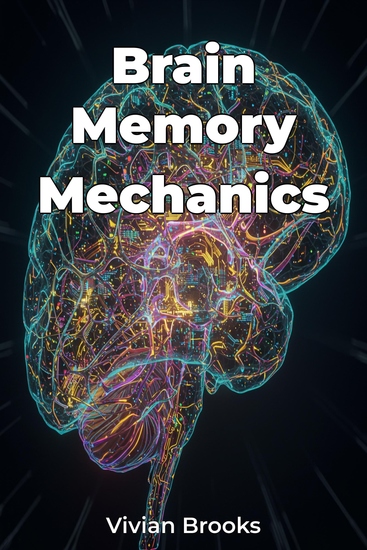
Brain Memory Mechanics - cover

Brain Memory Mechanics

Vivian Brooks

Übersetzer A AI

Verlag: Publifye

  • 0
  • 0
  • 0

Beschreibung

Brain Memory Mechanics explores the fascinating neuroscience behind how our brains create and store memories. The book investigates the neural mechanisms involved in memory encoding, consolidation, and retrieval, revealing how fleeting moments transform into lasting experiences that shape our perceptions.

 
Did you know that memory isn't a single process, but a dynamic interplay across brain regions like the hippocampus, amygdala, and prefrontal cortex? This book emphasizes understanding how synaptic plasticity, the strengthening or weakening of connections between neurons, forms the biological basis of memory.

 
The book uniquely integrates findings from molecular mechanisms to systems-level dynamics, offering a comprehensive view of memory. Beginning with the neuroanatomy of memory, it progresses through cellular and molecular processes, long-term storage, and different types of memory, such as episodic and semantic.

 
By using evidence from electrophysiological studies, neuroimaging, and lesion studies, the book provides a balanced, evidence-based approach, making complex concepts accessible to students and anyone interested in cognitive psychology and the science of memory.

 
Ultimately, understanding brain memory can help us improve learning strategies, combat memory disorders, and appreciate its significance in daily life.
Verfügbar seit: 22.02.2025.
Drucklänge: 78 Seiten.

Weitere Bücher, die Sie mögen werden

  • Mussolini As Revealed In His Political Speeches - cover

    Mussolini As Revealed In His...

    Benito Mussolini

    • 0
    • 0
    • 0
    “It’s better to live one day as a lion than 100 years as a sheep.” 
     
    "I am the most terrible animal that's ever existed." 
     
    "Democracy is beautiful in theory; in practice, it is a fallacy. You in America will see that someday." 
     
    "It's good to trust others but, not to do so is much better." 
     
    “I feel, when we have no friends upon whom to lean, or to look for moral guidance." (Mussolini) 
     
    This audiobook contains over 60 of Mussolini's earlier speeches, covering the years 1914-1923: from soon after his expulsion from the Socialist Party for supporting WWI, to his becoming Prime Minister yet still submitting outwardly to democratic rule. (He seized power, threw off the democratic yoke, and became dictator in 1925-1927. 
     
    Benito Amilcare Andrea Mussolini, born on July 29, 1883, who went by the nickname “Il Duce” (“the Leader”), was a deeply unbalanced tyrannical Italian dictator who created the dreaded Fascist Party in 1919. Eventually, he held all power in Italy as the country’s prime minister from 1922 to 1943. An ardent socialist as a youth, Mussolini followed in his father's political footsteps but was expelled by the party for his overt support of World War I. As an evil dictator during World War II (even murdering his own son by lethal injection) he greatly overextended his forces and was eventually killed by his own people in Mezzegra, Italy. Here, for the first time, are the words of the great dictator himself in his twisted manifesto on the political movement he started and is still so feared to this very day.
    Zum Buch
  • How I Found the Lost Atlantis! by Dr Paul Schliemann - narrated by Michael Henrik Wynn - cover

    How I Found the Lost Atlantis!...

    Dr. Paul Schliemann

    • 0
    • 0
    • 0
    The article on which this audio book is based was published in the 'New York American' on October 20th, 1912.  
    The author, Dr. Paul Schliemann, was the grandson of Heinrich Schliemann (1822 - 1890), a founder of modern archaeology. In this famous archaeological hoax he makes outrageous and sensational claims about the lost continent Atlantis, and his grandfather’s research.  
    The text was written in an age when many of the Victorian adventure writers, like H. Rider Haggard in Britain, Emilio Salgari in Italy and Karl May in Germany topped reading lists. In 1912, the jungle calls of Tarzan echoed through American pulp magazines for the very first time.  
    Paul Schliemann capitalizes on the contemporary craze for his grandfather’s archaeological discoveries, for lost worlds and legendary characters like the queen of Sheba and Prester John. Since 1907, Howard Carter had been excavating in Egypt, and in 1922 Carter made his historical discovery of the tomb of Tutankhamun. 
    Paul Schliemann’s article is highly entertaining, and features passages reminiscent of Indiana Jones. Michael Henrik Wynn, the editor of the educational net radio stream Historyradio.org, gives a spirited performance of what has become a classic and much loved hoax in archaeological circles.
    Zum Buch
  • Reclaiming Art in the Age of Artifice - A Treatise Critique and Call to Action (Manifesto) - cover

    Reclaiming Art in the Age of...

    J.F. Martel, Donna Tartt

    • 0
    • 0
    • 0
    A compelling call to rediscover the transformative power of art in an age of distraction, coercion, and spectacle – featuring an introduction from Pulitzer Prize–winning author Donna Tartt In Reclaiming Art in the Age of Artifice, J. F. Martel offers a compelling and incisive meditation on the nature of art in a world dominated by invasive media, rampant consumer culture, and artificial intelligence. Drawing on a wide range of examples, from Paleolithic cave art to contemporary cinema, Martel argues that true art reveals the unseen forces shaping our existence—forces that transcend politics, technology, and even culture. In contrast to artifice, which seeks to manipulate or distract, authentic art calls us back to the essence of things, opening “rifts” onto the sublime and the weird and reconnecting us with the radical mystery at the heart of the world.    Featuring an introduction by Pulitzer Prize–winning author Donna Tartt, this edition also includes a new afterword by the author, reflecting on the continued relevance of art in our increasingly mediated world.
    Zum Buch
  • Parallel Lives - A Love Story from a Lost Continent - cover

    Parallel Lives - A Love Story...

    Iain Pears

    • 0
    • 0
    • 0
    An extraordinary love story of two unlikely figures played out against the backdrop of the Cold War. 
      
    Best-selling novelist and art historian Iain Pears enchants readers with the real-life romance between Larissa Salmina, a Russian art curator, and Francis Haskell, a British art historian. His fabulous book brings into sharp focus the strange world of the Soviet Union, and the even stranger world of a certain variety of the English elite. It seeks to show how leaving the Soviet Union was a sacrifice for her and how it was the English man, not the Russian woman, who was set free because of their meeting. 
      
    Larissa was born in northern Russia, the daughter of a Soviet army officer from a noble family who survived the siege of Leningrad by eating cats’ tails and being evacuated over the ice. Francis was the grandson of an Iraqi Jew, forever feeling out of place in his adopted country of England. Parallel Lives is the story of how these two star-crossed lovers met, instantly understand each other, and were prepared to risk heartbreak, and in her case, retribution, to be together. 
      
    Escaping Leningrad, teenage Larissa lived in the Urals surrounded by Spanish revolutionaries, and after the war rose to become the youngest commissar in the Soviet Union and keeper of Italian drawings at the Hermitage. She took the Russian contribution to the Venice Biennale in 1962 and lost it on the journey. She briefly absconded with her supervisor’s corpse, developed a useful sideline in forgery, and stole (“I didn’t steal it. I liberated it”) a Matisse from the Italian government. Francis was a distinguished art historian, comfortably at home in King’s College Cambridge. But he was lonely, self-doubting, and had all but abandoned hope of falling in love. Larissa swept away all the years of anguish in one meal. 
      
    Iain Pears, who was neighbors with Larissa and Francis in Oxford, knew both his principal characters well. In telling Larissa and Francis’s love story, he is also capturing the Europe of a bygone era: a world of dancers, exiles, and the occasional spy, of artists, aristocrats, and academics. It is a tale of a world we have lost.
    Zum Buch
  • Life's Too Short to Pretend You're Not Religious - Reframed and Expanded - cover

    Life's Too Short to Pretend...

    David Dark

    • 0
    • 0
    • 0
    We can't just be done with religion, argues David Dark. The fact of religion is the fact of us. Religion is the witness of everything we're up to—for better or worse. 


    David Dark is one of today's most respected thinkers, public intellectuals, and cultural critics at the intersection of faith and culture. Since its original release, Dark's Life's Too Short to Pretend You're Not Religious has become essential reading for those engaged in the conversation on religion in contemporary American society. Now, Dark returns to his classic text and offers us a revised, expanded, and reframed edition that reflects a more expansive understanding, employs inclusive language, and tackles the most pressing issues of the day. 


    With the same keen powers of cultural observation, candor, and wit audiences have come to know and love, Dark weaves in current themes around the pandemic and vaccine responses, Black Lives Matter, the #MeToo and #ChurchToo movements, critical race theory, and more. By looking intentionally at our weird religious background (we all have one), he helps us acknowledge the content of our everyday existence—the good, the bad, and the glaringly inconsistent. When we make peace with the idea of being religious, we can more practically envision an undivided life.
    Zum Buch
  • Green Renaissance - Unveiling the Historical Influence of Cannabis on Wellness Lifestyle and Culture Worldwide - cover

    Green Renaissance - Unveiling...

    JM Balbuena

    • 0
    • 0
    • 0
    Embark on an eye-opening journey into the multifaceted world of one of the most vilified plant in the history of humanity. From its pre-historical roots to its groundbreaking future, this book explores the complexities and possibilities of the cannabis plant. Ever wondered about the significance of terms like 'THC' or 'wake and bake' or the difference between decriminalization and legalization? 
    Discover the vital role of activists, communities, and politicians and how their actions shaped the industry's past and continue to pave its future. Get an inside look at cannabis culture, complete with an exploration into the historical influence of the plant in wellness, lifestyle and culture. Understand the nuanced of policies, connect the dots between major historical events, dive into the legal challenges and opportunities that canna-preneurs currently face, and weigh in on the possible pros and cons of federal legalization. 
    With a blend of cultural insight, policy discussion and a nod to the cannabis culture that continues to bring people together, this book serves as an essential guide for anyone interested in the world of cannabis—be it as a consumer, advocate, entrepreneur, or curious George. Let this book be your hindsight to a rich history full of lessons learned, and your foresight to what lies ahead: a future filled with promise and potential.
    Zum Buch