Begleiten Sie uns auf eine literarische Weltreise!
Buch zum Bücherregal hinzufügen
Grey
Einen neuen Kommentar schreiben Default profile 50px
Grey
Jetzt das ganze Buch im Abo oder die ersten Seiten gratis lesen!
All characters reduced
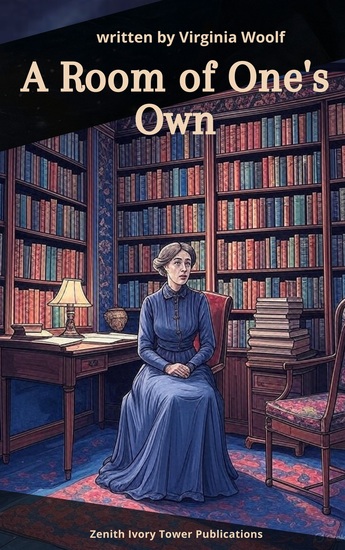
A Room of One's Own - The Groundbreaking Feminist Essay on Women Writing and Creative Freedom - cover

A Room of One's Own - The Groundbreaking Feminist Essay on Women Writing and Creative Freedom

Virginia Woolf, Zenith Ivory Tower Publications

Verlag: Zenith Ivory Tower Publications

  • 0
  • 0
  • 0

Beschreibung

What does a woman need to write? Virginia Woolf answered with a revolution.
A Room of One's Own is not just an essay—it's a manifesto for intellectual independence, creative equality, and artistic liberation.

Based on a series of lectures delivered at Cambridge in 1928, A Room of One's Own argues that women need both literal and figurative space—a private room and financial independence—to create literature. With wit, insight, and poetic power, Virginia Woolf exposes the social, historical, and economic barriers that have long silenced women's voices.

Blending memoir, fiction, and criticism, Woolf's essay remains a cornerstone of feminist thought and literary theory. She challenges institutions, imagines the lost works of Shakespeare's fictional sister, and calls on women to reclaim their right to create.

"A blazing beacon of feminist thought." — The New York Times
"Woolf's voice remains sharp, elegant, and necessary." — Roxane Gay
"Essential reading for every writer, thinker, and dreamer." — Goodreads Reviewer

Whether you're a writer, reader, or advocate for gender equality, A Room of One's Own will inspire you to question, reflect, and boldly pursue your creative freedom.

Click 'Buy Now' and enter one of the most important conversations in modern literature.
Verfügbar seit: 23.07.2025.
Drucklänge: 117 Seiten.
Weitere Bücher, die Sie mögen werden

  • Her Lover - From their pens to your ears genius in every story - cover

    Her Lover - From their pens to...

    Maxim Gorky

    • 0
    • 0
    • 0
    Alexei Maximovich Peshkov was born on 28th March 1868, in Nizhny Novgorod, Russia. 
    Better known as Maxim Gorky he was orphaned at 11 and ran away from home at 12.  At 19 he had already attempted suicide and thereafter travelled, by foot, across the Russian Empire for 5 years. 
    His first book ‘Essays & Stories’ in 1898 was a sensation and so began a long career as an author of short stories, novels and plays.  Gorky saw writing as a moral and political act that would help to change the unjust world around him.  He was an ardent early advocate of the emerging Marxist movement and publicly opposed the Tsarist regime leading several times to his arrest.  
    In 1904 he began his own theatre but the censor banned every play and Gorky was forced to abandon the project. 
    But Gorky was a financially successful author, editor, and playwright and gave monies to political parties as well as for civil rights and social reform.  The brutal shooting of workers, which set in motion the Revolution of 1905, pushed Gorky more decisively toward radical solutions.  
    In 1906 he went to the United States to raise funds for the Bolsheviks. Those experiences including a scandal over travelling with his lover and not his wife deepened his contempt for the ‘bourgeois soul.’ 
    Gorky now moved to Capri in Italy, both for health reasons and to escape the increasingly repressive times in Russia.  
    An amnesty for the 300th anniversary of the Romanov dynasty saw him return to Russia in 1914. His politics remained close to the Bolshevik cause.  But soon, after the 1918 revolution, his essays referred to Lenin as a tyrant for his senseless arrests and repression.  He was soon appealing to the outside world for food aid after the catastrophic crop failure. 
    In October 1921 Gorky returned to Italy, now in Fascist hands, and settled in Sorrento until 1932.  His health worsened with the onset of tuberculosis. 
    He wrote several successful books there but now decided to find an understanding with the communist regime. Stalin invited him home and his return was hailed as a major propaganda victory.  He was decorated with the Order of Lenin, and a province, a park, and various streets re-named in his honour. 
    But he had his faults too.  In 1933, Gorky co-edited a book on the White Sea-Baltic Canal and denied even a single prisoner died during its construction, but thousands had. As well, knowing that some Nazis were homosexual, a phrase was attributed to him that said ‘exterminate all homosexuals and fascism will vanish’.  Although he was himself was quoting another he was decidedly homophobic. 
    With the increase of Stalinist repression in 1935 Gorky was placed under unannounced house arrest. 
    Maxim Gorky died on the 18th June 1936 from pneumonia.  He was 68. 
    Stalin and Molotov were among those who carried Gorky's urn of ashes at his funeral.
    Zum Buch
  • Babbitt - cover

    Babbitt

    Sinclair Lewis

    • 0
    • 0
    • 0
    Lewis’ scathing satire of middle-class America, Babbitt explores the social pressures of conformity and materialism. It tells the story of George Babbitt, a middle-aged family man who becomes disillusioned with both conformity and his belated attempts at rebellion. Set in the fictional Midwestern town of Zenith, Babbitt offers a powerful critique of the American Dream and all it entails.
    Zum Buch
  • Anna Karenina (Part 4) - cover

    Anna Karenina (Part 4)

    Leo Tolstoy

    • 0
    • 0
    • 0
    Part 4: When Anna and Vronsky continue seeing each other, Karenin consults with a lawyer about obtaining a divorce. During the time period, a divorce in Russia could only be requested by the innocent party in an affair and required either that the guilty party confessed or that the guilty party be discovered in the act of adultery. Karenin forces Anna to hand over some of Vronsky's love letters, which the lawyer deems insufficient as proof of the affair. Stiva and Dolly argue against Karenin's drive for a divorce.
    Anna Karenina is a novel by the Russian author Leo Tolstoy, first published in book form in 1878. Many writers consider Anna Karenina the greatest work of literature ever, and Tolstoy himself called it his first true novel. It was initially released in serial installments from 1873 to 1877 in the periodical The Russian Messenger.
    Zum Buch
  • James (Giacomo) - English Version - cover

    James (Giacomo) - English Version

    Italo Svevo

    • 0
    • 0
    • 0
    Giacomo is a farmer that the narrator meets during a walk in the Friuli countryside and who tells him his story. Every time Giacomo finds a job he protests and ends up launching into propaganda and debates to convince his fellow workers to demand optimal working conditions, always causing big problems for his employers. Not finding any more jobs, he becomes a nomad, in vain search for a well-organized job. Therefore, practically non-existent. Until one day he is called back to his hometown for a particular job...
    Zum Buch
  • The Antiquary - cover

    The Antiquary

    Andrew Lang

    • 0
    • 0
    • 0
    The third novel in the Waverley series, and Scott's personal favorite, The Antiquary centers on a young man called Lovel who meets Jonathan Oldbuck, a loquacious old antiquary, on a trip to Scotland. There Lovel falls in love with the daughter of Sir Arthur Wardour, a local landowner. However, with no wealth or title to offer, Lovel's feelings go unrequited until an extraordinary act of courage.
    Zum Buch
  • Dream-Quest of Unknown Kadath The (Unabridged) - cover

    Dream-Quest of Unknown Kadath...

    H. P. Lovecraft

    • 0
    • 0
    • 0
    The Dream-Quest of Unknown Kadath is a novella by American writer H. P. Lovecraft. Begun probably in the autumn of 1926, the draft was completed on January 22, 1927 and it remained unrevised and unpublished in his lifetime. It is both the longest of the stories that make up his Dream Cycle and the longest Lovecraft work to feature protagonist Randolph Carter. Along with his 1927 novel The Case of Charles Dexter Ward, it can be considered one of the significant achievements of that period of Lovecraft's writing. The Dream-Quest combines elements of horror and fantasy into an epic tale that illustrates the scope and wonder of humankind's ability to dream.
    Zum Buch