Begleiten Sie uns auf eine literarische Weltreise!
Buch zum BĂĽcherregal hinzufĂĽgen
Grey
Einen neuen Kommentar schreiben Default profile 50px
Grey
Jetzt das ganze Buch im Abo oder die ersten Seiten gratis lesen!
All characters reduced
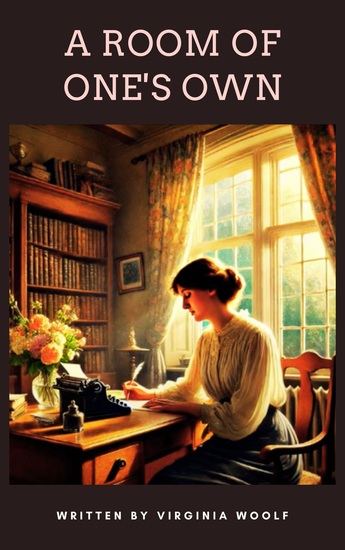
A Room of One's Own - A Voice of Independence - cover

A Room of One's Own - A Voice of Independence

Virginia Woolf, Zenith Crescent Moon Press

Verlag: Zenith Crescent Moon Press

  • 0
  • 0
  • 0

Beschreibung

🌟 Immerse yourself in Virginia Woolf's eloquent and thought-provoking masterpiece, A Room of One's Own. This seminal work of feminist literature challenges societal norms and explores the profound relationship between women, creativity, and independence.
🖋️ Inspired by a series of lectures delivered by Woolf in 1928, this essay delves into the barriers women face in achieving artistic and intellectual freedom. Woolf argues with piercing clarity that for a woman to succeed as a writer, she needs both financial independence and a private space to call her own.
đź’ˇ Through her timeless prose, Woolf illuminates the constraints of gender inequality, while envisioning a world where women can freely pursue their passions and potential. Her reflections remain as relevant and powerful today as they were nearly a century ago, igniting discussions about equity, creativity, and empowerment.
🌍 Recognized as a cornerstone of feminist literature, A Room of One's Own has inspired generations of readers and writers alike. Ideal for anyone passionate about gender equality, literature, or intellectual freedom, this book offers an enriching and transformative reading experience.
👉 Click now to explore Virginia Woolf's enduring vision of freedom, creativity, and the power of a woman's voice.
VerfĂĽgbar seit: 18.03.2025.
Drucklänge: 128 Seiten.

Weitere Bücher, die Sie mögen werden

  • Tulip Mania - The First Economic Bubble Caused by Speculative Dutch Investors - cover

    Tulip Mania - The First Economic...

    Kelly Mass

    • 0
    • 0
    • 0
    Tulip Mania, often considered the first recorded speculative bubble in history, took place during the Dutch Golden Age in the early 17th century. This period saw some tulip bulbs, which had been newly introduced to Europe, achieve extraordinary prices. The peak of the tulip market occurred in 1634, with prices reaching unbelievable levels before plummeting drastically in February 1637. This event is frequently cited as an early example of an asset bubble, where the prices of goods diverged dramatically from their intrinsic value. The tulip mania of the 1630s remains one of the most notable cases of speculative fever in financial history. 
    Despite the frenzied speculation surrounding tulips, the overall economic impact on the Dutch Republic was limited. While the tulip mania itself was a unique socio-economic event, it did not significantly harm the prosperity of the Dutch economy. In fact, the Dutch Republic was one of the world's leading economic and financial powers during the 17th century, boasting the highest per capita income in the world from around 1600 to 1720. The country’s financial and economic institutions were advanced, and its economy continued to thrive even as the tulip market collapsed. Today, the term "tulip mania" has evolved into a metaphor used to describe any situation in which asset prices become detached from their underlying value, only to be followed by a sharp decline.
    Zum Buch
  • Friendship Love Autism - Communication Challenges and the Autism Diagnosis that Gave Us a New Life Together - cover

    Friendship Love Autism -...

    Michelle Preston, Andrew Preston

    • 0
    • 0
    • 0
    Andrew didn’t realize he might be autistic until his girlfriend, Michelle, approached him about it months into their relationship. No amount of life experience could’ve prepared Michelle for the confusion she felt while dating Andrew, as he was unlike any man she had ever dated before. The thought never dawned on her that she could fall deeply in love with a man who was autistic or that he might be unaware of this, even into his thirties. 
     Whenever they share their story, they are asked the same three questions: 
     How did you figure out Andrew was autistic? 
     How did you approach him about it? 
     How did you get a diagnosis? 
    These are all fair questions and have interesting and often comedic answers. In this compelling book, Michelle and Andrew answer these questions and share much more. 
    You will follow along as their friendship unexpectedly blossoms into a relationship. You will see love flourish among ridiculous twists and turns. They bring you along for the autism diagnosis that allowed them to grow a deeper understanding of each other. 
    Andrew’s contributions to this book are invaluable as they give insight as to what life is like to be him. Michelle’s humor and authenticity are both unexpected and refreshing. 
    Come along on this outrageous journey of friendship turned to love on the spectrum. 
     “You’ll laugh, you’ll cry, and you’ll see numerous people you are close to through a whole new lens! This book is a must-read for people of all ages and walks of life.” (Teresa de Grosbois, number one international best-selling author of Mass Influence) 
    Photos can be found at: Bellamimalifestyles.com
    Zum Buch
  • The Complete Enochian Dictionary - A Dictionary of the Angelic Language as Revealed to Dr John Dee and Edward Kelley - cover

    The Complete Enochian Dictionary...

    Donald C. Laycock, Edward...

    • 0
    • 0
    • 0
    The complete reference for understanding the Enochian language (“the language of the angels”), the proper pronunciation of the letters of the Enochian alphabet, and the use of evocations to call forth celestial beings and perform Enochian magic.   In 1581, Dr. John Dee, an advisor in the court of Queen Elizabeth I, began a series of scrying experiments intended to explore the ability to contact the spirit world. With Edward Kelley acting as the medium in these experiments, Dee was able to record these communications as they were transmitted in Enochian, the language of the angels. Dr. Dee’s efforts furthered the development of the system of Enochian magic and his methods of invocation have been taken up and expounded upon by Aleister Crowley and many other magicians.   Donald C. Laycock has thoroughly analyzed the work of Dee and Kelley. In this volume, he recounts the history of their experiments. He provides a pronunciation guide for the twenty-one letters, significant to untangling both the meaning and the derivation of the messages handed down from Dee and Kelley, and an essential Enochian/English and English/Enochian dictionary. The result is a fascinating linguistic and magical mystery story integral to any study of the Enochian tradition.   This new edition of Laycock’s work includes a new preface by Stephen Skinner that sets the tone and historical context for today’s readers. Lon Milo DuQuette’s foreword gives a delightful and edifying description of how he and his students put The Complete Enochian Dictionary to the test with astonishing results. This book is a must-have for any serious magician’s library.
    Zum Buch
  • The Mother Artist - Portraits of Ambition Limitation and Creativity - cover

    The Mother Artist - Portraits of...

    Catherine Ricketts

    • 0
    • 0
    • 0
    Few women artists feature prominently in the history of art, and even fewer who are mothers. What can we learn about ambition, limitation, and creativity from women who persist in doing both? 


    Forged in the stress of early motherhood, The Mother Artist explores the fraught yet generative ties between caregiving and creative practice. As a young mother working at a museum, essayist Catherine Ricketts began asking questions about the making of motherhood and the making of art. Now, with incantatory prose and an intuitive gaze, she twines intimate meditations on parenthood with studies of the work and lives of painters, writers, dancers, musicians, and other creatives. Ricketts takes listeners through the studios of mother artists, placing us in the company of women from the past and the present who persevere in both art and caregiving. We encounter Senga Nengudi's sculptures, which celebrate the pregnant body, and Toni Morrison's powerful writing on childbirth. We behold Joan Didion's meditations on maternal grief and Alice Neel's portraits of mothers and babies. And we observe the ambition of sculptor Ruth Asawa, the activism of printmaker Elizabeth Catlett, and the constancy of writer Madeleine L'Engle. This book is for mothers who aspire to make art, anyone eager to discover the stories of visionary women, and all who long for a revolution of tenderness.
    Zum Buch
  • Fewer Rules Better People - The Case for Discretion - cover

    Fewer Rules Better People - The...

    Barry Lam

    • 0
    • 0
    • 0
    A philosopher argues that the proliferation of rules and mandates is making us dumber, less moral, more deceptive, and less able to govern important institutions. 


    Wherever there's a rule, there is someone with the power to apply or ignore it—or add to it, in the interest of justice. From enforcing chores to issuing life sentences, decision-makers deliver flawed and sometimes arbitrary outcomes. But is their use of discretion good or bad overall? As a society, should we seek to minimize or maximize discretion, with all its potential for bias and other kinds of human error? 


    Reframing our understanding of justice and ethics, philosopher Barry Lam argues that while use of discretion—whether by a sports referee, a parent, a police officer, or a judge—can never be perfect, removing it has even more problematic effects. Mandatory arrests and sentencing laws have not eliminated bias, but have corrupted the courtroom, institutionalized lying, and brought about even more unjust and arbitrary results. Fewer Rules, Better People is a bold, riveting treatise that sheds new light on political debates about law and justice while aiming to prepare us for the imminent threat of more "perfect," discretion-less rule enforcement by AI.
    Zum Buch
  • A Rare Recording of William Butler Yeats Reading His Poetry - cover

    A Rare Recording of William...

    William Butler Yeats

    • 0
    • 0
    • 0
    The following are the live recordings of William Butler Yeats reading and discussing the inspiration behind three of his most famous poems, "The Lake Island of Innisfree," "The Fiddler of Dooney," and "Song of the Old Mother." Yeats made these three recordings in 1932, 1934, and on October 28, 1937 when he was 72. 
     
    "The Lake Island of Innisfree" is a twelve-line poem comprising three quatrains, written in 1888 and first published in the National Observer in 1890. The poem is featured in Irish passports. "The Fiddler of Dooney" was first published in 1892. The word "Dooney" refers to Dooney Rock, a small hill overlooking Lough Gill near Sligo. The central theme of poem is the celebration of life and the joy that comes from living it to the fullest. "Song of the Old Mother" first appeared in The Wind Among the Reeds anthology, published in 1899. Written in first person, the poem echoes Yeats' fascination with the Irish peasantry, explaining the difficult chores and struggles of an aged, unfortunate woman.
    Zum Buch