Rejoignez-nous pour un voyage dans le monde des livres!
Ajouter ce livre à l'électronique
Grey
Ecrivez un nouveau commentaire Default profile 50px
Grey
Abonnez-vous pour lire le livre complet ou lisez les premières pages gratuitement!
All characters reduced
The Culture of the Teutons - Collected Edition - cover

The Culture of the Teutons - Collected Edition

Vilhelm Gronbech

Maison d'édition: Antelope Hill Publishing LLC

  • 0
  • 0
  • 0

Synopsis

Vilhelm Grønbech was a preeminent professor of the history of religion at the University of Copenhagen in the early twentieth century. His vast breadth of knowledge of world cultures and religions had profound effect on Danish academic thought, and in The Culture of the Teutons, Grønbech turns his keen analysis toward his own culture, that of Germanic Europe.

Grønbech draws upon a rich panoply of sources in the Norse sagas, legal rulings, and historical figures both living and mythological to deliver for us a compelling thesis of the tribes that harried Rome, of the Viking Age, of pagan rituals and later widespread adoption of Christianity as much more than the sum of bloodthirsty plundering, as less charitable historians have condemned them. Instead, we delve into a culture alien to that of Tacitus or the Greeks, misunderstood for hundreds if not thousands of years. In seeming contradiction, the pagan worldview is foreign compared to our own today, or to the culturally imperialistic Romans who documented their "barbarian" foes, yet one cannot be truly estranged from his own ancestors. The genius of The Culture of the Teutons lies in Grønbech's ability to weave together what at first glance appear polar opposites, but in reality are inexorably linked.

The various Germanic tribes of Europe, the Teutons, place unshakeable value on honor, family, and religion to create a society perplexingly carnal yet sophisticated, advanced yet close to nature. And nowhere is this clearer than in their settlement of inhospitable lands such as Iceland or the Faroe Islands, in which they brought order to a seemingly untamable environment. The impact of the peoples of Northern Europe on world history today is so vast no amount of spilled ink can pay it justice.

Antelope Hill Publishing is proud to bring this expansive tome back into the limelight for a modern English-speaking audience, now complete with a substantial glossary, index, and hundreds of footnotes to confer important cultural context that would have been assumed common knowledge to its intended Danish audience. This complete edition includes volumes I and II, published in 1909 and 1912, respectively.

 
Disponible depuis: 20/11/2023.

D'autres livres qui pourraient vous intéresser

  • Summary of Edward Bernays’s Propaganda - cover

    Summary of Edward Bernays’s...

    Falcon Press

    • 0
    • 0
    • 0
    Buy now to get the main key ideas from Edward Bernays’s Propaganda 
      
    People talk about “propaganda” all the time. Although the word seems to have negative connotations, whether it is good or bad depends entirely on the cause behind it and the correctness of the information it carries. 
    In Propaganda (1928), Edward Bernays explores the structure of systems that control the public mind and public opinion, and examines how propaganda affects all political and social practices. He explains how people are controlled by hidden governments that try to achieve public acceptance of certain concepts. Bernays also attempts to establish the role of intelligent propaganda in society.
    Voir livre
  • Eleanor - A 200-Mile Walk in Search of England's Lost Queen: From the bestselling author of Eighteen - cover

    Eleanor - A 200-Mile Walk in...

    Alice Loxton

    • 0
    • 0
    • 0
    Read by the author.An extraordinary journey that uncovers historical secrets about England’s forgotten Queen. From Alice Loxton, author of the acclaimed bestseller Eighteen.‘Alice Loxton is the star of her generation’ – Dan Snow, historian and host of History Hit‘I loved this beautiful, elegiac, honest and compelling book - a modern-day pilgrimage walking in the footsteps of one of the great forgotten queens’ – Kate Mosse, bestselling author of The Map of BonesIn 1290, England mourned the death of a queen, Eleanor of Castile, beloved wife of King Edward I. Her body was carried on a 200-mile journey from Lincoln to London, a solemn procession that would become immortalized in stone. To mark the places where her cortege rested, a heartbroken Edward commissioned twelve magnificent Eleanor Crosses.More than seven centuries later, bestselling historian Alice Loxton set herself an epic challenge: following in history’s footsteps by walking the entire 200-mile funeral route on the corresponding dates.As Alice journeys in search of England’s forgotten Queen, over ancient paths and modern motorways, history comes alive in surprising ways. Lively and entertaining, Eleanor uncovers the extraordinary life and formidable character of this lesser-known royal, revealing her inspiring legacy and the hidden history of Britain.'Captivating . . . Eleanor is a reminder of the beauty and intrigue all around us on this storied island' – Luke Sherlock, bestselling author of Forgotten Churches‘Loxton has the novelist’s skill of seeing the world through her characters’ eyes, and the historian’s accuracy of vision’ – Philippa Gregory, bestselling author of Normal Women
    Voir livre
  • New Welsh Review 136 (winter 2024) - East Asia - cover

    New Welsh Review 136 (winter...

    Lafcadio Hearn, Jayne Joso,...

    • 0
    • 0
    • 0
    EDITORIAL by Gwen Davies
    
    
    EAST ASIAN LITERATURE
    
    
    'The River Claims Its Debt' – Story by Phước Tiến, translated from the Vietnamese by Nguyễn An Lý
    
    'Powder to the People! The philosophy of Hokkaido capitalist ski bum, Jack Philips' – Biography/oral history by Susan Karen Burton
    
    'Hi-Mawari', the lost Welsh story of Lafcadio Hearn (alias Koizumi Yakumo) –Translated from the Japanese
    
    Jayne Joso on how Japan shapes her work
    
    
    FURTHER FICTION
    
    
    'The Banana Banshee' – Story by Deidre Brennan, translated from the Irish by the author
    
    
    REVIEW-ESSAYS
    
    
    Steven Lovatt on restoring natural and cultural ecologies in the work of Ruth Bidgood, Rae Howells and Carwyn Graves
    
    JL George on trauma and the magical child in recent novels by Lloyd Markham, Carly Holmes and Vajra Chandrasekera
    Voir livre
  • Uncle Tom's Cabin (Illustrated) - cover

    Uncle Tom's Cabin (Illustrated)

    Harriet Beecher Stowe

    • 0
    • 0
    • 0
    Uncle Tom's Cabin; or, Life Among the Lowly is an anti-slavery novel by American author Harriet Beecher Stowe. Published in two volumes in 1852, the novel had a profound effect on attitudes toward African Americans and slavery in the U.S., and is said to have "helped lay the groundwork for the [American] Civil War."
    Voir livre
  • Libertarianism and Its Practices - Exploring Libertarian Policies and Their Real-World Application (2 in 1) - cover

    Libertarianism and Its Practices...

    Arlo Holders

    • 0
    • 0
    • 0
    This book contains the following two topics: 
      - The Libertarian Ideal: Libertarianism is a political philosophy that places individual liberty at its core, emphasizing the importance of personal freedom, limited government, and voluntary cooperation. Rooted in centuries of intellectual thought, libertarianism advocates for a society in which individuals are free to pursue their own goals and aspirations as long as they respect the rights of others. This emphasis on freedom and responsibility makes libertarianism distinct from other political ideologies, which often prioritize collective goals or centralized authority. 
      - Libertarian Policies: Rooted in the principles of classical liberalism, libertarianism advocates for a limited government whose primary role is to protect individual rights and maintain peace. It emphasizes personal responsibility, free markets, and the belief that voluntary exchange is the foundation of a prosperous society. At its core, libertarianism seeks to protect the rights of individuals to live as they see fit, free from the coercive power of the state. The history of libertarian thought can be traced back to influential philosophers such as John Locke, who argued for the natural rights of individuals to life, liberty, and property. His ideas formed the intellectual groundwork for the concept of limited government, which would later be expanded by thinkers like Adam Smith, who promoted the idea of free markets. The Enlightenment era, with its focus on reason, individualism, and skepticism of authority, provided a fertile ground for the development of libertarian ideas. In the 20th century, libertarianism gained further prominence through the works of economists such as Friedrich Hayek and Milton Friedman, who critiqued the expansion of government power and emphasized the importance of individual liberty in economic affairs.
    Voir livre
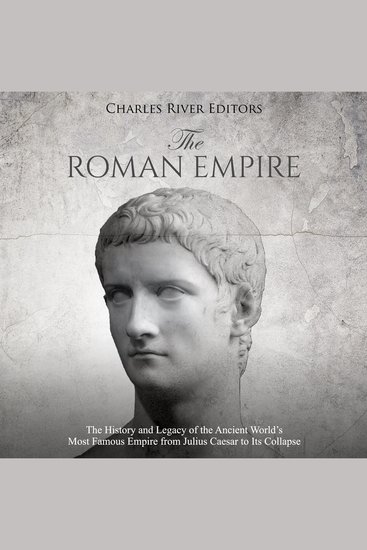
  • Roman Empire The: The History and Legacy of the Ancient World’s Most Famous Empire from Julius Caesar to Its Collapse - cover

    Roman Empire The: The History...

    Editors Charles River

    • 0
    • 0
    • 0
    Possibly the most important man of antiquity, and even all of history, was Julius Caesar. Alexander Hamilton, the famous American patriot, once remarked that “the greatest man who ever lived was Julius Caesar”. Such a tribute, coming from one of the Founding Fathers of the quintessential modern democracy in reference to a man who destroyed the Roman Republic, is testament to the enduring mark that Caesar left upon the world. The ultimate conqueror, statesman, dictator, visionary, and opportunist, during his time in power Caesar expanded the borders of Rome to almost twice their previous size, revolutionized the infrastructure of the Roman state, and destroyed the Roman Republic for good, leaving a line of emperors in its place. His legacy is so strong that his name has become, in many languages, synonymous with power: the Emperors of Austria and Germany bore the title Kaiser, and the Czars of Russia also owe the etymology of their title to Caesar. His name also crept further eastward out of Europe, even cropping up in Hindi and Urdu, where the term for “Emperor” is Kaisar. 
    Even in his time, Caesar was in many ways larger than life, and because of his legacy as virtual founder of the Roman Empire, much of what was written about – and by – him during his life and immediately after his assassination was politically motivated. His successor, Octavian Augustus, had a strong interest in ensuring that Caesar’s life be painted in a favorable light, while Caesar’s political enemies attempted to paint him as a corrupt, undemocratic dictator who was destroying the old order of the Republic.  
    As Roman leaders vied with each other for power and constantly fought civil wars, Rome’s famous roads fall into disrepair, the economy was crippled, the continent-wide trade system that had flourished in the previous years was replaced with a basic barter system, and there was a reduction in international trade.
    Voir livre