Rejoignez-nous pour un voyage dans le monde des livres!
Ajouter ce livre à l'électronique
Grey
Ecrivez un nouveau commentaire Default profile 50px
Grey
Abonnez-vous pour lire le livre complet ou lisez les premières pages gratuitement!
All characters reduced
THE HUNCHBACK OF NOTRE DAME - Enriched edition The Original Isabel Hapgood Translation - cover

THE HUNCHBACK OF NOTRE DAME - Enriched edition The Original Isabel Hapgood Translation

Victor Hugo

Maison d'édition: Musaicum Books

  • 0
  • 0
  • 0

Synopsis

Victor Hugo's 'The Hunchback of Notre Dame' is a stunning work of Gothic fiction that delves into the themes of love, betrayal, and societal injustice. Set in medieval Paris, the novel follows the tragic life of Quasimodo, a deformed bell-ringer of Notre Dame Cathedral, and his love for the beautiful gypsy Esmeralda. Hugo's rich and descriptive writing style creates a vivid portrayal of the bustling city and its inhabitants, drawing readers into a world of passion and prejudice. The novel's exploration of moral ambiguity and the complexities of human nature make it a timeless classic of French literature. Victor Hugo, a prominent French author and political activist, was known for his progressive views and commitment to social justice. 'The Hunchback of Notre Dame' reflects Hugo's belief in the importance of empathy and understanding towards the marginalized members of society. Drawing inspiration from the historical architecture of Notre Dame Cathedral, Hugo crafted a narrative that challenges societal norms and highlights the power of love and compassion. I highly recommend 'The Hunchback of Notre Dame' to readers who appreciate masterfully-crafted prose, intricate character development, and thought-provoking themes. Hugo's masterpiece offers a poignant commentary on the human condition and the enduring power of love amidst adversity.

In this enriched edition, we have carefully created added value for your reading experience:
- A succinct Introduction situates the work's timeless appeal and themes.
- The Synopsis outlines the central plot, highlighting key developments without spoiling critical twists.
- A detailed Historical Context immerses you in the era's events and influences that shaped the writing.
- An Author Biography reveals milestones in the author's life, illuminating the personal insights behind the text.
- A thorough Analysis dissects symbols, motifs, and character arcs to unearth underlying meanings.
- Reflection questions prompt you to engage personally with the work's messages, connecting them to modern life.
- Hand‐picked Memorable Quotes shine a spotlight on moments of literary brilliance.
- Interactive footnotes clarify unusual references, historical allusions, and archaic phrases for an effortless, more informed read.
Disponible depuis: 06/10/2017.
Longueur d'impression: 525 pages.
D'autres livres qui pourraient vous intéresser

  • After the Funeral - From their pens to your ears genius in every story - cover

    After the Funeral - From their...

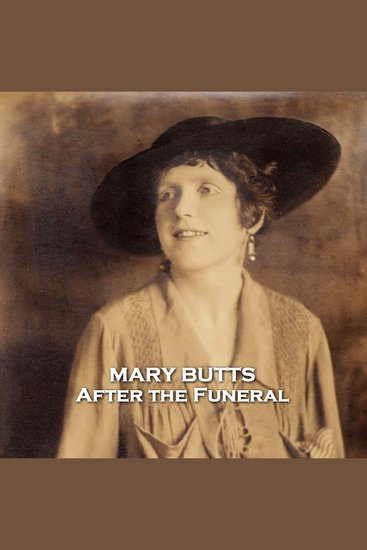
    Mary Butts

    • 0
    • 0
    • 0
    Mary Frances Butts was born on 13th December 1890 in Poole, Dorset. 
    Her early years were spent at Salterns, an 18th-century house overlooking Poole Harbour.  Sadly in 1905 her father died, and she was sent for boarding at St Leonard's school for girls in St Andrews. 
    Her mother remarried and, from 1909, Mary studied at Westfield College in London, and here, first became aware of her bisexual feelings.  She was sent down for organising a trip to Epsom races and only completed her degree in 1914 when she graduated from the London School of Economics.  By then Mary had become an admirer of the occultist Aleister Crowley and she was given a co-authorship credit on his ‘Magick (Book 4)’. 
    In 1916, she began the diary which would now detail her future life and be a constant reference point for her observations and her absorbing experiences. 
    During World War I, she was doing social work for the London County Council in Hackney Wick, and involved in a lesbian relationship.  Life changed after meeting the modernist poet, John Rodker and they married in 1918. 
    In 1921 she spent 3 months at Aleister Crowley's Abbey of Thelema in Sicily; she found the practices dreadful and also acquired a drug habit.  Mary now spent time writing in Dorset, including her celebrated book of short stories ‘Speed the Plough’ which saw fully develop her unique Modernist prose style. 
    Europe now beckoned and several years were spent in Paris befriending many artists and writing further extraordinary stories.   
    She was continually sought after by literary magazines and also published several short story collections as books. Although a Modernist writer she worked in other genres but is essentially only known for her short stories.  Mary was deeply committed to nature conservation and wrote several pamphlets attacking the growing pollution of the countryside. 
    In 1927, she divorced and the following year her novel ‘Armed with Madness’ was published.  A further marriage followed in 1930 and time was spent attempting to settle in London and Newcastle before setting up home on the western tip of Cornwall.  By 1934 the marriage had failed. 
    Mary Butts died on 5th March 1937, at the West Cornwall Hospital, Penzance, after an operation for a perforated gastric ulcer. She was 46.
    Voir livre
  • The Comedy of Errors - cover

    The Comedy of Errors

    William Shakespeare

    • 0
    • 0
    • 0
    We came into the world like brother and brother; And now let's go hand in hand, not one before another. - Dromio of Ephesus 
    The Comedy of Errors is likely the very first play Shakespeare ever wrote, and for that reason alone it deserves a special place in literary history. Yet, despite the author's lack of maturity, the play is unmistakably the work of a burgeoning master. A farce of a type that was wildly popular in Shakespeare's day, The Comedy of Errors transcends its genre, and is as accessible and as entertaining as any of the Bard's later comedies. Revolving around the naturally comedic themes of identical twins and mistaken identity, The Comedy of Errors is a delightful milestone in the remarkable career of the greatest dramatist of all time.
    Voir livre
  • At the Villa Rose - cover

    At the Villa Rose

    A. E. W. Mason

    • 0
    • 0
    • 0
    Harry Wethermill, the brilliant young scientist, a graduate of Oxford and Munich, has made a fortune from his inventions, and is taking a vacation at Aix-les-Bains. There he meets, and immediately falls in love with, the young and beautiful Celia Harland, who serves as companion to the aging but warm-hearted Madam Dauvray of Paris. All this is observed by Julius Ricardo, a retired financier from the City of London, who spends every August at Aix, expecting there to find a pleasant and peaceful life. Imagine his consternation when he learns that Mme. Dauvray has been brutally murdered, and imagine Harry Wethermill's consternation when he learns that every finger of suspicion is pointed at the now vanished Celia Harland. 
    Implored to do so by Wethermill, Ricardo asks his friend Inspector Hanaud, the great detective of the Paris Sûreté (who is also vacationing in Aix) to involve himself in the case so that the truth may come out. Hanaud agrees to do so (with the permission of the Aix police, of course), and goes to work. Will he be up to the job? And will Harry Wethermill ultimately be glad that he called in the great man? We can only wait to find out. But surely Hanaud will exercise his powerful little grey cells – one of several characteristics he shares with a famous Belgian detective of later decades, and indeed some scholars of mystery stories suggest that Agatha Christie, in her invention of Hercule Poirot, owes a debt to Mason and his invention of Inspector Hanaud. And indeed Julius Ricardo has than a passing resemblance to Arthur Hastings, Poirot's sidekick, who is invariably a few confused steps behind the detective
    Voir livre
  • Christmas Is a Sad Season for the Poor - cover

    Christmas Is a Sad Season for...

    John Cheever

    • 0
    • 0
    • 0
    Here is one of twelve magnificent stories, originally part of The John Cheever Audio Collection, in which John Cheever celebrates—with unequaled grace and tenderness—the deepest feelings we have. 
    As Cheever writes in his preface, ""These stories seem at times to be stories of a long-lost world when the city of New York was still filled with a river light, when you heard the Benny Goodman quartets from a radio in the corner stationery store, and when almost everybody wore a hat.""
    Voir livre
  • 1984 - cover

    1984

    George Orwell

    • 0
    • 0
    • 0
    It was a bright cold day in April, and the clocks were striking thirteen. Winston Smith, his chin nuzzled into his breast in an effort to escape the vile wind, slipped quickly through the glass doors of Victory Mansions, though not quickly enough to prevent a swirl of gritty dust from entering along with him.
    
    The hallway smelt of boiled cabbage and old rag mats. At one end of it a coloured poster, too large for indoor display, had been tacked to the wall. It depicted simply an enormous face, more than a metre wide: the face of a man of about forty-five, with a heavy black moustache and ruggedly handsome features.
    
    Winston made for the stairs. It was no use trying the lift. Even at the best of times it was seldom working, and at present the electric current was cut off during daylight hours. It was part of the economy drive in preparation for Hate Week. The flat was seven flights up, and Winston, who was thirty-nine and had a varicose ulcer above his right ankle, went slowly, resting several times on the way. On each landing, opposite the lift-shaft, the poster with the enormous face gazed from the wall. It was one of those pictures which are so contrived that the eyes follow you about when you move.
    
    BIG BROTHER IS WATCHING YOU, the caption beneath it ran.
    Voir livre
  • Fantomina: Love in a Maze - cover

    Fantomina: Love in a Maze

    Eliza Haywood

    • 0
    • 0
    • 0
    'Her design was once more to engage him, to hear him sigh, to see him languish, to feel the strenuous pressures of his eager arms, to be compelled, to be sweetly forc'd to what she wished with equal ardour.'
    
    Originally published in 1725, and daringly exploring themes such as identity, class and female desire, Fantomina: Love in a Maze is comprehended as one of the finest – yet underappreciated – novellas of the eighteenth-century.
    
    A beautiful young woman becomes intrigued with a charming, but severely shallow, young man at the theatre: Beauplaisir. Witnessing his treatment of some of the ladies there, she disguises herself as 'Fantomina', to determine whether his behaviour would change towards her. After a short fling, Beauplaisir tires of her and leaves, much to her outrage. Fantomina then takes on a series of alternative personas in a bid to re-capture his attention. A scathing commentary on men's treatment of women in society, Fantomina: Love in a Maze is a remarkable work which would have scandalised its readers at the time of publication. This audiobook is brought to life by the brilliant Helen Keeley.
    Eliza Haywood (1693 – 1756) was an English writer, actress and publisher. In her lifetime, she penned over seventy works, including novels, poetry, plays and periodicals. A proto-feminist, she was famed for her romance writing, which mirrored contemporary scandals in eighteenth century society.
    Voir livre