Rejoignez-nous pour un voyage dans le monde des livres!
Ajouter ce livre à l'électronique
Grey
Ecrivez un nouveau commentaire Default profile 50px
Grey
Abonnez-vous pour lire le livre complet ou lisez les premières pages gratuitement!
All characters reduced
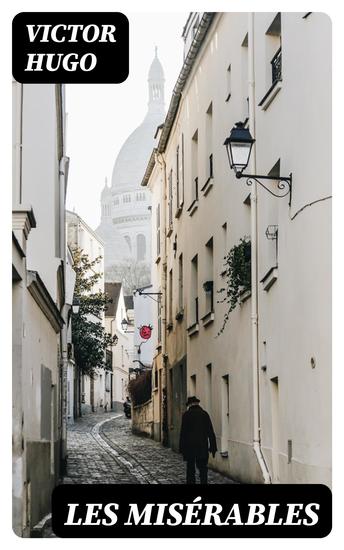
Les Misérables - cover

Les Misérables

Victor Hugo

Traducteur Isabel Florence Hapgood

Maison d'édition: DigiCat

  • 0
  • 0
  • 0

Synopsis

Victor Hugo's "Les Misérables" is a monumental exploration of justice, redemption, and the human condition, set against the backdrop of early 19th-century France. Through its intricate narrative, featuring vivid characters such as Jean Valjean, Javert, and Fantine, the novel employs a rich, emotive literary style that deftly blends melodrama with philosophical introspection. This epic work is not only a gripping tale of suffering and resilience but also a profound social commentary, reflective of the tumultuous political landscape and class struggles of its era, serving as a harbinger for later humanitarian movements. Victor Hugo, a titan of French literature and a vocal advocate for social reform, crafted this masterpiece during a period of deep personal and political upheaval. His experiences with poverty, exile, and political injustice greatly influenced his writing. Amidst his literary pursuits, Hugo sought to awaken the conscience of society, and "Les Misérables" epitomizes this mission, intertwining personal tragedy with broader social critique, capturing the zeitgeist of his time. To readers seeking a transformative literary experience, "Les Misérables" is an essential narrative that transcends time and geography. It invites reflection on the inherent dignity of all individuals, challenging societal norms and moral conventions. This novel not only captivates with its storytelling but also serves as a catalyst for empathy and understanding, making it a timeless classic worthy of exploration.
Disponible depuis: 16/09/2022.
Longueur d'impression: 1437 pages.
D'autres livres qui pourraient vous intéresser

  • Christmas Tree A (Unabridged) - cover

    Christmas Tree A (Unabridged)

    Charles Dickens

    • 0
    • 0
    • 0
    Charles John Huffam Dickens (7 February 1812 - 9 June 1870) was an English writer and social critic. He created some of the world's best-known fictional characters and is regarded as the greatest novelist of the Victorian era. His works enjoyed unprecedented popularity during his lifetime, and by the twentieth century critics and scholars had recognised him as a literary genius. His novels and short stories enjoy lasting popularity.
    I have been looking on, this evening, at a merry company of children assembled round that pretty German toy, a Christmas Tree. The tree was planted in the middle of a great round table, and towered high above their heads. It was brilliantly lighted by a multitude of little tapers; and everywhere sparkled and glittered with bright objects. There were rosy-cheeked dolls, hiding behind the green leaves; and there were real watches (with movable hands, at least, and an endless capacity of being wound up) dangling from innumerable twigs; there were French-polished tables, chairs, bedsteads, wardrobes, eight-day clocks, and various other articles of domestic furniture (wonderfully made, in tin, at Wolverhampton), perched among the boughs, as if in preparation for some fairy housekeeping; there were jolly, broad-faced little men, much more agreeable in appearance than many real men-and no wonder, for their heads took off, and showed them to be full of sugar-plums; there were fiddles and drums; there were tambourines, books, work-boxes, paint-boxes, sweetmeat-boxes, peep-show boxes, and all kinds of boxes; there were trinkets for the elder girls, far brighter than any grown-up gold and jewels; there were baskets and pincushions in all devices; there were guns, swords, and banners; there were witches standing in enchanted rings of pasteboard, to tell fortunes; there were teetotums, humming-tops, needle-cases, pen-wipers, smelling-bottles, conversation-cards, bouquet-holders; real fruit, made artificially dazzling with gold leaf; imitation apples, pears, and walnuts, crammed with surprises; in short, as a pretty child, before me, delightedly whispered to another pretty child, her bosom friend, "There was everything, and more."
    Voir livre
  • The Gambler - cover

    The Gambler

    Fyodor Dostoyevsky

    • 0
    • 0
    • 0
    The classic novel by Fyodor Dostoyevsky, based to some extent on the author's personal experiences as a gambler.
    Voir livre
  • Anesidora - A Dramatic Poem - cover

    Anesidora - A Dramatic Poem

    Bryan de Justin

    • 0
    • 0
    • 0
    Anesidora: A Dramatic Poem is a one-act dramatic poem set on the slopes of Vesuvius in the final days before the historical eruption that buried Pompeii. Written in elevated verse and shaped in the tradition of Romantic and Pre-Raphaelite drama, Anesidora illustrates the duality of spirituality and passionate love. Anesidora, at its heart, is a symbolic play that signifies the tempestuous awakening of passionate love within a young girl. 
    Performed by a full cast with immersive sound and dramatic narration, this dramatised version captures the passion and intensity of the play, drawing the listener into its romantic and hypnotic verse.
    Voir livre
  • The Picture of Dorian Gray - cover

    The Picture of Dorian Gray

    Oscar Wilde

    • 0
    • 0
    • 0
    The story revolves around a portrait of Dorian Gray by Basil Hallward, an artist impressed and infatuated by Dorian's beauty. Through Basil, Dorian meets Lord Henry Wotton, and he soon is enthralled by the aristocrat's hedonistic worldview: that beauty and sensual fulfilment are the only things worth pursuing in life. Newly understanding that his beauty will fade, Dorian expresses the desire to sell his soul, to ensure that the picture, rather than he, will age and fade. The wish is granted, and Dorian pursues a libertine life of varied amoral experiences while staying young and beautiful; all the while, his portrait ages and records every one of Dorian's sins.
    Voir livre
  • The Valley of Fear - cover

    The Valley of Fear

    Arthur Conan Doyle

    • 0
    • 0
    • 0
    The Valley of Fear is the fourth and final Sherlock Holmes novel by Sir Arthur Conan Doyle. It is loosely based on the Molly Maguires and Pinkerton agent James McParland. The story was first published in the Strand Magazine between September 1914 and May 1915. The novel starts with Sherlock Holmes receiving a cipher message from Fred Porlock, a pseudonymous agent of Professor Moriarty. After Porlock sends the message, however, he changes his mind for fear of Moriarty's discovering that he is a traitor. He decides not to send the key to the cipher, but he sends Holmes a note telling of this decision. From the cipher message and the second note, Holmes is able to deduce that it is a book cipher and that the book used for the encryption is a common book, large (with at least 534 pages), printed in two columns per page, and standardised. An almanac fits these conditions exactly. Holmes tries the latest edition of Whitaker's Almanac, which he had only received a few days earlier, and fails; he then tries the previous edition. With this almanac, Holmes is able to decipher the message as a warning that "some devilry is intended against one "Douglas", a country gentleman residing at Birlstone House.Unlike many of the other Holmes novels, mostly linear entertainments, Doyle crafted The Valley of Fear as "two parts and a coda and carefully stage managed the elements of fear and terror".Famous works of the author Arthur Conan Doyle: A Study in Scarlet, The Sign of the Four, The Adventures of Sherlock Holmes, The Memoirs of Sherlock Holmes, The Hound of the Baskervilles, The Return of Sherlock Holmes, The Valley of Fear, His Last Bow, The Case-Book of Sherlock Holmes, Stories of Sherlock Holmes, The Lost World.
    Voir livre
  • Dream of Armageddon A (Unabridged) - cover

    Dream of Armageddon A (Unabridged)

    H. G. Wells

    • 0
    • 0
    • 0
    "A Dream of Armageddon" is a short story by H. G. Wells which was first published in 1901 in the British weekly magazine Black and White. The story opens aboard a train, when an unwell-looking man strikes up a conversation with the narrator when he sees him reading a book about dreams. The white-faced man says that he has little time for dream analysis because, he says, his dreams are killing him.
    Voir livre