Begleiten Sie uns auf eine literarische Weltreise!
Buch zum Bücherregal hinzufügen
Grey
Einen neuen Kommentar schreiben Default profile 50px
Grey
Jetzt das ganze Buch im Abo oder die ersten Seiten gratis lesen!
All characters reduced
The History of the Middle Ages (476-1453) - cover

The History of the Middle Ages (476-1453)

Victor Duruy

Übersetzer Emily Henrietta Whitney, Margaret Dwight Whitney

Verlag: DigiCat

  • 0
  • 0
  • 0

Beschreibung

In "The History of the Middle Ages (476-1453)," Victor Duruy offers a comprehensive examination of a pivotal era in human history, meticulously chronicling the cultural, political, and social transformations that defined the Middle Ages. His narrative style combines vivid storytelling with rigorous scholarship, presenting a tapestry woven from the lives of key figures, significant events, and the prevailing ideologies of the time. Duruy adeptly navigates through a complex historical landscape, addressing not only the well-known occurrences such as the rise of feudalism, the Crusades, and the emergence of the Renaissance but also the often-overlooked influences that shaped medieval society, making the book an essential resource for students and enthusiasts alike. Victor Duruy, a distinguished French historian of the 19th century, brings a passionate and scholarly lens to this exploration of the Middle Ages. His educational background and profound interest in historical scholarship led him to craft this work as a response to the misconceptions and romanticized views of the medieval period prevalent in his time. Duruy's commitment to accuracy, alongside his belief in the importance of understanding the past, informs every page of this monumental text. This book is highly recommended for readers eager to delve into the complexities of medieval Europe. It serves as both a scholarly resource and an engaging narrative, making it suitable for academics, students, and any history enthusiasts. Duruy's ability to elucidate intricate historical processes while remaining accessible ensures that this work will complement any collection on medieval history.
Verfügbar seit: 13.11.2022.
Drucklänge: 821 Seiten.


Weitere Bücher, die Sie mögen werden

  • Great Escapes of the American Civil War The: The History of the Most Daring Prisoner Breakouts during America’s Deadliest Conflict - cover

    Great Escapes of the American...

    Editors Charles River

    • 0
    • 0
    • 0
    During the Civil War, armies took many soldiers captive, but they also captured some civilians as well, such as sutlers, nurses, teamsters, and other service personnel. In addition, both the Union and the Confederacy imprisoned deserters, sympathizers with the enemy, traitors, and draft dodgers. The numbers cited vary somewhat, and often, precise numbers should be regarded with caution because the official numbers do not account for everyone. One somewhat authoritative total is that Confederates confined 7,092 Union officers and 179,091 enlisted men in prison camps, along with 1,962 civilians, for a total of 188,145 (Stack 3). By comparison, the Union captured 35,782 officers, 426,852 enlisted men, and 13,535 Confederate civilians, but this total is misleading because it includes the troops that surrendered when the war ended, including the commands of Robert E. Lee, Joseph E. Johnston, Richard Taylor, and Edmund Kirby Smith. Almost all the troops who surrendered at the end of the war were immediately paroled and allowed to go home. A commonly cited estimate is that 215,000 Confederate and 195,000 Union soldiers were prisoners of war in one of the various prison camp facilities. There were 32 sizable Confederate camps during the war, half of them in South Carolina, Georgia, and Alabama. 
    	Of the Union prisoners, 2,696 escaped from prison, and 3,170 others joined the Confederate armies. Of the Confederates, 2,098 escaped, and 5,432 joined the Union forces. 94,000 Union troops were paroled, and 248,599 Confederates were also released on parole (Stack 4).That said, the number of escapees cited are best regarded as estimates rather than exact totals - record-keeping was accurate in some places and inaccurate in others, and as the Confederacy was in its last months, chaotic conditions prevailed.
    Zum Buch
  • Me Myself and I - Unraveling the Mysteries of the Mind and Self - cover

    Me Myself and I - Unraveling the...

    Grant Mattos

    • 0
    • 0
    • 0
    Embark on a profound journey of self-discovery with "Me, Myself, and I: Unraveling the Mysteries of the Mind and Self." This meticulously crafted guide blends science, philosophy, and psychology to explore the essence of being human. From understanding the complexities of consciousness to the influence of technology on our identities, each chapter invites deep reflection and provides practical tools for self-discovery. Through engaging with existential questions and spiritual traditions, readers are encouraged to delve into the depths of their being and emerge more aware and connected. Join this transformative odyssey into the heart of who you are and embrace a richer, more meaningful life.
    Zum Buch
  • The Fall of the Assads - The End of Half a Century of Tyranny in Syria and How It Will Change the World - cover

    The Fall of the Assads - The End...

    James Snell

    • 0
    • 0
    • 0
    In this gripping and concise account, Middle East expert James Snell delves deep into the collapse of the al-Assads' dictatorship, tracing their brutal atrocities from 1970 and what it means for the West. Through detailed narratives and eyewitness testimonies, he chronicles the relentless oppression and war crimes that fuelled the opposition's struggle. The fall of Damascus in December 2024 not only marked the end of over 50 years of Assad-family rule but also provided an unexpected development in the international drug trade, terrorism, Russia's strategic stronghold in the Mediterranean, highlighting significant geopolitical shifts. James currently writes for the Telegraph and Spectator on Syria.
    Zum Buch
  • Tiny Twink Gives It Up To The Bodybuilder - cover

    Tiny Twink Gives It Up To The...

    Rod Mandelli

    • 0
    • 0
    • 0
    The gay erotic holiday serial comes to its climactic conclusion as Splooge returns home from his visits with the Christmas spirits a changed man. He gives Tiny Twink the best Christmas present ever – hot mansex with an amazing bodybuilder.
    Zum Buch
  • The Greatest Civilizations of Ancient Mesopotamia - cover

    The Greatest Civilizations of...

    Editors Charles River

    • 0
    • 0
    • 0
    Long before Alexandria was a city and even before Memphis and Babylon had attained greatness, the ancient Mesopotamian city of Ur stood foremost among ancient Near Eastern cities. Today, the greatness and cultural influence of Ur has been largely forgotten by most people, partially because its monuments have not stood the test of time the way other ancient culture’s monuments have. For instance, the monuments of Egypt were made of stone while those of Ur and most other Mesopotamian cities were made of mud brick and as will be discussed in this report, mud-brick may be an easier material to work with than stone but it also decays much quicker. The same is true to a certain extent for the written documents that were produced at Ur. No site better represents the importance of the Sumerians than the city of Uruk. Between the fourth and the third millennium BCE, Uruk was one of several city-states in the land of Sumer. 
    As Hittite power grew during the Old Kingdom, the royal city of Hattusa became more important and even wealthier. From his citadel overlooking Hattusa, Hattusili I launched the first major Hittite attacks into the Near East, first conquering the cities between Hattusa and the Mediterranean.  
    Although the Biblical accounts of the Assyrians are among the most interesting and are often corroborated with other historical sources, the Assyrians were much more than just the enemies of the Israelites and brutal thugs. Among all the cities that thrived in the ancient Near East, few can match the opulence and ostentatiousness of Nineveh, the capital of the Assyrian Empire for much of the seventh century BCE. During that time it became known for its mighty citadels, grand palaces, beautiful gardens, and even its zoos. In fact, the beauty of Nineveh, especially its gardens, impressed later writers so much that they assigned its gardens as one of the original Seven Wonders of the World.
    Zum Buch
  • Imperial Germany’s Invasions of France: The History of the German Invasions in the Franco-Prussian War and World War I - cover

    Imperial Germany’s Invasions of...

    Editors Charles River

    • 0
    • 0
    • 0
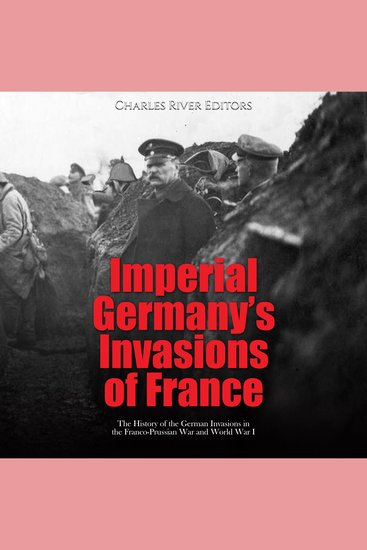
    Prussian leaders, especially Otto von Bismarck, the chancellor and advisor to Prussia’s king, believed Prussia could be a united and respected power, but only without the traditional Austrian dominance. At the time, the Austrian empire was a collection of ethnically diverse peoples and had been dominated by a socio-political conservatism that sought to keep the empire ruled in Hapsburg tradition.  
    After Prussia was victorious in the Austro-Prussian War, Bismarck played a waiting game where the unification of Germany was concerned, as the joining of the southern states - initially resistant to Prussian rule, friendly with Austria, and bent on independence - would have to be overcome. What was needed was “a clear case of French aggression” toward either Prussia or the southern states. Not only would such a move by Emperor Napoleon III trigger the terms of the treaty between the German states, but it would keep the remaining world powers out of the conflict. It would be a dispute over the throne of Spain that would cause Napoleon III to act. 
    	If trench warfare was an inevitability during the war, it is only because the events leading up to the First Battle of the Marne were quite different. The armies at the beginning of the war moved quickly through the land, but the First Battle of the Marne devolved into a bloody pitched battle that led to the construction of trenches after the Germans retreated, blocked in their pursuit of Paris. When the aftermath disintegrated into a war between trenches, some Germans thought they had the upper hand since they were occupying French territory, but with fewer soldiers than the combined Allied nations and fewer resources and supplies, it was possibly only a matter of time before they were ultimately defeated. The commander of the German armies, General Helmuth von Moltke, allegedly said to Kaiser Wilhelm II immediately after the First Battle of the Marne, "Your Majesty, we have lost the war."
    Zum Buch