Rejoignez-nous pour un voyage dans le monde des livres!
Ajouter ce livre à l'électronique
Grey
Ecrivez un nouveau commentaire Default profile 50px
Grey
Abonnez-vous pour lire le livre complet ou lisez les premières pages gratuitement!
All characters reduced
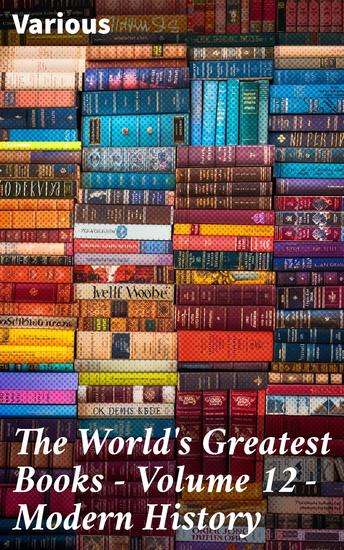
The World's Greatest Books — Volume 12 — Modern History - A Literary Journey Through Modern History - cover

The World's Greatest Books — Volume 12 — Modern History - A Literary Journey Through Modern History

Various Various

Maison d'édition: Good Press

  • 0
  • 0
  • 0

Synopsis

The World's Greatest Books 'Äî Volume 12 'Äî Modern History presents a meticulously curated selection of seminal texts that illuminate the pivotal moments and transformative ideas shaping the modern world. This anthology features a rich tapestry of essays, writings, and documents reflecting diverse perspectives that span the social, political, and cultural landscapes from the Enlightenment to the contemporary era. The literary style is both engaging and thought-provoking, inviting readers to grapple with the complexities of historical narratives through a well-structured format, making it accessible to both scholars and general readers alike. Compiled by various esteemed literary scholars and historians, this volume showcases authors who have significantly contributed to the field of modern history. Their expertise spans several disciplines, allowing them to draw connections between pivotal events and their lasting impact on society. The editors'Äô commitment to inclusivity also reveals previously marginalized voices, thus providing a more comprehensive view of history. This dedication to a multifaceted approach is likely influenced by the authors' own backgrounds as educators and historians, seeking to inspire a deeper understanding of our collective past. I highly recommend The World's Greatest Books 'Äî Volume 12 'Äî Modern History to anyone passionate about history or literature. This volume not only serves as an excellent reference for students and educators but also as a captivating read for those interested in the narratives that have shaped our present. The blending of authoritative scholarship with accessible writing makes this anthology a valuable addition to any literary or historical collection.
Disponible depuis: 12/08/2023.
Longueur d'impression: 250 pages.
D'autres livres qui pourraient vous intéresser

  • The Mindset Revolution - (3 Books in 1) The Art of Problem Solving Thinking Big and Taking Positive Action in Your Life to Manifest the Ultimate Success - cover

    The Mindset Revolution - (3...

    Michael Sloan

    • 0
    • 0
    • 0
    The Mindset Revolution by Michael Sloan is an empowering guide that unifies three transformative approaches to reshape your life. This comprehensive volume combines the wisdom of Sloan's three previous works into a singular, dynamic resource. 
    In "The Art of Problem Solving 101," Sloan takes you on a journey to unlock your innate problem-solving abilities. This part of the book is not just about solving problems but transforming you into a problem solver who embraces adversity and develops resilient strategies for any challenge. It's an inspiring guide for those ready to approach life with a solution-focused mindset. 
    "The Art of Thinking Big" expands your horizon, urging you to break free from limited thinking. Sloan teaches you how to cultivate a grand vision for your life and to set and achieve ambitious goals. This section is a call to action for anyone who has ever felt constrained by their own doubts or societal norms, providing practical steps to build a life that aligns with your most aspirational dreams. 
    Lastly, "Positive Thinking with Action" shifts the focus from external challenges to internal narratives. Sloan addresses the toxic patterns of negative thinking and guides you through transforming these into positive, actionable thoughts. This section is crucial for anyone seeking to live a more optimistic and fulfilling life, offering concrete strategies to replace cynicism with positivity.
    Voir livre
  • Race for Nuclear Weapons during World War II The: The History and Legacy of Both Sides’ Efforts to Build an Atomic Bomb - cover

    Race for Nuclear Weapons during...

    Editors Charles River

    • 0
    • 0
    • 0
    Before the Second World War, military conflicts were fought under orthodox conditions, usually termed “conventional warfare,” but several innovations had significantly changed combat, leading inextricably to the race for a nuclear weapon in the 1930s and 1940s. Conflicts had been fought by armies on horseback with guns of varying sophistication since the 16th century, but mechanized warfare and machine guns changed this calculus and set the stage for future combat by the end of World War I. Other sinister changes entered the fray during this conflict, such as chemical weapons like chlorine and mustard gas. The total warfare brought about by World War I and ensuing wars like the Spanish Civil War made the quest for the most powerful weapons somewhat necessary. 
    The Manhattan Project would ultimately yield the “Little Boy” and “Fat Man” bombs that released more than 100 Terajoules of energy at Hiroshima and Nagasaki, but as it turned out, the Axis were not far behind with their own nuclear weapons program. When the Nazis’ quest for a nuclear weapon began in earnest in 1939, no one really had a handle on how important nuclear weapons would prove to war and geopolitics. The attacks on Hiroshima and Nagasaki in August 1945, along with the Cold War-era tests and their accompanying mushroom clouds, would demonstrate the true power and terror of nuclear weapons, but in the late 1930s these bombs were only vaguely being thought through, particularly after the successful first experiment to split the atom by a German scientist. The nuclear age itself was in its infancy, barely 35 years old, but within a few short years the advent of nuclear war loomed over the world and the prospect of the enemy winning the nuclear race kept Allied leaders awake at night.
    Voir livre
  • Enlightenment is an Accident - Ancient Wisdom & Simple Practices to Make You Accident Prone - cover

    Enlightenment is an Accident -...

    Tim Burkett

    • 0
    • 0
    • 0
    A warm-hearted guide to Buddhist practice for those ready to contend with the reality that enlightenment—the realization of non-self—can't be achieved by the self. 


    A well-known spiritual saying goes, "Enlightenment is an accident. But we can make ourselves more accident-prone." As an authentic American Zen takes shape, enlightenment continues to be misunderstood as a project to be completed, a goal to be achieved, or a prize to be awarded. Tim Burkett's new book unhooks enlightenment from the hot air balloon of ego and brings it back down to earth. 


    Drawing on stories of his first teacher, the Zen master Shunryu Suzuki (author of Zen Mind, Beginner's Mind), and Burkett's decades of practice and teaching, he reveals how to live in the world with a deep joy that comes from embracing the work and play of this very moment. With the wisdom and humor of a seasoned practitioner familiar with all manner of eccentric fixations and silly dead-ends, he offers views and practices we can use to support the paradoxical process of letting enlightenment happen on its own.
    Voir livre
  • Moors of Andalusia The: The History of the Muslims in the Iberian Peninsula during the Middle Ages - cover

    Moors of Andalusia The: The...

    Editors Charles River

    • 0
    • 0
    • 0
    The history of the Spanish Peninsula is closely bound to that of the Moors. The term “Spain” was not in wide use until the region was united by the monarchs of Aragon and Castile, and the Moors called the lands they ruled in the Iberian Peninsula Al-Andalus, traditionally thought to be an Arabic transliteration of Vandal, the Germanic tribe which briefly ruled the region in the early fifth century. The English name Andalusia derives from the Spanish Andalucia, which is still used by Spain to name its southern region. 
    	Not surprisingly, three religions attempting to coexist during medieval times resulted in nearly incessant conflicts, marked by high taxation, disparate societies, rigid cultural controls, and systemic violence. Despite the odds, these three religions managed to live in a state of quasi-acceptance and peace in most of the major cities in the Iberian Peninsula like Cordoba and Toledo, with sporadic warfare occurring on the borders between Al-Andalus and the Christian kingdoms near the Pyrenees Mountains. Muslims, Christians, and Jews would attempt to reorganize their societies several times over the centuries through warfare, always with Jews on the lower rungs and Christians and Muslims fighting it out above them.  
    	Though it’s often forgotten today, the fighting that took place during the Reconquista was not originally driven by religion. Instead, the majority of the battles were fought by ambitious rulers who sought territorial expansion, like many other civilizations during the Middle Ages. In fact, the Reconquista would not gain its unique religious flavor until the 13th century, when the territories that would become Castile and Aragon drummed up religious fervor to achieve its aims and gained papal support from Rome.
    Voir livre
  • Normandy to Nazi Surrender - Firsthand Account of a P-47 Thunderbolt Pilot - cover

    Normandy to Nazi Surrender -...

    Patrecia Slayden Hollis, Colonel...

    • 0
    • 0
    • 0
    The late Van Slayden trained on the PT-3 kite-like biplane in 1937, but he learned fighter pilot operations flying "by the seat of his pants," walking away from five crashes. Shortly after the invasion of Normandy, he landed on Utah Beach to help establish a US Army Air Forces' (AAF's) presence in Europe. He flew the P-47 Thunderbolt, a fighter-bomber, in combat over Northern France and commanded the 36th Fighter Group-the "Fightin' 36th-at Batogne, St. Vith, the Bridgehead at Remagen, Operations Grenade, Clarion, Varsity and other missions. His 22nd Fighter Squadron was the first in the AAF to land voluntarily on German soil. 


    He was deep into Germany when the Nazis surrendered on May 8, 1945, which was remarkably anticlimactic. Van Slayden, a country boy from rural Tennessee, like so many of his contemporaries, stepped up to the challenge as part of the Greatest Generation.
    Voir livre
  • Ion - Inspiration and Art – Plato’s Dialogue on Poets Prophets and Divine Madness - cover

    Ion - Inspiration and Art –...

    Plato, Tim Zengerink

    • 0
    • 0
    • 0
    What if the artist wasn’t a master of his craft—but a mouthpiece for something divine? 
    In Ion, Plato explores the nature of poetic inspiration in a lively exchange between Socrates and the rhapsode Ion. Ion claims mastery over Homer’s verses, but Socrates questions whether such talent comes from knowledge or from divine possession. 
    This modern translation brings Plato’s insight into the modern era, opening a timeless discussion about where creativity truly comes from—and what that means for artists, performers, and thinkers alike. 
    What you'll discover inside: 
    •	The Origins of Artistic Inspiration – Explore Plato’s view of creativity as divine madness 
    •	Socrates’ Challenge to Poetic Pride – Ion’s mastery is questioned by reason itself 
    •	Art, Prophecy, and the Irrational – Connect poetry to prophecy and the mysteries of the human mind 
    •	A Modern, Engaging Translation – Clear and accessible, with Plato’s irony and brilliance intact 
    Whether you’re a poet, philosopher, or curious mind, Ion will challenge how you understand genius—and where it comes from.
    Voir livre