Join us on a literary world trip!
Add this book to bookshelf
Grey
Write a new comment Default profile 50px
Grey
Subscribe to read the full book or read the first pages for free!
All characters reduced
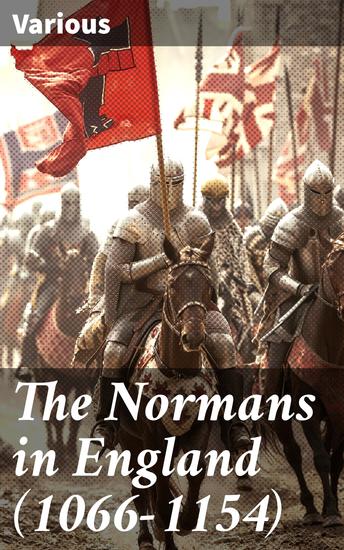
The Normans in England (1066-1154) - Examining the Norman Conquest and Its Lasting Impact on Medieval England - cover

The Normans in England (1066-1154) - Examining the Norman Conquest and Its Lasting Impact on Medieval England

Various Various

Publisher: Good Press

  • 0
  • 0
  • 0

Summary

In "The Normans in England (1066-1154)", a collective of esteemed historians delves into the transformative impact of Norman rule on English society following the pivotal events of the 1066 conquest. This meticulously researched volume not only chronicles the political upheaval and land redistribution that characterized the period but also employs a narrative style akin to that of medieval chronicles, giving voice to the lived experiences of various social strata. The work paints a vivid picture of the blend of cultures as the Normans imposed their governance, architecture, and feudal systems upon the English landscape, thereby reshaping the identity of the nation. The contributors to this compilation are well-established scholars of medieval history, each bringing a wealth of knowledge and unique perspectives that inform this critical examination of the Norman influence. Their scholarly rigor is grounded in extensive research, drawing upon primary sources, archaeological findings, and previous historiographical debates. This collective endeavor reflects a deep engagement with the complexities of the era, as the authors seek to illuminate the often-overlooked nuances of Norman administration and its ramifications for future generations. For anyone intrigued by the evolution of England's cultural and political heritage, this book serves as an essential resource. Its accessible prose and in-depth analysis cater to both novices and seasoned historians, making it an invaluable addition to any historical library. Readers will gain profound insights into how the Norman presence shaped medieval England, paving the way for subsequent developments in British history.
Available since: 10/12/2023.
Print length: 114 pages.

Other books that might interest you

  • Why People Kill - cover

    Why People Kill

    Raphael Terra

    • 0
    • 0
    • 0
    This audiobook has been recorded using Text to speech (TTS). 
     
    Nothing can be more terrifying than knowing the streets are being prowled by a twisted serial killer. To be a female of a certain age and profession on the streets of 19th century London, with the knowledge that one of your clients could be Jack the ripper himself. 
     
    There were many more Jack the Rippers in the world. 
     
    Every human has a capacity for good or evil. We are all dark and light. This has been known for thousands of years. It has been written, preached and symbolised across the world. 
     
    Just as there are those in history who have stood out for their compassion and good works, there are also those who have become infamous for their propensity to evil. From serial killers who murder one human after another to dictators who order mass genocide upon their own citizens - evil knows no bounds. 
     
    But what is it that creates these people? Is there an inbuilt genetic lock inside awaiting the turning of a key? Or are these people the result of their life experiences? Does abuse by parents play a key role? Does society itself have to answer for the actions of the murderers that it creates? 
     
    It is time to delve deep into the world and mind of serial killers and discover why they kill.
    Show book
  • Criminal (In)Justice - What the Push for Decarceration and Depolicing Gets Wrong and Who It Hurts Most - cover

    Criminal (In)Justice - What the...

    Rafael A. Mangual

    • 0
    • 0
    • 0
    In his impassioned-yet-measured book, Rafael A. Mangual offers an incisive critique of America's increasingly radical criminal justice reform movement, and makes a convincing case against the pursuit of "justice" through mass-decarceration and depolicing.After a summer of violent protests in 2020—sparked by the deaths of George Floyd, Breonna Taylor, and Rayshard Brooks—a dangerously false narrative gained mainstream acceptance: Criminal justice in the United States is overly punitive and racially oppressive. But, the harshest and loudest condemnations of incarceration, policing, and prosecution are often shallow and at odds with the available data. And the significant harms caused by this false narrative are borne by those who can least afford them: black and brown people who are disproportionately the victims of serious crimes.In Criminal (In)Justice, Rafael A. Mangual offers a more balanced understanding of American criminal justice, and cautions against discarding traditional crime control measures. A powerful combination of research, data-driven policy journalism, and the author's lived experiences, this book explains what many reform advocates get wrong, and illustrates how the misguided commitment to leniency places America's most vulnerable communities at risk. The stakes of this moment are incredibly high. Ongoing debates over criminal justice reform have the potential to transform our society for a generation—for better or for worse. Grappling with the data—and the sometimes harsh realities they reflect—is the surest way to minimize the all-too-common injustices plaguing neighborhoods that can least afford them.
    Show book
  • Emotional Intelligence - Practical Steps to Build a Better Life Improve Your Social Skills Get Ahead at Work and Master Your Emotions By: Charles Cummings - cover

    Emotional Intelligence -...

    Charles Cummings

    • 0
    • 0
    • 0
    Do you feel that you have been stuck in the same place for so long without making progress? Do you feel like your recent decisions have been all over the place? Do you want to do well at work, improve your relationships, and succeed in school? Do you wish to achieve your career and personal growth? 
    If you answered "yes" to any of the questions above, then keep reading! 
    Learning about emotional intelligence is the first step in gaining the upper hand and improving yourself. This guide will be your starting point for knowledge and information about yourself and how you can improve your emotional intelligence. Despite what society tells you, you can empower yourself to live an emotionally healthier (and healthier overall) life. 
    This book will discuss effective, efficient methods for boosting your emotional intelligence and social abilities that you can use right away. You'll feel greater purpose and develop more fruitful interpersonal connections. 
    Within these minutes, you will discover:What emotional intelligence isThe components of emotional intelligenceThe importance of emotional intelligencePractical steps to boost your emotional intelligenceHow to apply emotional intelligence in everyday lifeAnd much more! 
    With the help of this book, you can gain the upper hand in life, whether in your professional, romantic, or social field, and ultimately translate your learning on emotional intelligence into higher salaries, success, power, greater productivity, and an overall happier life! 
    If you're ready to take control and learn what emotional intelligence can do to better your life, look no further.Don't waste another minute, scroll up and hit "Buy Now" to get started today!
    Show book
  • Swapped with My Housewife - Gender Swap - cover

    Swapped with My Housewife -...

    Kinky Press

    • 0
    • 0
    • 0
    This is a home where a man’s word is law—no matter which of them is the man. 
      
    I’m used to giving the orders, so when my wife produces a pair of magic potions for the bedroom, she only demurely suggests we drink. A suggestion I will come to regret—or will I? 
      
    As I am turned into a stunning model of the feminine side, I am amazed to find the hot man who used to be my wife now makes my mouth water—a mouth that wants to wrap around that firm rod. 
      
    But not before doing the dishes and getting that sweet new rear end of mine bent over the sink, where my newfound innocence will be taken. 
      
    How much can I take before I turn back to a man, and will I ever be the same?
    Show book
  • Epicurus: A short biography - 5 Minutes: Short on time - long on info! - cover

    Epicurus: A short biography - 5...

    5 Minutes, 5 Minute Biographies,...

    • 0
    • 0
    • 0
    Epicurus, Greek philosopher: Life and works in a short biography! Everything you need to know, brief and concise. Infotainment, education and entertainment at its best!
    Show book
  • Why White Liberals Fail - Race and Southern Politics from FDR to Trump - cover

    Why White Liberals Fail - Race...

    Anthony J. Badger

    • 0
    • 0
    • 0
    From FDR to Clinton, Democratic leaders have promised a New South—a model of social equality and economic opportunity. So how did the region become the stronghold of conservative Republicans in thrall to Donald Trump? After a lifetime studying Southern politics, Anthony Badger has come to a provocative conclusion: white liberals failed because they put their faith in policy solutions as an engine for social change and were reluctant to confront directly the explosive racial politics dividing their constituents. 


    After World War II, many Americans believed that if the edifice of racial segregation, white supremacy, and voter disfranchisement could be dismantled across the South, the forces of liberalism would prevail. Hopeful that economic modernization and education would bring about gradual racial change, Southern moderates were rattled when civil rights protest and federal intervention forced their hand. Most were fatalistic in the face of massive resistance. When the end of segregation became inevitable, it was largely driven by activists and mediated by Republican businessmen. 


    Badger considers the dilemmas liberals faced across the South, arguing that their failure cannot be blamed simply on entrenched racism. Conservative triumph was not inevitable, he argues, before pointing to specific false steps and missed opportunities.
    Show book