Join us on a literary world trip!
Add this book to bookshelf
Grey
Write a new comment Default profile 50px
Grey
Subscribe to read the full book or read the first pages for free!
All characters reduced
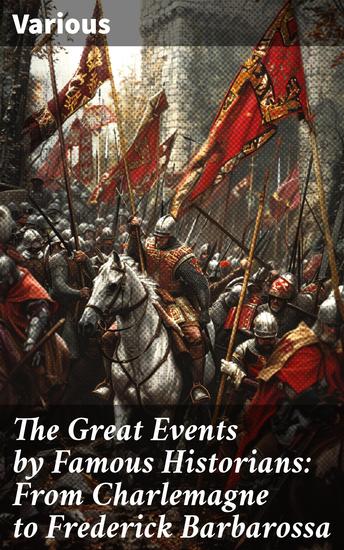
The Great Events by Famous Historians: From Charlemagne to Frederick Barbarossa - Unveiling Medieval Chronicles: From Conquests to Intrigues - cover

The Great Events by Famous Historians: From Charlemagne to Frederick Barbarossa - Unveiling Medieval Chronicles: From Conquests to Intrigues

Various Various

Publisher: Good Press

  • 0
  • 0
  • 0

Summary

The Great Events by Famous Historians: From Charlemagne to Frederick Barbarossa is a monumental anthology that chronicles pivotal moments in European history through the eyes of prominent historians of their times. This compilation uses a rich tapestry of narratives to weave together the lives and actions of key figures like Charlemagne and Frederick Barbarossa, presenting their historical contexts and significance. The book employs a diverse literary style, blending engaging storytelling with rigorous analysis, making it both accessible to general readers and enriching for scholars. It situates historical discourse within its era, showcasing how perceptions of these figures evolved alongside contemporary cultural values and political ideologies. The various authors featured in this work represent a wide spectrum of historical thought, each bringing their unique perspectives and expertise. Drawing on a legacy of scholarship dating back to the Middle Ages, these historians were often motivated by a desire to understand and elucidate the impact of major events and figures on the development of European civilization. Their writings reflect the complexities of interpreting history, especially in an age where the truth could often be swayed by the politics of the day. I wholeheartedly recommend The Great Events by Famous Historians to anyone with an interest in European history or historiography. This collection not only offers rich insights into significant historical milestones but also encourages readers to contemplate the ways history is constructed and remembered. It is an essential read for history enthusiasts and scholars alike, seeking to grasp the interplay between historical narrative and cultural identity.
Available since: 08/12/2023.
Print length: 387 pages.

Other books that might interest you

  • The Crisis of Psychoanalysis - Essays on Freud Marx and Social Psychology - cover

    The Crisis of Psychoanalysis -...

    Erich Fromm

    • 0
    • 0
    • 0
    "This book is must [listening] . . . although it will at times shock and perhaps even offend the sensibilities of traditional therapists." —American Journal of Psychiatry 


    This book brings together Erich Fromm's basic statements on the application of psychoanalytic theory to social dynamics. At the same time, it offers an image of man consonant with the hopes of radical humanism. 


    The Crisis of Psychoanalysis is a collection of nine brilliant essays. Although his work is deeply rooted in Freudian theory, Fromm further develops Freud's doctrines by including both social and ethical dimensions, and applies his discoveries and insights to address the problems we face in society at large.
    Show book
  • Ancient Egypt and the Pyramids - World Knowledge for Children - cover

    Ancient Egypt and the Pyramids -...

    KidsChoice

    • 0
    • 0
    • 0
    KidsChoice: World knowledge for Children is an engaging audiobook series that takes young listeners on a fascinating journey to explore and understand the world around them. Aimed at curious children aged 7 to 99, this series dives into a variety of topics in science, society, and culture, making complex ideas accessible and exciting.  Each episode brings a unique theme to life—whether exploring the mysteries of space, uncovering the secrets of the human body, or discovering the diversity of cultures and traditions worldwide. With lively narration, interesting facts, and interactive elements, the series guides young listeners on an adventure full of discovery, encouraging them to ask questions and expand their understanding in a fun way.  In the scientific world of KidsChoice, children learn about the wonders of nature and the universe. Concepts like the solar system, animal behavior, the human body, and Earth's various ecosystems are explained in a way that is easy for kids to grasp and find fascinating. Exciting analogies and vivid examples help spark curiosity, turning learning into an adventure.  Societal topics also have a special place in the series. KidsChoice introduces young listeners to the basics of community, compassion, and making a positive impact. Children learn what it means to be a good citizen and how they can make small, meaningful contributions to their communities.  Additionally, KidsChoice opens a window to the vibrant world of global cultures. Through a virtual journey around the globe, children discover how people in other countries live, the customs and traditions they follow, the languages they speak, and the foods they enjoy. This fosters understanding and respect for diverse ways of life, celebrating the richness of human experience as a beautiful, valuable part of the world.  With its vivid language and captivating soundscapes, "KidsChoice: World knowledge for Children" turns learning into an exciting experience, sparking a lifelong curiosity and a deeper understanding of the world around them.
    Show book
  • House of Bush House of Saud - The Birth of Modern Terrorism - cover

    House of Bush House of Saud -...

    Craig Unger

    • 0
    • 0
    • 0
    In 2001, the 9/11 attacks awoke the world to the military-style threat of Islamism. Due to the White House, the nationality of fifteen Saudis among the nineteen suicide bombers remained cast in shadows. In this exceptional tour-de-force, Craig Unger meticulously pieces together the US role in the birth of modern terrorism by relying on research and interviews with those who would prefer to deny the truth.The acclaimed account of the link between modern terrorism and Saudi and corporate greed whose first UK publisher cancelled for fear of libel, and which several online retailers dared not stock.'Excellent.'—Sunday Times'A notably intelligent piece of investigative reporting which lights the blue touch-paper.'—Observer'A forensic examination.'—Daily Telegraph'Very powerful.'—Guardian, book of the week'Hard-hitting.'—Independent on Sunday'An explosive book.'—Scotland on Sunday'None can match this.'—Irish Times'Well-sourced... cool, calm and collected.'—Times Higher Education Supplement'As chilling as it is gripping.'—Belfast Telegraph'Craig Unger has done America and the world a huge favor.'—Michael Moore, Director of Fahrenheit 9/11, the movie inspired by House of Bush House of Saud'Unger's meticulously researched book raises troubling questions about the ties between the Bush family and the Saudi royal family, especially in the aftermath of 9/11. It's a provocative read that challenges conventional narratives.'—The Washington Post'Craig Unger's House of Bush, House of Saud is a compelling and disturbing account of the intertwining interests of two powerful families. While some may dismiss it as conspiracy theory, the depth of research demands attention.'—The Washington Post'Unger's book is a gripping and unsettling exploration of the Bush-Saudi nexus. It's a damning indictment of how personal and financial interests can overshadow national security.'—The Guardian'Craig Unger's House of Bush, House of Saud is a meticulously documented account of the symbiotic relationship between two of the world's most powerful families. It's a chilling read that raises more questions than it answers.'—The Independent'Unger's book is a riveting and deeply researched exposé that sheds light on the shadowy connections between the Bush family and the Saudi elite. It's a sobering reminder of the complexities of global power dynamics.'—The Sydney Morning Herald'Craig Unger's House of Bush, House of Saud is a provocative and eye-opening investigation into the ties that bind American politics and Saudi wealth. It's a must-read for anyone interested in the hidden forces behind global events.'—Le Monde'Unger's book is a meticulously researched and deeply unsettling account of the Bush-Saudi relationship. It's a powerful critique of the intersection of politics, oil, and terrorism.'—Der Spiegel'Craig Unger's House of Bush, House of Saud is a provocative and deeply researched account of the intricate ties between the Bush family and the Saudi royal family. While some of its claims are controversial, the book provides valuable insights into the intersection of oil, politics, and terrorism.'—Foreign Affairs'Unger's book is a bold and controversial examination of the ties between the Bush family and the Saudi royal family. While some may question its conclusions, the depth of research and the questions it raises make it a valuable contribution to the field.'—International Affairs
    Show book
  • Great Escapes of the American Civil War The: The History of the Most Daring Prisoner Breakouts during America’s Deadliest Conflict - cover

    Great Escapes of the American...

    Editors Charles River

    • 0
    • 0
    • 0
    During the Civil War, armies took many soldiers captive, but they also captured some civilians as well, such as sutlers, nurses, teamsters, and other service personnel. In addition, both the Union and the Confederacy imprisoned deserters, sympathizers with the enemy, traitors, and draft dodgers. The numbers cited vary somewhat, and often, precise numbers should be regarded with caution because the official numbers do not account for everyone. One somewhat authoritative total is that Confederates confined 7,092 Union officers and 179,091 enlisted men in prison camps, along with 1,962 civilians, for a total of 188,145 (Stack 3). By comparison, the Union captured 35,782 officers, 426,852 enlisted men, and 13,535 Confederate civilians, but this total is misleading because it includes the troops that surrendered when the war ended, including the commands of Robert E. Lee, Joseph E. Johnston, Richard Taylor, and Edmund Kirby Smith. Almost all the troops who surrendered at the end of the war were immediately paroled and allowed to go home. A commonly cited estimate is that 215,000 Confederate and 195,000 Union soldiers were prisoners of war in one of the various prison camp facilities. There were 32 sizable Confederate camps during the war, half of them in South Carolina, Georgia, and Alabama. 
    	Of the Union prisoners, 2,696 escaped from prison, and 3,170 others joined the Confederate armies. Of the Confederates, 2,098 escaped, and 5,432 joined the Union forces. 94,000 Union troops were paroled, and 248,599 Confederates were also released on parole (Stack 4).That said, the number of escapees cited are best regarded as estimates rather than exact totals - record-keeping was accurate in some places and inaccurate in others, and as the Confederacy was in its last months, chaotic conditions prevailed.
    Show book
  • Max Planck: A short biography - 5 Minutes: Short on time - long on info! - cover

    Max Planck: A short biography -...

    5 Minutes, 5 Minute Biographies,...

    • 0
    • 0
    • 0
    Max Planck, physicist and nobel prize laureate: Life and works in a short biography! Everything you need to know, brief and concise. Infotainment, education and entertainment at its best!
    Show book
  • The Rio Grande Sniper Killings - Caught in the Sights of a Drug Conspiracy - cover

    The Rio Grande Sniper Killings -...

    John Primomo

    • 0
    • 0
    • 0
    Untangle the complex conspiracy that led to the tragic deaths of Charlotte Kay Elliott and Kevin Edwin Frase on the banks of the Rio Grande. On the night of July 13, 1980, a hitman fired a high-powered rifle into the crowd at Pepe's On the River, an outdoor bar in Mission, Texas. He missed his target, a witness in the Loop 360 drug case, but killed two young bystanders. While state court prosecutions for capital murder inexplicably faltered, a federal court gave the assassin a life sentence for attempted murder of a grand jury witness. A member of the judge's staff who was present throughout the trial, author John W. Primomo revisits the dramatic twists and turns surrounding this murder on the Rio Grande.
    Show book