Rejoignez-nous pour un voyage dans le monde des livres!
Ajouter ce livre à l'électronique
Grey
Ecrivez un nouveau commentaire Default profile 50px
Grey
Abonnez-vous pour lire le livre complet ou lisez les premières pages gratuitement!
All characters reduced
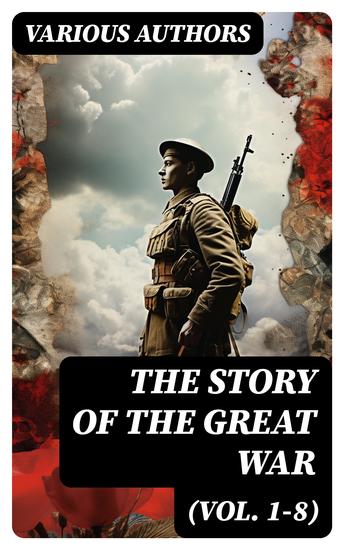
The Story of the Great War (Vol 1-8) - Enriched edition Complete Edition - cover

The Story of the Great War (Vol 1-8) - Enriched edition Complete Edition

Various Authors

Maison d'édition: DigiCat

  • 0
  • 0
  • 0

Synopsis

The multi-volume anthology "The Story of the Great War" offers an extensive examination of World War I, capturing the complex tapestry of human experience during one of history's most devastating conflicts. Through a diverse range of narratives, essays, and personal accounts, this collection weaves together the political, social, and military dimensions of the war, all presented in a rich literary style that balances meticulous research with heartfelt storytelling. The varied perspectives—including frontline soldiers, nurses, and civilians—serve to provide a comprehensive view of the war's multifaceted impacts on lives and nations, situating the narrative within the broader historical context of early 20th-century global upheaval. Composed by various esteemed authors—including historians, journalists, and soldiers—this anthology reflects the diverse influences that shaped early 20th-century literature and historical writing. Each contributor brings unique insights shaped by their personal experiences or scholarly pursuits, resulting in a collaborative work that not only seeks to inform but also to evoke empathy and understanding for those who lived through the war. The book illustrates a collective effort to process the trauma and consequences of a world irrevocably altered by conflict. I highly recommend "The Story of the Great War" to both history enthusiasts and general readers interested in understanding the complexities of World War I. Its accessible yet profound narrative style invites readers to engage with the past, offering a thorough exploration that will resonate with anyone seeking to grasp the depth of human resilience and tragedy in the face of unparalleled adversity.

In this enriched edition, we have carefully created added value for your reading experience:
- An Introduction draws the threads together, discussing why these diverse authors and texts belong in one collection.
- Historical Context explores the cultural and intellectual currents that shaped these works, offering insight into the shared (or contrasting) eras that influenced each writer.
- A combined Synopsis (Selection) briefly outlines the key plots or arguments of the included pieces, helping readers grasp the anthology's overall scope without giving away essential twists.
- A collective Analysis highlights common themes, stylistic variations, and significant crossovers in tone and technique, tying together writers from different backgrounds.
- Reflection questions encourage readers to compare the different voices and perspectives within the collection, fostering a richer understanding of the overarching conversation.
Disponible depuis: 15/11/2023.
Longueur d'impression: 3768 pages.

D'autres livres qui pourraient vous intéresser

  • The Irish Troubles - Conflict and Peace in Northern Ireland - cover

    The Irish Troubles - Conflict...

    Nova Ashford

    • 0
    • 0
    • 0
    The deep divisions that came to define the Troubles in Northern Ireland have their roots in centuries of conflict, conquest, and colonization. The split between the largely Catholic Irish population and the Protestant settlers brought by British rule laid the groundwork for enduring hostility. This divide was not merely religious but deeply political and cultural, with Catholic nationalists largely advocating for a united Ireland, while Protestant unionists were loyal to the British crown and sought to remain part of the United Kingdom. These opposing identities hardened over time, especially in the north, where British colonization during the 16th and 17th centuries planted a Protestant presence in predominantly Catholic lands, most notably in the province of Ulster. 
    The 1921 partition of Ireland formalized the division, creating Northern Ireland as a separate political entity within the United Kingdom. While the south eventually became the Republic of Ireland, the north remained under British control with a Protestant-majority government. This arrangement was viewed by many Catholics as both illegitimate and oppressive, fostering a sense of exclusion and marginalization. Protestants, in turn, felt under siege by the threat of Irish republicanism and feared losing their political and cultural dominance. The new state was marked from the beginning by systemic discrimination against the Catholic minority in areas such as housing, employment, and political representation. 
    Tensions simmered for decades, occasionally flaring into violence, but it was in the 1960s that the situation began to unravel. Inspired by civil rights movements elsewhere, Northern Irish Catholics began organizing protests demanding equal treatment and an end to institutionalized bias. The state’s heavy-handed response to these demonstrations, combined with Protestant fears of losing control, only intensified the divide.
    Voir livre
  • The Hour of the Predator - Encounters with the Autocrats and Tech Billionaires Taking Over the World - cover

    The Hour of the Predator -...

    Giuliano da Empoli

    • 0
    • 0
    • 0
    How do you defend democracy when the rules have changed?
    Presidents turning into monarchs. Tech tycoons and autocrats intent on global regime change. Armies of cyber trolls.
    The old order is at an end. The Hour of the Predator has come.
    Former political advisor Giuliano da Empoli takes us on an insider's journey through this new geopolitical reality, from the Glass Palace of the UN to the Riyadh Ritz-Carlton, from top secret meetings to violent power struggles. We encounter dictators and tyrants, strongmen and AI billionaires - geopolitical predators, and the flailing leaders who desperately try to appease them.
     
    Just as in the age of the Borgias or the conquistadors, cynical scheming and brute force increasingly determine the course of international affairs. This is an urgent guide to our new world, and our uncertain future.
    Voir livre
  • White Lies - cover

    White Lies

    Rudolph Bader

    • 0
    • 0
    • 0
    In Nazi Germany, young Manfred is hardly aware of the influence that draws him into the existing political system. After the War he changes his name and builds up a new career, starting a family, first in the States, later in Britain. While his friends and family have no idea of his activities during the War, his daughter Nora and his grandson Andrew, being interested in recent history, begin to suspect their (grand-) father’s dark secret.How far does moral responsibility go? Can really heavy guilt ever be expiated in Dostoyevsky’s sense or is there no hope for atonement by later generations? Is it ever too late to learn fundamental lessons from political developments?
    Voir livre
  • You Can't Libel the Dead - A Life in Journalism - cover

    You Can't Libel the Dead - A...

    Neil Benson

    • 0
    • 0
    • 0
    Standing on the Derbyshire moors as a blizzard rages, a young reporter is about to cover the biggest story of his life - the infamous Pottery Cottage Murders. 
    A newspaper editor comes face to face with a city's most notorious armed robber...who is offering to strike a deal that will blow two major court cases apart. 
    A senior publishing executive flies to Pakistan to plead for the release of a terrified British reporter, who has been locked in a flea-ridden jail surrounded by murderers and thugs, on suspicion of being a spy. 
    These are just three of the riveting moments from the career of journalist Neil Benson, recounted in fascinating detail in his memoir You Can't Libel the Dead. 
    The book lifts the lid on the life and professional challenges of a newspaper editor, from the decision to unmask a popular priest as a serial paedophile, to fiery confrontations with household-name football managers. 
    Neil rose from rookie reporter to the top of the editorial tree in an era of tumultuous change for the news industry. His memoir is packed with amusing anecdotes and the cavalcade of colourful characters he encountered in 45 action-packed years as a journalist.
    Voir livre
  • The Science of Reading - Information Media and Mind in Modern America - cover

    The Science of Reading -...

    Adrian Johns

    • 0
    • 0
    • 0
    For the first time, the story of how and why we have plumbed the mysteries of reading, and why it matters today. 
      
    Reading is perhaps the essential practice of modern civilization. For centuries, it has been seen as key to both personal fulfillment and social progress, and millions today depend on it to participate fully in our society. Yet, at its heart, reading is a surprisingly elusive practice. This book tells for the first time the story of how American scientists and others have sought to understand reading, and, by understanding it, to improve how people do it. 
     
    Starting around 1900, researchers—convinced of the urgent need to comprehend a practice central to industrial democracy—began to devise instruments and experiments to investigate what happened to people when they read. They traced how a good reader’s eyes moved across a page of printed characters, and they asked how their mind apprehended meanings as they did so. In schools across the country, millions of Americans learned to read through the application of this science of reading. At the same time, workers fanned out across the land to extend the science of reading into the social realm, mapping the very geography of information for the first time. Their pioneering efforts revealed that the nation’s most pressing problems were rooted in drastic informational inequities, between North and South, city and country, and white and Black—and they suggested ways to tackle those problems. 
     
    Today, much of how we experience our information society reflects the influence of these enterprises. This book explains both how the science of reading shaped our age and why, with so-called reading wars still plaguing schools across the nation, it remains bitterly contested.
    Voir livre
  • Battle of Cape Matapan The: The History of the Biggest Naval Battle in the Mediterranean during World War II - cover

    Battle of Cape Matapan The: The...

    Editors Charles River

    • 0
    • 0
    • 0
    Naval combat underwent a significant metamorphosis during World War II. Nazi Germany and Imperial Japan launched some of the most powerful battleships ever to sail the world's oceans, yet the conflict witnessed the emergence and triumph of the aircraft carrier as the 20th century's true monarch of the seas. Submarine warfare expanded and developed, while aircraft technology and doctrine experienced several revolutionary changes due to the unforgiving demands of the new combat environment.  
    While many large-scale naval engagements were fought in the Pacific at places like the Coral Sea, Midway, and the Philippines, engagements were rare in Europe. There were flurries of action as the German warships Admiral Graf Spee and Bismarck were hunted and destroyed in 1939 and 1941, and there was a constant battle between surface ships and German U-Boats that lasted throughout the war. But there was only one major naval engagement fought between battle fleets in Europe – at the Battle of Cape Matapan, the British Royal Navy and the Royal Australian Navy would square off with the Italian Regia Marina in early 1941. 
    Though it was the most decisive naval battle in the Mediterranean, the Battle of Cape Matapan has largely been forgotten today, even as military historians have recognized its significance and some have even compared it with the legendary Battle of Trafalgar in 1805. Indeed, the battle shaped the remainder of the war in the Mediterranean, which would prove crucial when the Western Allies would use it to amphibiously invade Sicily in 1943, marking their return to the European continent. 
    Voir livre