Begleiten Sie uns auf eine literarische Weltreise!
Buch zum Bücherregal hinzufügen
Grey
Einen neuen Kommentar schreiben Default profile 50px
Grey
Jetzt das ganze Buch im Abo oder die ersten Seiten gratis lesen!
All characters reduced
Reliques of Ancient English Poetry (Vol 1-3) - Collection of Old Heroic Ballads Songs and Other Pieces of Early Poetry - cover

Reliques of Ancient English Poetry (Vol 1-3) - Collection of Old Heroic Ballads Songs and Other Pieces of Early Poetry

Various Authors

Verlag: Good Press

  • 0
  • 0
  • 0

Beschreibung

Reliques of Ancient English Poetry (Vol. 1-3) is a seminal anthology that offers readers a rich tapestry of early English verse, showcasing literary gems from the Middle Ages to the late 17th century. Compiled by various authors, this collection features an assortment of ballads, lyrics, and epic narratives, intricately woven together to reflect the linguistic evolution and cultural milieu of England. Its literary style is characterized by a nostalgic yet accessible tone, employing a mix of rustic and courtly language that bridges the gap between oral traditions and written forms, thus capturing the essence of the English poetic heritage. The anthology emerged during the Romantic period, a time when there was a renewed interest in folk traditions and the authenticity of ancient texts. The editors, notably Thomas Percy, were motivated by a desire to preserve these oft-neglected voices, emphasizing the national identity that arose from England's varied oral traditions. Their passion for uncovering and reviving forgotten works illustrates the Romantic ethos of valuing the past while seeking a connection to a burgeoning sense of national consciousness. Reliques of Ancient English Poetry is an essential read for anyone interested in the foundations of English literature. Its varied formats and themes not only enchant modern readers but also provoke critical reflections on history, culture, and identity. This anthology serves as a vital resource for scholars and casual readers alike, offering insights into the poetic forms that have shaped English literary heritage.
Verfügbar seit: 27.12.2023.
Drucklänge: 1184 Seiten.

Weitere Bücher, die Sie mögen werden

  • GAZA Today - Would You Turn Your Back - cover

    GAZA Today - Would You Turn Your...

    Mike Blake

    • 0
    • 0
    • 0
    GAZA Today: Would You Turn Your Back. 
    (Harmony-Join Book 4) 
    Everyone knows what Gaza is. A strip of land in the Middle East, being vociferously fought over. 
    I don't want to get into the Politics of it, but at least a brush with it is unavoidable if you attempt 
    any kind of dialogue or description of the occurrences that are happening there - truly awful. 
    This poem is a short one, and keeps to the suffering of its people, and not delving too much into sides 
    of the Political spectrum. 
    I think the suffering in a modern day scenario with instant and graphic footage of this one-sided war 
    is horrific. 
    Regardless of who did what to who, and who did it first etc, it should be focused on the humanitarian side 
    in any conflict lest we lose sight of what we maybe fighting for - I think the focus on humanity has been totally 
    lost. 
    Are we to Turn Our Back on these people. The West should push for extreme Sanctions to reign in the seemingly 
    unstoppable gungho aggression of the combatants - There is a Geneva convention you know. 
    It can only mean something if it is enforced... 
    Footnote: This Poem is all about the kids in this conflict. Whose right and whose wrong, shouldn't come into it 
    on the humanitarian field of view.
    Zum Buch
  • The birthday Party - cover

    The birthday Party

    Harold Pinter

    • 0
    • 0
    • 0
    The Birthday Party (1957) is the first full-length play by Harold Pinter, first published in London by Encore Publishing in 1959.[1] It is one of his best-known and most frequently performed plays.[2] 
    In the setting of a rundown seaside boarding house, a little birthday party is turned into a nightmare when two sinister strangers arrive unexpectedly. The play has been classified as a comedy of menace, characterised by Pinteresque elements such as ambiguous identity, confusions of time and place, and dark political symbolism. 
    Pinter began writing The Birthday Party in the summer of 1957 while touring in Doctor in the House. He later said: "I remember writing the big interrogation scene in a dressing room in Leicester.
    Zum Buch
  • two Palestinians go dogging (NHB Modern Plays) - cover

    two Palestinians go dogging (NHB...

    Sami Ibrahim

    • 0
    • 0
    • 0
    The year is 2043, and Reem and her husband Sayeed are going to share a 'Serious Play about Palestine'. Things are tense. People are on the edge. The Fifth Intifada is right around the corner. But on a contested piece of land near their village of Beit al-Qadir, Reem and Sayeed are about to go dogging. Don't worry, you're allowed to laugh.
    Sami Ibrahim's play two Palestinians go dogging uses the lens of humour to explore how the everyday becomes political and the political becomes everyday in a conflict zone.
    The play won the Theatre Uncut Political Playwriting Award in 2019 and was premiered in May 2022 at the Royal Court Jerwood Theatre Upstairs, London, directed by Omar Elerian.
    Zum Buch
  • The Two Voices - An autobiographical poem written by Tennyson after his friend committed suicide - cover

    The Two Voices - An...

    Alfred Lord Tennyson

    • 0
    • 0
    • 0
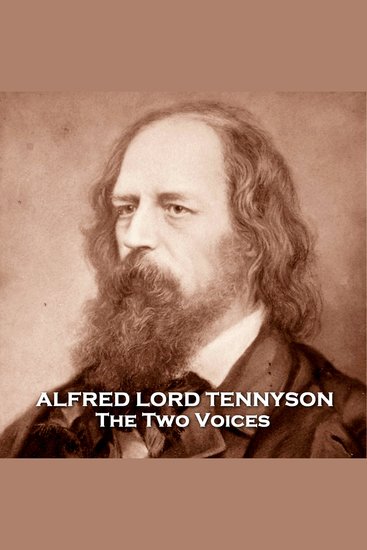
    Alfred Tennyson was born on August 6th, 1809, in Somersby, Lincolnshire, the fourth of twelve children. 
    Most of Tennyson's early education was under the direction of his father, although he did spend four unhappy years at a nearby grammar school.  He also showed an early and burgeoning talent for writing; by the age of twelve he had written a 6,000-line epic poem.  
    In the 1820s, however, Tennyson’s father began to suffer frequent mental breakdowns exacerbated by his alcoholism. One brother had frequent violent quarrels with his father, a second would be confined to an insane asylum, and another was later an opium addict. 
    Tennyson left home in 1827 to join his brothers at Trinity College, Cambridge and with it escape from Somersby. At Trinity he was those who knew little of the problems that clouded his life. Although shy he was keen to make new friends; he was handsome, intelligent, humorous, and a gifted impersonator. 
    That same year, he and his brother Charles published Poems by Two Brothers. It attracted the attention of the “Apostles," a select undergraduate literary club led by Arthur Hallam. They provided friendship and confidence. Hallam and Tennyson became the best of friends. 
    The pair, in the summer of 1830, were involved in a ridiculous jaunt to take money and secret messages to revolutionaries plotting to overthrow the Spanish king. Tennyson's political enthusiasm was marginal compared to Hallam's, but he was glad to make his first trip abroad.  
    The landscape and atmosphere of the Pyrenees generated such wonderful poems as "Oenone," "The Lotus-Eaters;" inspired by a waterfall in the mountains; and "The Eagle;" invoked from the sight of the great hunters circling above them. The small village of Cauteretz and the surrounding valley became a location Tennyson would return to many times over the next sixty years. 
    In 1830, he published Poems, ‘Chiefly Lyrical’ and in 1832 a volume entitled ‘Poems’.  Tennyson, stung by the harshness of several reviews, would not publish again for nine years.  
    In the autumn of 1833, in what was meant as a gesture of gratitude and reconciliation to his father, Hallam accompanied him to the Continent. In Vienna Hallam died suddenly of apoplexy as a result of a congenital malformation of the brain.  
    Hallam’s death, together with that of his father and a myriad of anxieties, stem-ming mainly from the belief that his family were grimly attached to poverty, and fears that he might become a victim of epilepsy, madness, alcohol, and drugs, as others in his family had, or that he might die like Hallam, conspired to upset the delicate balance of Tennyson's emotions.  
    In 1836, he became engaged to Emily Sellwood. From their correspondence it is clear that she was very much in love with him. He seems to excessively worry about not having the financial means to marry.  He was also falling into trances, which he thought were connected with the epilepsy from which other family members suffered. To marry, he thought, would mean passing on the disease to any children he might father. He broke off the engagement. 
    During these years he used the dark feelings and events to write many of his finest works; "Ulysses," "Morte d'Arthur," "Tithonus," "Tiresias," and "Break, break, break."  
    In 1842 Tennyson’s Poems (in two volumes) was a tremendous critical and popular success.  
    In 1845 he was granted a government pension of £200 a year in recognition of his poetic achievements and his financial need.  Despite this financial support his doubts persisted.  
    Life for Tennyson was becoming increasingly productive and more lucrative.  By 1849 ‘The Princess’ had been published. He was now offered a large advance if he would assemble his elegies on Hallam into one complete poem.  
    Tennyson had now also resumed his relationship with Emily Sellwood and by the following year was talking again of marrying her. 
    In the Spring of 1850 the Poet Laureate William Wordsworth died and a new Laureate was
    Zum Buch

  • A Rhyme A Dozen ― The Rain - 12 Poets 12 Poems 1 Topic - cover

    A Rhyme A Dozen ― The Rain - 12...

    Frances Ledwidge, Ivor Gurney,...

    • 0
    • 0
    • 0
    ‘A dime a dozen’ as known in America, is perhaps equal to the English ‘cheap as chips’ but whatever the lingua franca of your choice in this series we hereby submit ‘A Rhyme a Dozen’ as 12 poems on many given subjects that are a well-rounded gathering, maybe even an essential guide, from the knowing pens of classic poets and their beautifully spoken verse to the comfort of your ears. 
    1 - A Rhyme a Dozen - 12 Poets, 12 Poems, 1 Topic.  The Rain - An Introduction 
    2 - A Rainy Day in April by Francis Ledwidge 
    3 - April Rain by Mathilde Blind 
    4 - The Summer Rain by Henry David Thoreau 
    5 - Rain Music by Joseph Semon Cotter 
    6 - The Rainy Season by Mirabai 
    7 - The Rainy Day by Tagore 
    8 - Rainy Midnight by Ivor Gurney 
    9 - All Day It Has Rained by Alun Lewis 
    10 - Spring Rain by Sara Teasdale 
    11 - Rain by Edward Thomas 
    12 - Bells in the Rain by Elinor Wylie 
    13 - Rain on a Grave by Thomas Hardy
    Zum Buch
  • Reversing Entropy - Poems - cover

    Reversing Entropy - Poems

    Luci Shaw

    • 0
    • 0
    • 0
    From the pen of beloved poet Luci Shaw comes a new collection that celebrates inspired creativity as an antidote to chaos.
    The poet's own words best describe the heart of this pinnacle collection of new work by beloved writer Luci Shaw:
    
    Entropy: A measure of the molecular disorder, or randomness, of a system, its lack of order or predictability, resulting in a gradual decline into disorder. 
    
    Our universe, and the systems within it, constantly shift from their created states of order towards disorder, or chaos. The second law of thermodynamics asserts that entropy, or disorder, always increases with time. Creative human activities such as art, architecture, music, story or film are human efforts to halt and reverse this loss of meaning. Thus, smaller systems, like individual poems, become highly ordered as they receive energy from outside themselves, from the poet. They reverse entropy because they are moving from a state of disorder (all the random ideas, words and phrases available to the writer) into an orderly form designed by the writer to create meaningful images and concepts in the reader's mind (which is where the word "imag-ination" comes from.) This transfer of images, concepts and ideas into the mind of a reader is the task of poetry and the calling of the poet. Just as a composer of music gathers rhythms, notes, melodies, or harmony, organizing them into fugues or sonatas or concertos, so poets work and write to discover ways of arranging their responses to the world in words that introduce meaning and beauty in the mind of the reader. 
    
    Which is what I've been trying to do for most of my life.
    Zum Buch