Rejoignez-nous pour un voyage dans le monde des livres!
Ajouter ce livre à l'électronique
Grey
Ecrivez un nouveau commentaire Default profile 50px
Grey
Abonnez-vous pour lire le livre complet ou lisez les premières pages gratuitement!
All characters reduced
General William Booth Enters into Heaven and Other Poems - cover

General William Booth Enters into Heaven and Other Poems

Vachel Lindsay

Maison d'édition: DigiCat

  • 0
  • 0
  • 0

Synopsis

In "General William Booth Enters into Heaven, and Other Poems," Vachel Lindsay employs a unique blend of rhythmic verse and vivid imagery to explore the spiritual dimensions of American life and the struggles of the human condition. This collection includes the renowned title poem, which portrays the posthumous journey of the Salvation Army founder, merging themes of faith, redemption, and social justice with Lindsay's characteristic exuberance and musicality. The work is reflective of the early 20th-century literary movement that sought to elevate poetry away from the confines of elitism, aiming to capture the voice of the common man through accessible language and energetic rhythms. Vachel Lindsay, often considered the "poet of the American people," was deeply influenced by his own experiences with social issues and his passion for justice. Emerging from the Midwest, Lindsay was a fervent advocate of the arts as a catalyst for social change and was directly inspired by the tenets of spiritualism and the growing Progressive movement of his time. His background in art, music, and performance poetry also shaped his distinctive style, marrying visual elements with lyrical expression in a way that resonated with a diverse audience. This collection is highly recommended for readers interested in the intersection of spirituality and social advocacy in literature. Those who appreciate a dynamic and rhythmic approach to poetry will find Lindsay's work both refreshing and thought-provoking. "General William Booth Enters into Heaven, and Other Poems" serves not only as a work of art but also as a call to action, celebrating the resilient spirit of humanity.
Disponible depuis: 16/09/2022.
Longueur d'impression: 31 pages.

D'autres livres qui pourraient vous intéresser

  • The Poetry of Michael Drayton - Collection of poems from renowned Elizabethan poet - cover

    The Poetry of Michael Drayton -...

    Michael Drayton

    • 0
    • 0
    • 0
    Michael Drayton was born in 1563 at Hartshill, near Nuneaton, Warwickshire, England. The facts of his early life remain unknown.  
    Drayton first published, in 1590, a volume of spiritual poems; The Harmony of the Church.  Ironically the Archbishop of Canterbury seized almost the entire edition and had it destroyed. 
    In 1593 he published Idea: The Shepherd's Garland, 9 pastorals celebrating his own love-sorrows under the poetic name of Rowland. This was later expanded to a 64 sonnet cycle. 
    With the publication of The Legend of Piers Gaveston, Matilda and Mortimeriados, later enlarged and re-published, in 1603, under the title of The Barons' Wars. His career began to gather interest and attention.  
    In 1596, The Legend of Robert, Duke of Normandy, another historical poem was published, followed in 1597 by England's Heroical Epistles, a series of historical studies, in imitation of those of Ovid. Written in the heroic couplet, they contain some of his finest writing. 
    Like other poets of his era, Drayton wrote for the theatre; but unlike Shakespeare, Jonson, or Samuel Daniel, he invested little of his art in the genre. Between 1597 and 1602, Drayton was a member of the stable of playwrights who worked for Philip Henslowe. Henslowe's Diary links Drayton's name with 23 plays from that period, and, for all but one unfinished work, in collaboration with others such as Thomas Dekker, Anthony Munday, and Henry Chettle. Only one play has survived; Part 1 of Sir John Oldcastle, which Drayton wrote with Munday, Robert Wilson, and Richard Hathwaye but little of Drayton can be seen in its pages. 
    By this time, as a poet, Drayton was well received and admired at the Court of Elizabeth 1st. If he hoped to continue that admiration with the accession of James 1st he thought wrong.  In 1603, he addressed a poem of compliment to James I, but it was ridiculed, and his services rudely rejected.  
    In 1605 Drayton reprinted his most important works; the historical poems and the Idea. Also published was a fantastic satire called The Man in the Moon and, for the for the first time the famous Ballad of Agincourt. 
    Since 1598 he had worked on Poly-Olbion, a work to celebrate all the points of topographical or antiquarian interest in Great Britain. Eighteen books in total, the first were published in 1614 and the last in 1622.  
    In 1627 he published another of his miscellaneous volumes.  In it Drayton printed The Battle of Agincourt (an historical poem but not to be confused with his ballad on the same subject), The Miseries of Queen Margaret, and the acclaimed Nimphidia, the Court of Faery, as well as several other important pieces. 
    Drayton last published in 1630 with The Muses' Elizium.  
    Michael Drayton died in London on December 23rd, 1631.  He was buried in Westminster Abbey, in Poets' Corner.  A monument was placed there with memorial lines attributed to Ben Jonson. 
     This volume comes to you from Portable Poetry, a specialized imprint from Deadtree Publishing.  Our range is large and growing and covers single poets, themes, and many compilations.
    Voir livre
  • The Poetry of Elizabeth Siddal - Talented poet who was also one of the most famous art models of her age - cover

    The Poetry of Elizabeth Siddal -...

    Anonyme

    • 0
    • 0
    • 0
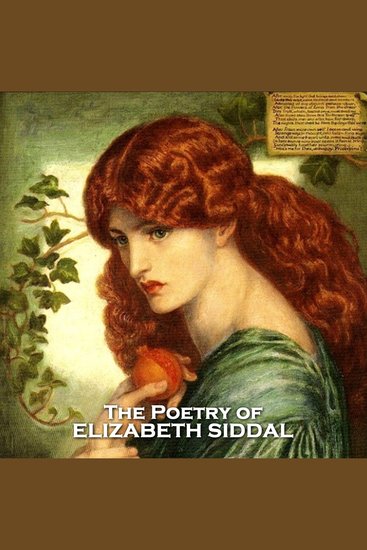
    Elizabeth Eleanor Siddall was born on the 25th July, 1829 in London into a working-class family where she received an ‘ordinary education’.   
    Whilst accounts differ, it is clear that she met the Pre-Raphaelite painter William Deverell whilst working in a millinery shop and he asked her to model for him, describing her as "magnificently tall, with a lovely figure, and a face of the most delicate and finished modelling ... she has grey eyes, and her hair is like dazzling copper, and shimmers with luster."  She personified female beauty for the Pre-Raphaelite Brotherhood and her face became well known in Victorian Britain, gracing many famous paintings such as John Everett Millais's Ophelia, where she is portrayed drowned, floating in a pond. From the experience she also caught pneumonia.  
    Although Siddal (she later changed the spelling of her name) endured a toxic and probably controlling relationship with Dante Gabriel Rossetti, who wouldn’t allow her to model for anyone but himself, she made great strides under his tuition and in her endeavours as an artist.  She was the only woman to exhibit with the Pre-Raphaelites in 1857 where she sold one of her paintings to an American collector. 
    She created many paintings, often inspired by Medieval themes, but her output of poetry was scant despite the positive reception to her verse.  Their motifs were sad and often tragic, dwelling on lost or doomed love.  As well they suggest a strong connection with nature and often plead with God with a haunting yet evocative simplicity. 
    Allied to this was a laudanum addiction which may have contributed to a still-born birth in 1861 and from which she never fully recovered.   
    Elizabeth Siddal committed suicide by an overdose, whilst pregnant, on the 11th February 1862.  She was 32.
    Voir livre
  • How to be Dead in a Year of Snakes - cover

    How to be Dead in a Year of Snakes

    Chris Tse

    • 0
    • 0
    • 0
    The award-winning first book of poetry by Chris Tse – now available as an audiobook.
    Winner – Jessie Mackay Award for Best First Book of Poetry at the 2016 Ockham New Zealand Book Awards
    The world is full of murder
    
    and words are usually
    the first to go
    In 1905, white supremacist Lionel Terry murdered the Cantonese gold prospector Joe Kum Yung to draw attention to his crusade to rid New Zealand of Chinese and other East Asian immigrants.
    Chris Tse uses this story – and its reenactment for a documentary a hundred years later – to reflect on the experiences of Chinese migrants of the period, their wishes and hopes, their estrangement and alienation, their ghostly reverberation through a white-majority culture. Along the way we visit the gold fields of the south, a shipwreck in the Hokianga that left the spirits of 500 Chinese goldminers in an unmemorialised limbo for a hundred years and the streets of Newtown, Wellington, where Lionel Terry went out one night ' looking for a Chinaman' .
    Chris Tse' s flickering use of imagery, resonant language and flexible pronouns are particularly suited to the historic events he describes and the viewpoints he shifts through.  How to be Dead in a Year of Snakes  is a welcome poetic addition to New Zealand literature.
    Voir livre
  • Woman Eat Me Whole - Poems - cover

    Woman Eat Me Whole - Poems

    Ama Asantewa Diaka

    • 0
    • 0
    • 0
    A bold, mesmerizing debut collection exploring womanhood, the body, mental illness, and what it means to move between cultures  
    Renowned for her storytelling and spoken-word artistry, Ama Asantewa Diaka is also an exultant, fierce, and visceral poet whose work leaves a lasting impact. 
    Touching on themes from perceptions of beauty to the betrayals of the body, from what it means to give consent to how we grapple with demons internal and external, Woman, Eat Me Whole is an entirely fresh and powerful look at womanhood and personhood in a shifting world. Moving between Ghana and the United States, Diaka probes those countries’ ever-changing cultural expectations and norms while investigating the dislocation and fragmentation of a body—and a mind—so often restless or ill at ease. 
    Vivid and bodily while also deeply cerebral, Woman, Eat Me Whole is a searing debut collection from a poet with an inimitable voice and vision. 
    Voir livre
  • Rhyme A Dozen A - Trains - 12 Poets 12 Poems 1 Topic - cover

    Rhyme A Dozen A - Trains - 12...

    Damon Runyon, Walt Whitman,...

    • 0
    • 0
    • 0
    ‘A dime a dozen’ as known in America, is perhaps equal to the English ‘cheap as chips’ but whatever the lingua franca of your choice in this series we hereby submit ‘A Rhyme a Dozen’ as 12 poems on many given subjects that are a well-rounded gathering, maybe even an essential guide, from the knowing pens of classic poets and their beautifully spoken verse to the comfort of your ears. 
     
    01 - A Rhyme A Dozen - 12 Poems, 12 Poets, 1 Topic - Trains - An Introduction 
    02 - A Song of the Rails by Damon Runyon 
    03 - Song of a Train by John Davidson 
    04 - Song of the Rail by Ella Wheeler Wilcox 
    05 - To a Locomotive in Winter by Walt Whitman 
    06 - Faintheart in a Railway Train by Thomas Hardy 
    07 - From a Railway Carriage by Robert Louis Stevenson 
    08 - An Incident in a Railroad Car by James Russell Lowell 
    09 - What's the Railroad to Me by Henry David Thoreau 
    10 - On the Engine by Night by Alexander Anderson 
    11 - Adlestrop by Edward Thomas 
    12 - In the Train and At Versailles by Dante Gabriel Rossetti 
    13 - The Railway Train by Emily Dickinson
    Voir livre
  • Poets & Their Afflictions – Tuberculosis - Poems by poets all linked by suffering similar ailments - cover

    Poets & Their Afflictions –...

    John Keats, Kahlil Gibran, Paul...

    • 0
    • 0
    • 0
    The stereotypical image of a poet is one of unknown talent starving in a garret and who’s faithfulness and legacy to the art is discovered only after their death. 
    In some cases this is undoubtedly true, but Poets being human and with the same building blocks of physical and mental health as the rest of us, also had the same afflictions and problems as the rest of us.   
    The long roll call of names and the truncated legacies that were left behind is filled with these lost talents. 
    In this volume we bring together the poems and verse of those wordsmiths whose lives were blighted by tuberculosis, then more commonly known as consumption, and its debilitating and usually terminal effects.   
    The long roll call and the truncated legacies that were left behind are filled with the names of these lost talents.
    Voir livre