¡Acompáñanos a viajar por el mundo de los libros!
Añadir este libro a la estantería
Grey
Escribe un nuevo comentario Default profile 50px
Grey
Suscríbete para leer el libro completo o lee las primeras páginas gratis.
All characters reduced
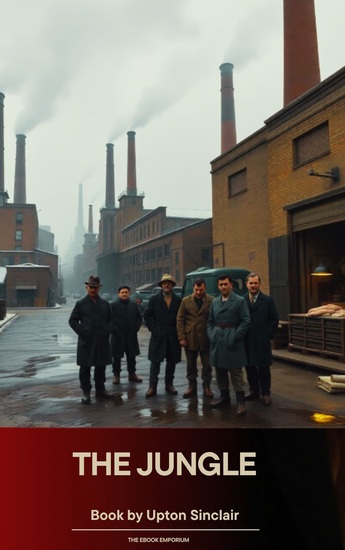
The Jungle - cover

The Jungle

Upton Sinclair

Editorial: The Ebook Emporium

  • 0
  • 0
  • 0

Sinopsis

What happens when the American Dream becomes a nightmare?

Published in 1906, The Jungle by Upton Sinclair is a groundbreaking novel that exposed the harsh realities of immigrant life and industrial exploitation in early twentieth-century America. Set in the brutal world of Chicago's meatpacking industry, the story follows a working-class family struggling to survive in a system stacked against them.

Through vivid storytelling and unflinching detail, Sinclair reveals the dangers of unchecked capitalism, unsafe labor conditions, poverty, and corruption. The novel shocked the nation, inspired public outrage, and directly contributed to major food safety and labor reforms.

This eBook presents the original text in a clear, accessible format, allowing modern readers to experience one of the most influential works of social protest literature ever written.

Inside, you'll explore:

A powerful portrayal of immigrant hardship and exploitation

The realities of industrial labor in early America

Themes of injustice, resilience, and social reform

A novel that helped change U.S. laws and public awareness

Frequently studied in schools and universities, The Jungle remains essential reading for anyone interested in American history, social justice, and classic literature.

Read the novel that awakened a nation. Buy now and experience a classic that still resonates today.
Disponible desde: 21/01/2026.
Longitud de impresión: 179 páginas.

Otros libros que te pueden interesar

  • Black Flora - Inspiring Profiles of Floriculture's New Vanguard - cover

    Black Flora - Inspiring Profiles...

    Teresa J. Speight

    • 0
    • 0
    • 0
    Discover the growing community of Black floriculture leading the new vanguard in flowers.Black Flora is the first book to feature profiles of contemporary Black experts innovating in the world of flowers. Author and longtime gardener, Teresa Speight, offers a beautiful intersection of flowers and community. This book is a homecoming, one that unearths the floral legacies of the past and present, while providing a source of inspiration for younger generations of plant-lovers seeking examples of successful Black floral artists and entrepreneurs. Black Flora showcases a range of floral expertise and as visionary horticulturalist and garden historian, Abra Lee, reflects in her foreword, the community represented in Black Flora has an important significance both today, and in garden history.  Both a celebration of now and a vision for the future, Black Flora honors floriculture’s creative vanguard.
    Ver libro
  • The Advantage of Other - A Leader’s Guide to Building an Equitable Dynamic and Productive Workplace - cover

    The Advantage of Other - A...

    Nancy Geenen

    • 0
    • 0
    • 0
    The Advantage of Other is a practical, personable guide for anyone who has the right intentions around Diversity, Equity and Inclusion, but doesn’t have the tools they need to create a long-term, sustainable cultural shift in their company culture.If you are a little intimidated by the concepts of Diversity, Equity and Inclusion, this book will teach you everything you need to know about transforming your workplace from the inside out.The chapters will touch on the five pillars of an organization: People, Presence, Pipeline, Partners, and Profits. Each chapter includes personal stories and struggles, clear goals and objects, and actionable objectives and recommendations for personal and professional transformation. Written in a clear, personable and easy-to-understand style, this book will take you step by step through the process of creating a culture of inclusivity to build a high performing team.
    Ver libro
  • Hidden History of Detroit - cover

    Hidden History of Detroit

    Amy Elliott Bragg

    • 0
    • 0
    • 0
    "Engaging" stories of what the Motor City was like before the invention of the motor (Detroit Metro-Times). 


    Long before it became the twentieth-century automotive capital, Detroit was a muddy port town full of grog shops, horse races, haphazard cemeteries, and enterprising bootstrappers from all over the world. 


    In this lively book you'll discover the city's forgotten history and meet a variety of unforgettable characters—the argumentative French fugitive who founded the city; the tobacco magnate who haunts his shuttered factory; the gambler prankster millionaire who built a monument to himself; the governor who brought his scholarly library with him on canoe expeditions; and the historians who helped create the story of Detroit as we know it: one of the oldest, rowdiest, and most enigmatic cities in the Midwest.
    Ver libro
  • Sam Houston and Santa Anna: The Controversial History of the Texas Revolution’s Leaders - cover

    Sam Houston and Santa Anna: The...

    Charles River Editors

    • 0
    • 0
    • 0
    More than most men in history, Sam Houston was a contradictory individual. He was born in the United States while George Washington was in office, and in an era when the native people who were gradually being subjugated were considered savages, he called them friends and even lived among them. He was abandoned by his first wife and, after suffering the sting of divorce, married again in the manner of his native family, only to abandon his Indian bride to return to life among his own people. In the interim, he fought for their rights in the halls of government, defending them even as he obtained favor in the eyes of one of their worst enemies. He seemed to have the right mix of charm and grit to make a successful life with him and their large family. 
    	Though he was born and raised elsewhere, Houston is considered one of Texas’ truest sons, and during his life he fought for its independence from Mexico and then for its submission to the United States. He owned slaves himself but spent his entire political career fighting against the spread of “the American cancer” to the West. Then, when his beloved state seceded from the Union, he not only opposed secession but sacrificed his own position to protest it, only to turn around and support the Confederacy during the last years of his life.  
    The butcher of the Alamo and Goliad. The traitor who sold half of Mexico. The Napoleon of the West. Mr. Fifteen Nails. The Mother Country’s seducer. Almost 150 years after his death, a lot of name-calling is still being directed towards Antonio López de Santa Anna, president of Mexico 11 times in the 19th century, and today, the vast majority of his compatriots consider him the greatest traitor in history. It was not like that in his day; actually, there had never been a more popular man in Mexico, or anyone more eulogized and essential than General Santa Anna. In life he was the most famous - and infamous - Mexican general and politician. 
    Ver libro
  • Thunder on Bataan - The First American Tank Battles of World War II - cover

    Thunder on Bataan - The First...

    Donald L Caldwell

    • 0
    • 0
    • 0
    “An incisive, readable account of a group of National Guard tankers who fought in the Philippines in the opening phase of America’s war in the Pacific.” —Robert S. Cameron, Ph.D., military historian and author of Mobility, Shock, and Firepower: The Emergence of the U.S. Army’s Armor Branch, 1917-1945   The American Provisional Tank Group had been in the Philippines only three weeks when the Japanese attacked the islands hours after the raid on Pearl Harbor. Sent north to meet the Japanese landings in Lingayen Gulf, the men of the PTG found themselves thrust into a critical role when the Philippine Army could not hold back the Japanese. When General MacArthur ordered the retreat to Bataan, the PTG proved itself indispensable. During early months of 1942, the light tanks of the PTG patrolled Bataan’s beaches, encircling and destroying Japanese penetrations and small amphibious landings. By April 1942, the situation had become untenable, and 15,000 Americans, along with 60,000 Filipinos, surrendered in one of the worst defeats in U.S. military history. The Provisional Tank Group ceased to exist, and its men endured the Bataan Death March, the torture and starvation of POW camps, the hell ships that took them to Japan and Manchuria for slave labor, and the Palawan massacre.  In an evocatively written book, Donald L. Caldwell reveals the largely ignored role of tanks in the Philippine campaign. Conducting impressive primary research to bring to life the combat history of the PTG, Caldwell has dug deeper to tell the stories of soldiers from each of the group’s six companies, recounting their service from enlistment, training, and combat to imprisonment, liberation, and return home.    “Remarkable . . . [A] well-told history . . . highly recommended.” —Jay A. Stout, LtCol (Ret), USMC, author of Air Apaches
    Ver libro
  • Islamic Golden Age - A History of Economic Cultural and Artistic Growth - cover

    Islamic Golden Age - A History...

    Kelly Mass

    • 0
    • 0
    • 0
    The Islamic Golden Age, a period marked by extraordinary cultural, economic, and scientific prosperity, spanned roughly from the 8th to the 14th century. This era is often considered to have begun during the reign of the Abbasid caliph Harun al-Rashid (786–809), particularly with the establishment of the House of Wisdom in Baghdad. At this time, Baghdad was the world's largest city, serving as the epicenter of intellectual activity. The House of Wisdom became a hub for scholars and polymaths from a diverse range of backgrounds who were tasked with gathering, translating, and preserving the classical knowledge of the ancient world. Key works from Greek, Syriac, Middle Persian, and Sanskrit texts were translated into Arabic and Syriac, with some later making their way into Latin and Hebrew. This immense intellectual undertaking played a significant role in preserving and expanding upon the knowledge that would later form the foundation of the Renaissance in Europe. 
    The decline of the Abbasid caliphate, culminating in the Mongol invasions and the Siege of Baghdad in 1258, is commonly regarded as marking the end of this flourishing period. However, the exact timeline of the Golden Age’s conclusion is debated among scholars. Some place the end around 1350, coinciding with the Timurid Renaissance, while others extend it until the 15th or even the 16th century, linking it with the rise of the Islamic Gunpowder Empires. 
    One of the driving forces behind the Islamic Golden Age was the emphasis placed on learning within Islamic teachings. The Quran and Hadiths, which contain numerous references to the pursuit of knowledge, were fundamental in motivating Muslims during this period to engage in scientific, philosophical, and literary endeavors.
    Ver libro